
Why Most Business Owners Leave Money on the Table Before a Sale
How to increase business value is often the most critical question you’ll ask as an owner—and the answer is simpler than you think. Here’s what actually moves the needle:
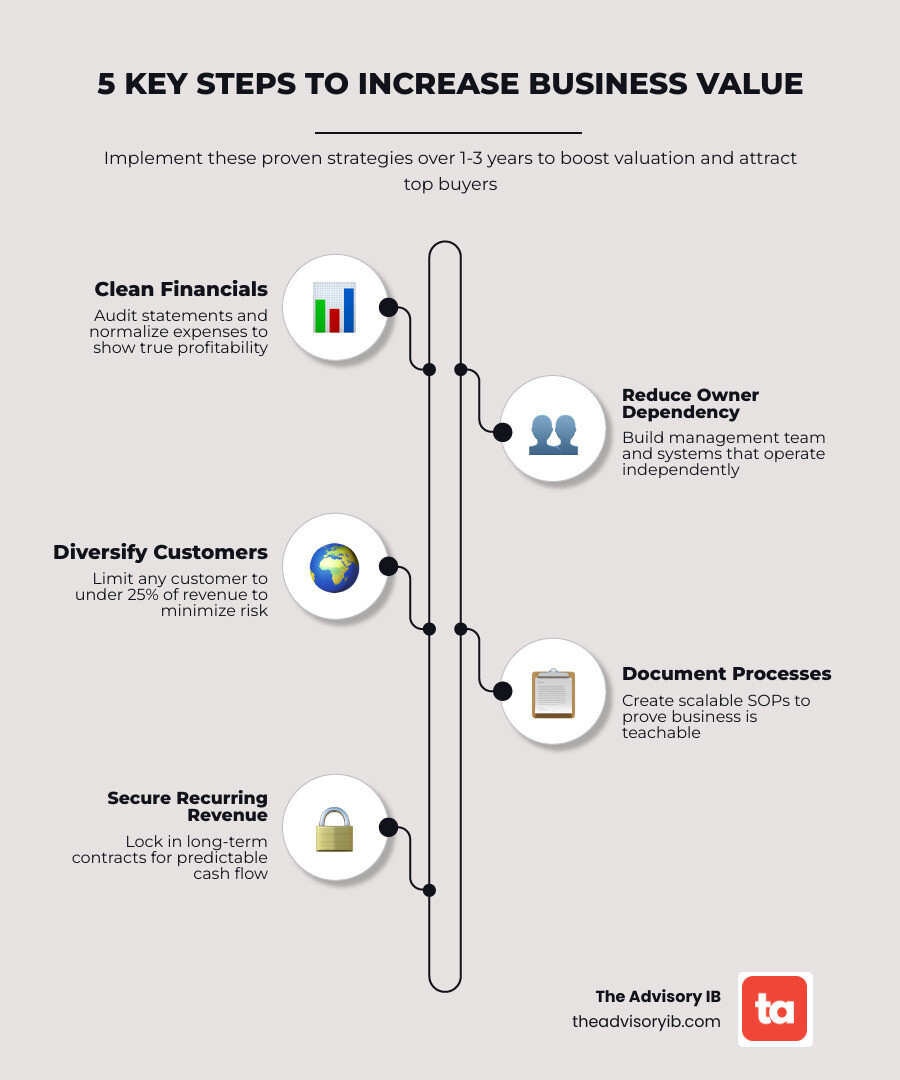
- Clean up your financials – Show consistent profitability with audited or reviewed statements
- Reduce owner dependency – Build systems and a management team that runs without you
- Diversify your customer base – Eliminate concentration risk (no customer over 20-25% of revenue)
- Document repeatable processes – Prove the business is scalable and teachable
- Invest in growth capacity – Demonstrate future potential through technology, talent, and strategic planning
- Secure recurring revenue – Lock in long-term contracts for predictable cash flow
- Minimize key person risk – Spread relationships and expertise across your team
- Get a professional valuation early – Understand your baseline and track progress over 1-3 years
The reality? Only 20 to 30% of businesses that go to market actually sell. The other 70 to 80% find too late that their business isn’t as attractive to buyers as they assumed. Most founders wait until they’re emotionally ready to exit before thinking about valuation—but buyers pay for future cash flow, not your sweat equity. That gap between internal valuations and market reality can be 40 to 60%, which is why preparation matters more than timing.
I’m Oliver Bogner, and I’ve built and sold five companies before founding The Advisory Investment Bank, where I’ve guided hundreds of essential service business owners through this exact process of how to increase business value before a competitive exit. The strategies in this guide come from real deals, real buyers, and real outcomes—not theory.
Understanding How to Increase Business Value Through Valuation Metrics
To maximize your exit, we first have to speak the language of the buyer. Most business owners spend years looking at their bank balance, but buyers look at specific metrics to determine what a company is truly worth.
When we talk about how is my business valued?, we generally look at a few primary methods:
- EBITDA Multiples: This is the “gold standard” for most essential services. It stands for Earnings Before Interest, Taxes, Depreciation, and Amortization. Buyers apply a “multiple” to this number based on your industry and risk profile.
- Revenue Multiples: Common in high-growth tech or subscription-based models where future scale is more important than current profit.
- Discounted Cash Flow (DCF): A more complex calculation that predicts future cash flows and “discounts” them back to today’s value.
- Asset-Based Valuation: Usually the “floor” for a business, calculating the fair market value of equipment, inventory, and property.
One of the biggest shocks for owners is the difference between internal and external valuations. Research shows that internal valuations—the number you have in your head or on your operating agreement—can be 40% to 60% below what the market will actually pay in a competitive transaction.
| Feature | Internal Valuation | External (Market) Valuation |
|---|---|---|
| Purpose | Buy-sell agreements, tax planning | Sale to third party or private equity |
| Standard | Book value or formula-based | Fair Market Value / Strategic Value |
| Focus | Historical performance | Future cash flow & growth potential |
| Accuracy | Often conservative/outdated | Reflects current buyer demand |
Strategic Steps to Increase Business Value Before a Sale
Increasing value isn’t just about working harder; it’s about working on the right things. To move the needle, you must focus on increasing your market share and aligning with industry trends. Buyers want to see a business valuation that reflects a strong competitive advantage—whether that’s proprietary technology, a dominant local presence, or exclusive supplier relationships.
The Role of Multiples in Essential Services
In essential services (like HVAC, plumbing, or electrical), Price-to-Earnings (PE) ratios and multiples are driven by stability. Buyers are looking for businesses that aren’t going anywhere. If you can prove that your market demand is “recession-proof,” you can command a higher multiple. Understanding what will my multiple be? requires looking at your growth potential and how easily a buyer can scale your current model.
Financial and Operational Cleanup for Maximum Sellability
Messy financials kill deals faster than almost anything else. If a buyer can’t trust your numbers, they’ll either walk away or apply a massive “risk discount.”
To increase business value, we recommend starting with a deep clean of your books. For companies with revenue over $10 million, investing in audited financials is almost always worth the cost. It provides a level of credibility that can add significant points to your valuation.
We also focus on “expense normalization” and “add-backs.” This means identifying personal expenses or one-time costs (like a lawsuit or a major equipment repair) that won’t continue under new ownership. Showing clear profitability trends over a 3-to-5-year period is essential to increase valuation for an essential service business.
Building Systems and Repeatable Processes
A business has intrinsic value when it can exist separately and apart from its owner. This is achieved through value maximization strategies like documenting Standard Operating Procedures (SOPs). If your business relies on “tribal knowledge” locked in your head, it isn’t a scalable asset—it’s just a job you own. Repeatable, teachable processes make your company a “turn-key” investment for a buyer.
Reducing Owner Dependency and Key Person Risk
We often suggest the “Vacation Test”: Can you leave your business for two weeks without checking your email? If the answer is no, your business is too dependent on you. This “key person dependency” can result in a 15% to 20% discount on your valuation. Effective exit planning involves building a stable management team and a succession plan that proves the company thrives even when you’re on the beach.
Mitigating Risks Through Diversification and Independence
Buyers are inherently risk-averse. They want to know that if one thing goes wrong, the whole ship won’t sink.
The most common risk we see is customer concentration. If a single customer accounts for more than 20-25% of your total revenue, you have a major valuation problem. If that customer leaves, your profits could be wiped out. To increase business value, you must diversify your client base. The same applies to your labor pool and suppliers—don’t let one point of failure hold your company hostage.
Protecting Intangible Assets and Intellectual Property
Your value isn’t just in your trucks and tools; it’s in your brand, your customer database, and your proprietary ways of doing things. Reviewing resources like IP Australia can help you understand how to protect trademarks, patents, and copyrights. Even simple things, like ensuring your employment contracts include IP ownership and non-compete clauses, protect the value you’ve built.
Securing Long-Term Contracts and Recurring Revenue
Recurring revenue is “gold” to a buyer. It provides the predictability that allows them to sleep at night. Whether it’s service maintenance agreements or long-term commercial contracts, having steady cash flow is the best way to grow essential service business value beyond revenue & profit. Predictable revenue equals a higher multiple every single time.
Driving Higher Multiples with Growth and Technology
If you want to see a 25% or more increase in your business value, you need to focus on the “three-legged stool” of strategic, financial, and operational improvements.
Buyers pay a premium for growth capacity. They aren’t just buying what you did last year; they are buying what they can do with your company next year. This might mean expanding into new geographic markets or pursuing strategic acquisitions to increase your footprint. Even in a deal slowdown, companies with clear growth paths remain highly attractive.
Leveraging Technology to Increase Business Value and Multiples
In the modern market, technology is a massive value driver. Utilizing CRM software for data-driven decisions, implementing automation for cost control, and using technology to find buyers more efficiently are all ways to drive higher multiples. Private equity firms specifically look for “platform” businesses that have the technological infrastructure to support rapid expansion.
Talent Management and Equity Incentives
Your people are your greatest asset—but only if they stay after the sale. High employee turnover is a red flag for buyers. On the other hand, 95% of HR leaders agree that equity compensation is a powerful driver of motivation. By offering professional development and incentives, you build a high-capability management team that adds immense value to the transaction.
Frequently Asked Questions about Business Valuation
Why do buyers apply discounts for customer concentration?
Buyers view customer concentration as a high-risk gamble. If one client represents 30% of your revenue and they decide to switch providers, the buyer’s investment is immediately underwater. Diversification ensures profit stability and revenue security, which is why a spread-out customer base always commands a higher price.
What is the ideal timeline for implementing value-creation strategies?
Ideally, you should start 1 to 3 years before you plan to sell. This gives you enough time to clean up financials, document processes, and—most importantly—show a multi-year trend of growth and profitability. Last-minute “polishing” is rarely as effective as long-term strategic planning.
When should I seek a professional valuation?
You should seek a professional valuation long before you’re ready to exit. Around 60% of owners have had a valuation in the last two years, but 98% of small businesses still don’t know their true market worth. Getting an early baseline allows you to identify “value gaps” and work with professional advisors to close them before you hit the market.
Conclusion
At The Advisory IB, we specialize in helping owners of essential service businesses steer the complex journey of how to increase business value. Our AI-driven platform is designed to deliver faster, stronger offers by connecting you with the right private equity partners who value what you’ve built.
We operate on a 100% success-based model, meaning we are as invested in your company’s growth as you are. Whether you are in the early stages of planning or ready to explore a sale, we can help you implement the coordinated strategic and operational improvements needed to increase business value and secure the exit you deserve.
Ready to see what your business is actually worth? Let’s start the conversation.