
Your Path to a Cost-Effective Business Sale
Finding business buyers affordably is a critical challenge for every business owner planning an exit. The good news: you don’t need a massive marketing budget to connect with qualified buyers who will pay fair value for your company.
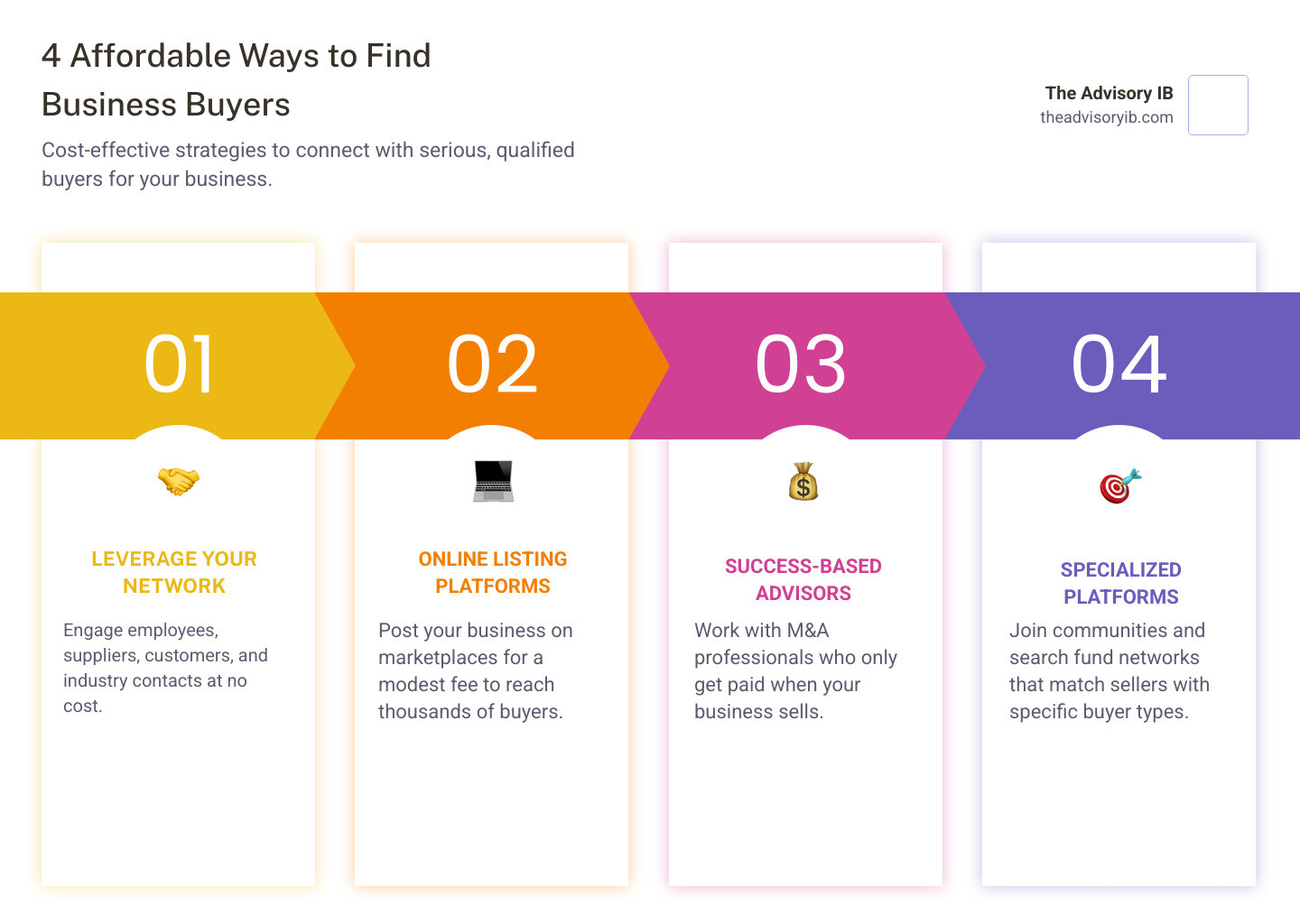
Quick Answer: How to Find Business Buyers Affordably
- Leverage Your Network – Reach out to employees, suppliers, customers, and industry contacts at no cost
- Use Online Listing Platforms – Post your business on marketplaces that connect you with thousands of buyers for a modest monthly fee
- Work with Success-Based Advisors – Engage M&A professionals who only get paid when your business sells
- Explore Succession Platforms – Join specialized communities that match sellers with specific buyer types, often commission-free
The market conditions favor sellers right now. For every single business listed for sale, there are about 15 prospective buyers actively searching. But here’s the catch: 90% of interested parties who actively search for listed businesses don’t follow through on the sale process, and only 20% of listed businesses end up selling successfully. The difference between a failed listing and a successful exit isn’t how much money you spend on marketing—it’s about using the right strategy to reach serious, qualified buyers.
Whether you run a Main Street business valued under $1 million or a Middle Market company worth tens of millions, affordable pathways exist to connect with buyers who have the resources and motivation to close. The key is understanding which methods deliver the best return on your time and investment for your specific situation.
I’m Oliver Bogner, and I’ve built and sold five companies across multiple industries before founding The Advisory Investment Bank to help essential service business owners steer their exits. Through hundreds of transactions, I’ve learned that the most expensive buyer-finding method isn’t always the most effective, and that business owners can find business buyers affordably by focusing their efforts strategically rather than spending indiscriminately.
Uncovering Your Options: How to Find Business Buyers Affordably
When we set out to sell a business, the goal is always the same: find the right buyer at the right price with the least amount of hassle. But the path to get there can vary wildly depending on the size and nature of your business, and, of course, your budget. We’ve seen owners successfully leverage everything from DIY outreach to highly specialized professional guidance. The trick is to understand the cost implications and potential return on investment (ROI) for each strategy.
For small businesses, especially those we categorize as “Main Street” businesses (generally valued under $1 million), direct, low-cost methods often yield excellent results. These typically involve local buyers, individuals, or small investment groups. For larger “Middle Market” businesses (valued over $1 million), the strategies become more sophisticated, often involving private equity groups or institutional investors who may be located anywhere from New York to Houston, Chicago to San Antonio, or Boston to Seattle.
Regardless of your business size, preparing your business for sale is a non-negotiable first step that can significantly impact the speed and success of your buyer search, and importantly, the affordability of that search. A well-prepared business is its own best advertisement.
Preparing Your Business to Attract Buyers Affordably
Before you even begin the hunt to find business buyers affordably, getting your house in order is paramount. Think of it like selling your home – you wouldn’t put it on the market without a fresh coat of paint and some decluttering, right? The same applies to your business, but instead of paint, we’re talking about pristine financial statements and a solid understanding of your operations.
First, gather and organize all your financial statements. This includes profit and loss statements, balance sheets, and tax returns for the past three to five years. Clean, accurate, and easily verifiable financials are gold to a potential buyer. They want to see a clear picture of your business’s health and profitability without having to dig through a mountain of disorganized paperwork.
Next, prepare for due diligence. This is the buyer’s deep dive into every aspect of your business. Having all your contracts, licenses, permits, employee agreements, and customer lists neatly organized and readily accessible will make this process smoother and faster. It demonstrates professionalism and transparency, building trust with potential buyers.
Inventory your business assets – equipment, intellectual property, customer databases, and even your brand’s reputation. Documenting these assets helps buyers understand the full value of what they’re acquiring.
Consider your exit strategy. What are your goals for the sale? A clear understanding of your objectives will help you communicate effectively with buyers and ensure you’re pursuing the right kind of deal.
Crucially, understand your business’s valuation. While professional valuations have a cost, understanding the key drivers of your business’s value beforehand can help you set realistic expectations and articulate your worth to buyers. We often guide owners through this process, exploring questions like How Is My Business Valued?.
Finally, consider any low-cost improvements. This could be as simple as updating your website, refreshing your marketing materials, or streamlining a key operational process. Think about the “curb appeal” of your business, both physically and digitally. A strong online presence, even a basic one, can make a significant difference in attracting qualified buyers without incurring significant upfront costs.
Leveraging Your Network: The Ultimate Low-Cost Strategy
One of the most cost-effective, and often overlooked, ways to find business buyers affordably is by tapping into your existing network. It’s true what they say: who you know makes a huge difference. This strategy requires time and a thoughtful approach, but it can yield highly motivated and pre-qualified buyers.
Start with your inner circle: friends, family, and other business owners you trust. They might not be direct buyers, but they could know someone who is. A personal recommendation carries significant weight and can open doors that impersonal advertising cannot.
Consider your industry contacts. Have you built relationships with suppliers, customers, or even competitors who might be interested in expanding or know someone looking to enter your market? Sometimes, a key employee in a related industry might be looking to step out on their own and purchase an established business.
Don’t forget your current employees. For some businesses, an employee buyout can be a remarkably smooth transition. They already know the business inside and out, understand the culture, and have a vested interest in its continued success. Similarly, a business partner might be ready to take the reins. While pricing in these scenarios can be tricky, a fair business valuation can help guide the conversation.
Finally, attend local meet-ups, chamber of commerce events, or industry tradeshows in cities like Charlotte, Boston, or Jacksonville. These are excellent opportunities to network discreetly, mention your intentions to trusted contacts, and potentially connect with individuals or brokers who are actively seeking businesses for sale. This organic approach allows you to gauge interest and build rapport before making any formal announcements.
Tapping into the Digital Marketplace: Online Listing Platforms
The internet is a powerful ally when you want to find business buyers affordably. Online business listing marketplaces offer unparalleled reach and accessibility, connecting sellers with a vast pool of potential buyers, both local and national. These platforms can be particularly effective for Main Street businesses, but many also cater to larger Middle Market opportunities.
The beauty of online platforms is their ability to cast a wide net without a hefty price tag. Many offer listing options that allow you to reach thousands of active buyers for a relatively modest monthly fee. This makes them a highly attractive option for sellers looking to manage their costs while maximizing exposure.
Leveraging Online Platforms to Find Business Buyers Affordably
Online platforms come in various shapes and sizes, each with its own advantages. We can categorize them broadly to understand how they help you find business buyers affordably:
| Platform Type | Features | Buyer Reach | Best For |
|---|---|---|---|
| General Marketplaces | Broad industry categories, search filters, direct seller-buyer communication. | Wide, national, and sometimes international | Most Main Street businesses (e.g., restaurants, retail, service businesses) and smaller Middle Market companies. |
| Niche/Industry-Specific | Specialized categories (e.g., SaaS, e-commerce, specific service industries). | Targeted, highly engaged buyers | Online businesses (SaaS, e-commerce, content sites), specialized service providers (e.g., IT support). |
| Local Classifieds | Free listings, community focus, simple ad format. | Local, community-driven buyers | Very small, local businesses where a quick, low-cost sale to a local individual is desired. |
For instance, some of the largest general marketplaces offer a comprehensive place where you can list your business and connect with buyers searching by industry, location (from New York to Chicago), or price range.
For online businesses, certain niche platforms position themselves as large marketplaces to buy and sell profitable online businesses, connecting entrepreneurs across various digital asset types like SaaS, e-commerce, agencies, and content sites.
Then there are cost-free options like local online classifieds. While less sophisticated, these sites exist for many major cities across the US, including Seattle, San Francisco, and Denver. You can create a free ad listing, and it can be a viable option for finding a local buyer, though it requires more personal vetting.
When considering these platforms, think about the type of buyer you want to attract. General marketplaces might bring individual entrepreneurs or small investment groups, while niche platforms could connect you with strategic buyers already operating in your specific sector.
Maximizing Your Online Listing for Success
Simply posting your business for sale online isn’t enough; you need to make your listing shine to truly find business buyers affordably. A well-crafted listing acts as your digital salesperson, working 24/7 to attract the right attention.
Start with a compelling headline that grabs attention and highlights the key appeal of your business. Follow this with a detailed business description that tells your story, outlines your operations, and explains why your business is a great investment. Be honest and thorough.
High-quality photos are non-negotiable. Professional, clear images of your storefront, interior, products, and team (if appropriate) can make a huge difference. Buyers are making a significant investment, and visuals help them envision themselves as the new owner.
Crucially, include financial highlights that showcase your business’s profitability and growth potential. While you’ll want to maintain confidentiality in the initial stages, providing key financial data (often anonymized) is essential to pique serious interest. Many platforms allow for confidential or anonymized listings initially, with full details only shared after a Non-Disclosure Agreement (NDA) is signed.
Be prepared to respond promptly and professionally to inquiries. Statistic? 90% of interested parties don’t follow through. Your responsiveness can help weed out the tire-kickers and keep serious buyers engaged. Develop a process for vetting potential buyers, asking questions about their experience, financial capacity, and acquisition goals before sharing sensitive information. This ensures you’re spending your valuable time with truly qualified prospects.
Engaging Professional Help with a Success-Based Approach
While DIY methods can be incredibly affordable, they also demand significant time and expertise from the seller. For many business owners, particularly those with Middle Market businesses or those who want to ensure a smooth, confidential process, engaging professional help is a wise investment. The good news is that many professionals operate on a success-based model, meaning they only get paid when your business sells, helping you to find business buyers affordably in the long run.
These professionals bring expertise, established networks, and a structured process to the table, increasing your chances of a successful sale at a fair price. When you’re ready to Sell My Business, vetting these professionals is key to ensuring you partner with someone who understands your goals and your industry.
The Role of Business Sale Advisors
Business sale advisors, often known as business brokers, act as intermediaries between sellers and buyers. They are particularly prevalent in the Main Street market, handling transactions for businesses typically valued under $1 million. For example, if you’re looking for Business Broker Services in Boston, MA or Dallas, TX, you’ll find many reputable brokers specializing in local small businesses.
A good business broker offers several advantages. They have established networks and databases of prospective buyers, often including individuals, family offices, and small private equity groups. They can maintain confidentiality by marketing your business discreetly, without revealing its identity until serious interest is established. Brokers also assist with buyer screening, ensuring that only qualified individuals with the financial capacity to purchase your business are brought to the table. They can also provide invaluable support during negotiations, helping you steer offers and counteroffers to achieve the best possible outcome.
Typically, business brokers are paid by the seller on a commission basis, which is usually a percentage of the final sale price. This success-based fee structure means your interests are aligned, as you’re not paying them upfront unless a sale occurs, making it an affordable approach for many. When selecting a broker, it’s wise to look for those with a strong track record and professional credentials that indicate they meet high standards of experience and ethics. You can often find accredited professionals in your area, whether you’re in Phoenix, AZ, or Charlotte, NC.
Understanding M&A Advisory Services
For Middle Market businesses, generally those with valuations over $1 million and sales from $2 million to $100 million, the landscape shifts towards Mergers & Acquisitions (M&A) advisory services. M&A advisors and investment bankers specialize in more complex transactions, often involving strategic buyers, private equity groups, or larger corporate acquirers.
These advisors possess a deeper understanding of sophisticated deal structures and financial modeling. They are experts at identifying and approaching a broader range of buyers, including those who aren’t actively searching on public listing sites. This often includes private equity firms, which are significant players in the acquisition market, particularly for essential services businesses. We frequently work with owners to understand Who Buys My Business? Private Equity and how to attract them.
M&A advisors also bring specialized valuation expertise, helping sellers understand What Will My Multiple Be? and how to position their business to maximize its value. Their fees are typically success-based, often a percentage of the transaction value, sometimes with a retainer. This ensures their incentives are aligned with yours: to achieve the highest possible sale price.
For essential services businesses with sales from $2 million to $100 million, M&A advisory firms like The Advisory IB leverage cutting-edge technology, including AI, to identify and connect with the most qualified private equity buyers. This AI-driven approach allows us to deliver faster, stronger offers on a 100% success-based model, making the process to find business buyers affordably highly efficient and financially sensible for our clients.
Specialized Platforms and Succession Planning
Beyond general listing sites and traditional brokerage, a growing number of specialized platforms and succession planning initiatives offer unique, often affordable, ways to connect with specific types of buyers. These approaches can be particularly valuable for owners who are thinking about their business’s long-term legacy or who have specific criteria for their successor. Understanding Who Will Buy My Business? is a crucial first step.
How Specialized Platforms Offer Affordable Solutions
Certain specialized platforms are designed to facilitate business and farm transitions. They offer a unique approach to find business buyers affordably by emphasizing compatibility and sometimes offering a commission-free model for sellers.
These platforms often use compatibility algorithms to match sellers with buyers who not only have the financial capacity but also share similar values or visions for the business. This can lead to a more harmonious transition and a greater likelihood of long-term success for the business.
Sellers can often join these platforms with various membership options, some of which are free to browse public resources or request consultations. While creating a listing might involve an annual fee, the absence of a traditional sales commission can represent significant savings. They also connect sellers with a network of succession planning professionals (accountants, lawyers, economic development officers) to guide them through the process. Some even offer formal succession planning programs, which help owners prepare their business for sale, ensuring they find the right buyer at the best price with optimal tax planning.
Considering a Sale to a Search Fund
Another specialized avenue to find business buyers affordably is through search funds. A “search fund” is an entity typically set up by an aspiring CEO or a first-time buyer with the goal of acquiring a single business. These individuals, often mentored by experienced investors and advisors, bring leadership acumen and a desire to become company owners.
The search fund model was pioneered at Stanford in 1984 and has since expanded, attracting hundreds of private investors, family offices, and private equity firms. These funds are usually looking for profitable, stable businesses that they can grow and operate. For a seller, selling to a search fund can offer a clear path to exit, as the buyers are highly motivated and often have committed capital behind them.
While search funds typically focus on acquiring a single business, they are backed by professional investors who provide the bulk of the funding. This can make them an attractive option for owners seeking a clean exit with potentially less complexity than a sale to a large corporate entity. Sometimes, seller financing options can also be part of the deal, providing flexibility for both parties. This path can be particularly appealing for owners who might not have a clear successor within their family or management team but want to see their business continue to thrive under new, dedicated leadership.
Conclusion: Finding the Right Buyer on the Right Budget
Finding the right buyer for your business, especially when you need to find business buyers affordably, is a strategic endeavor, not a random act. We’ve explored a spectrum of methods, from the grassroots efforts of DIY networking to the sophisticated strategies employed by M&A advisors. Each approach has its merits and its place, depending on the unique characteristics of your business and your personal goals.
We’ve seen how leveraging your existing network – friends, family, employees, and industry contacts – can be a zero-cost yet highly effective way to uncover potential buyers. Online listing platforms, with their accessible fees, provide broad exposure to a vast pool of interested individuals and groups. And for those seeking professional guidance without significant upfront costs, success-based advisors, including business brokers and M&A firms, offer their expertise, only earning a commission when your business successfully sells. Specialized platforms and search funds present unique, often affordable, pathways to connect with specific types of buyers, particularly for succession planning.
Regardless of the method you choose, the importance of thorough preparation cannot be overstated. From organizing your financial statements to understanding your Business Valuation, a well-prepared business is your best asset in attracting qualified buyers and securing a fair deal.
The right strategy for you will depend on your business’s size, complexity, and your personal objectives. For owners of essential services businesses with sales from $2 million to $100 million, M&A advisory firms like The Advisory IB offer a particularly compelling solution. We leverage an AI-driven platform to deliver faster, stronger offers by connecting you with qualified private equity buyers on a 100% success-based model.
We invite you to learn more about how we can help you steer your exit strategy and Explore the industries we serve.