
Why Business Valuation Matters for Your Exit Strategy
Business valuation is the process of determining the economic worth of a company, typically for purposes like selling, raising capital, estate planning, or resolving ownership disputes. Here’s what you need to know:
Key Business Valuation Methods:
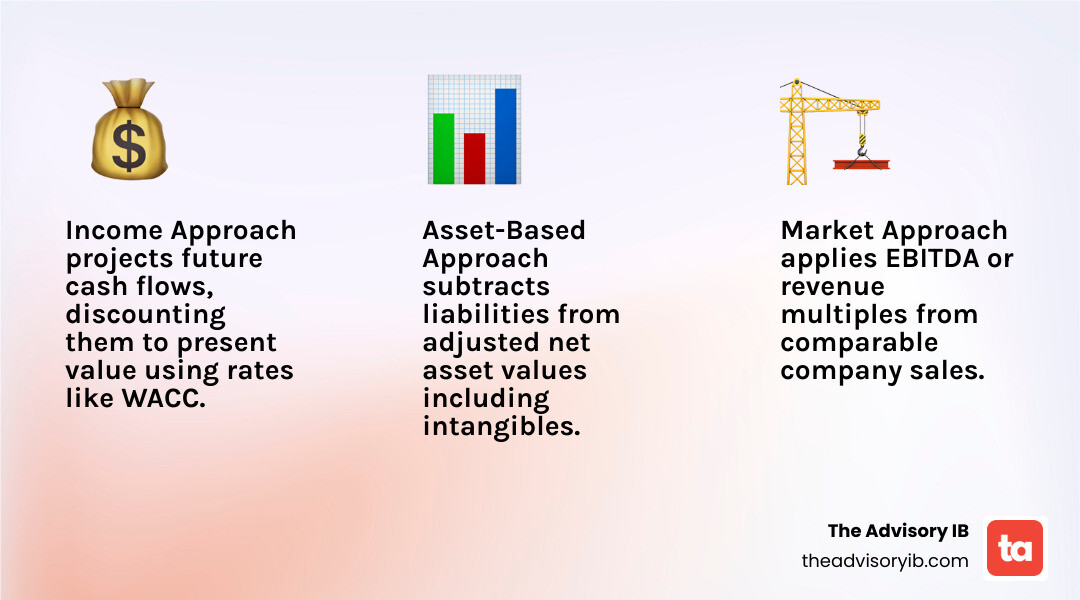
- Income Approach – Values your business based on future earnings potential using discounted cash flow or capitalization of earnings
- Market Approach – Determines value by comparing your company to similar businesses that have sold, using multiples like EBITDA or revenue
- Asset-Based Approach – Calculates value based on the company’s net assets, including tangible and intangible assets minus liabilities
When You Need a Valuation:
- Preparing to sell your business
- Negotiating with private equity buyers
- Estate and succession planning
- Resolving shareholder disputes
- Tax compliance and reporting
If you’re a founder of an essential services business generating $2 million to $100 million in annual sales, understanding business valuation isn’t just academic—it’s the difference between leaving money on the table and achieving a life-changing exit. The valuation process reveals not only what your company is worth today, but also which levers you can pull to maximize value before a sale. Yet many business owners find too late that buyers and sellers often have vastly different opinions on value, and without objective, defensible methodology, negotiations can stall or fall apart entirely.
The challenge intensifies when you’re dealing with private equity firms that employ sophisticated valuation models and teams of analysts whose job is to find reasons to pay less. They understand the nuances of EBITDA adjustments, working capital calculations, and risk premiums in ways that most operators simply don’t. This information asymmetry puts Main Street business owners at a significant disadvantage during what may be the most important financial transaction of their lives.
I’m Oliver Bogner, Managing Partner of The Advisory Investment Bank, and I’ve spent my career helping essential service business owners steer complex business valuation processes and achieve premium exits. After building and selling five companies of my own and advising on hundreds of millions in transactions, I’ve seen how proper business valuation methodology can transform negotiating positions and deal outcomes.
Understanding Business Valuation and Its Strategic Importance
At its core, business valuation is both an art and a science. While the numbers on a balance sheet provide the foundation, the true value of a company often lies in its future potential and the stability of its cash flows. For stakeholders, a valuation isn’t just a “sticker price”; it is a strategic roadmap.
To steer this landscape, we must first understand a few fundamental concepts that underpin every professional appraisal:
- Fair Market Value (FMV): This is the highest price, expressed in terms of cash equivalents, at which property would change hands between a hypothetical willing buyer and a hypothetical willing seller. Crucially, both parties must be acting at arm’s length, with reasonable knowledge of the relevant facts, and without compulsion to buy or sell.
- Enterprise Value (EV): Unlike market capitalization, which only looks at equity, Enterprise Value provides a more comprehensive picture. It accounts for the total value of the business, including its debt and cash reserves. Think of it as the “takeover price” of the company.
- Time Value of Money (TVM): This is the principle that a dollar today is worth more than a dollar tomorrow because of its potential earning capacity. In valuation, we use this concept to “discount” future earnings back to what they are worth in today’s dollars.
Why does this matter for you? Whether you are engaging in Strategic planning or preparing for M&A readiness, having a formal valuation allows you to identify weaknesses—like high customer concentration or poor management depth—and fix them before you hit the market. It is also essential for tax compliance, particularly in estate and gift tax planning, and for resolving shareholder disputes where emotions often cloud financial reality.
The Three Primary Approaches to Business Valuation
When we sit down to determine How is My Business Valued?, we don’t just pick a number out of a hat. Professional valuators use three primary lenses to look at a company. Each approach offers a different perspective on economic reality.
Before applying these methods, we perform Normalization. This is the process of adjusting financial statements to reflect the true “economic” earnings of the business. We strip out one-time expenses (like a lawsuit settlement), non-operating assets (like the owner’s personal boat on the company books), and discretionary spending (like excessive owner bonuses) to see what the business would look like under new ownership.
Enterprise Value vs. Equity Value
| Feature | Enterprise Value (EV) | Equity Value |
|---|---|---|
| Definition | Total value of the business operations | Value available to shareholders |
| Formula | Equity Value + Debt – Cash | EV – Debt + Cash |
| Used For | Comparing companies regardless of capital structure | Determining the actual check written to the owner |
| Perspective | The “whole house” value | The “equity in the home” after the mortgage |
The Income Approach: Discounted Cash Flow and Capitalization
The Income Approach is based on the “principle of expectation.” It assumes that the value of a business is the present value of all the money it will make for you in the future. This is often the most accurate way to Defend True Business Value Main Street vs Wall Street.
There are two main methodologies here:
- Capitalization of Earnings: This is best for mature businesses with stable, predictable growth. We take a single period of normalized earnings and divide it by a “capitalization rate.”
- Discounted Cash Flow (DCF): This is a more detailed model used for companies where future growth is expected to vary. We project free cash flows (usually for 5-10 years) and then calculate a “Terminal Value” for everything beyond that.
To make these future dollars make sense today, we use a Discount Rate, often calculated via the Weighted Average Cost of Capital (WACC). This rate accounts for the Risk-free rate (like government bonds) plus premiums for the risk of the industry, the small size of the company, and specific operational risks. Typically, discount rates for private businesses fall between 8% and 12%, though they can be higher for riskier ventures.
The Market Approach: Multiples and Comparable Sales in Business Valuation
The Market Approach relies on the “principle of competition.” It looks at what similar businesses have sold for recently. This is where you hear the term “multiples.”
Common benchmarks include:
- EBITDA Multiples: (Earnings Before Interest, Taxes, Depreciation, and Amortization). This is the gold standard for mid-market M&A. While “5x EBITDA” is a common rule of thumb, What Will My Multiple Be? depends heavily on your industry. A tech firm might see 10x, while a local service firm might see 3x or 4x.
- Revenue Multiples: Often used for high-growth software companies where profits haven’t caught up to sales yet. A tech firm might be valued at 3x revenue, while a service firm might only see 0.5x revenue.
- Precedent Transactions: Analyzing what private equity firms or competitors paid for similar companies in the last 12–24 months.
The Asset-Based Approach: Net Asset Value and Liquidation
This approach is most common for asset-heavy businesses (like real estate holding companies) or businesses that aren’t currently profitable enough to justify an income-based valuation. It asks: “If we sold everything and paid off all the debt, what’s left?”
We look at:
- Adjusted Net Book Value: We take the balance sheet and adjust assets like equipment or real estate to their current fair market value, rather than their depreciated “book value.”
- Intangible Assets & Goodwill: This includes your brand, customer lists, and proprietary processes. Even if you’re an asset-light business, you can Increase Valuation Essential Service Business by documenting these “hidden” assets.
- Liquidation Value: This is the “fire sale” price—what you would get if you had to sell everything in a very short timeframe (usually 6-12 months).
Key Factors Influencing a Business Valuation Conclusion
A business valuation isn’t performed in a vacuum. External and internal factors can swing the conclusion by millions of dollars.
- Economic Conditions: High inflation or rising interest rates can increase your discount rate, which lowers your valuation. Conversely, a “hot” M&A market can lead to multiple expansion.
- Industry Trends: Is your sector consolidating? If private equity is “rolling up” your industry, your multiple might increase because you represent a strategic “bolt-on” for a larger platform.
- Financial Performance: Consistency is king. Buyers pay a premium for “sticky” revenue and high margins. If you have high customer concentration (e.g., one client is 40% of your revenue), expect a significant “risk discount.”
- Management Strength: If the business can’t run without the owner, it’s not a business—it’s a job. A strong middle-management team significantly reduces buyer risk and increases value.
A Deal Slowdown What Does That Mean for Your Valuation? usually means buyers become more selective, focusing on companies with the strongest risk profiles and most defensible growth potential.
Special Considerations for Startups and High-Growth Companies
Valuing a company with little to no historical profit is where things get interesting. For these firms, we often use the Venture Capital Method.
Instead of looking at the past, we look at Market Potential and Scalability. The valuation is driven by the “exit price” the investor expects in 5 years. Because the risk is so high, the discount rates used in these models can be 30% to 50% or more.
Key metrics for high-growth companies include:
- Burn Rate: How fast are you spending cash to acquire customers?
- Intangible Value: Does your AI platform or proprietary tech offer a “moat” that competitors can’t cross?
- Future Cash Flows: We focus on the “hockey stick” growth curve, but these projections must be backed by a realistic customer acquisition cost (CAC) and lifetime value (LTV) analysis.
To Grow Essential Service Business Value Beyond Revenue Profit, startups must prove that their model is repeatable and that they can eventually achieve “operating leverage”—where revenue grows much faster than expenses.
Frequently Asked Questions about Business Valuation
When is a business valuation typically required?
A valuation is usually required during major life or business transitions. This includes Buy-sell agreements (to ensure partners can exit fairly), Estate planning and Gift tax reporting (to satisfy the IRS), and Litigation (such as divorce or partner disputes). It is also the first step if you want to Increase Business Value, as you need a baseline to measure your progress against.
Who performs professional business valuations?
You should look for credentialed professionals who have “letters after their name.” The most recognized are:
- CPA/ABV: Certified Public Accountant / Accredited in Business Valuation.
- ASA: Accredited Senior Appraiser.
- CVA: Certified Valuation Analyst.
- CBA: Certified Business Appraiser. These professionals provide independent objectivity, which is critical if your valuation needs to stand up to IRS scrutiny or cross-examination in court.
What is the difference between price and fair market value?
This is a vital distinction. Fair Market Value is a theoretical, hypothetical number. Price is what someone actually pays. A strategic buyer might pay a “synergy premium” well above FMV because your company helps them enter a new market or cut costs. Conversely, in a forced liquidation, the price might be well below FMV. Market volatility and negotiation leverage also play massive roles in the final check size.
Conclusion
Navigating a business valuation can feel like learning a second language, but it is the most critical skill a business owner can possess. At The Advisory IB, we believe that Main Street founders deserve the same level of sophistication as the private equity firms they sit across from.
Our AI-driven platform is specifically designed to help essential services businesses in the $2-100M range find their true market value and connect with the right buyers. By combining deep human expertise with cutting-edge technology, we deliver faster, stronger offers on a 100% success-based model. Whether you are in Los Angeles, New York, Chicago, or any of our other US locations, we are here to ensure you don’t just sell your business—you achieve the exit you’ve earned.
Ready to see what your hard work is truly worth? Meet an Advisor today and let’s start the conversation.