
Why Every Small Business Owner Needs an Exit Strategy
An exit strategy for small business is your roadmap for transitioning out of the company you built – whether through a sale, succession, or other method. Most owners spend decades building their business but only months planning their exit, which often leaves significant value on the table.
Quick Answer: Common Small Business Exit Strategies
- Third-Party Sale – Selling to a strategic buyer or private equity firm (typically maximizes value)
- Family Succession – Transferring ownership to the next generation
- Management Buyout – Selling to your existing leadership team
- Merger or Acquisition – Combining with another company
- Liquidation – Selling assets and closing operations
- IPO – Taking the company public (rare for small businesses)
Here’s a sobering fact: only 19% of small-to-medium enterprises have a formal exit or succession plan. That means 81% of owners are flying blind when it comes to the biggest financial event of their lives. The research shows that selling a business typically takes 9 to 12 months, and succession planning should ideally begin 18 to 24 months before your desired exit date. Without proper planning, you risk undervaluing your business, facing unexpected tax burdens, or scrambling to find qualified buyers when you’re ready to move on.
The stakes are especially high for essential services businesses – HVAC, plumbing, electrical, landscaping, pest control, and similar trades. These companies often have strong cash flow and recurring revenue, making them attractive to buyers, but they also face unique challenges around customer concentration, owner dependency, and operational documentation that can significantly impact sale value.
I’m Oliver Bogner, and I’ve been on both sides of the exit table – first as a founder who built and sold five companies, then as an investment banker who’s guided hundreds of essential service business owners through life-changing exits. Through building my exit strategy for small business ventures early, I learned that the best exits aren’t accidents – they’re the result of deliberate planning, often years in advance.
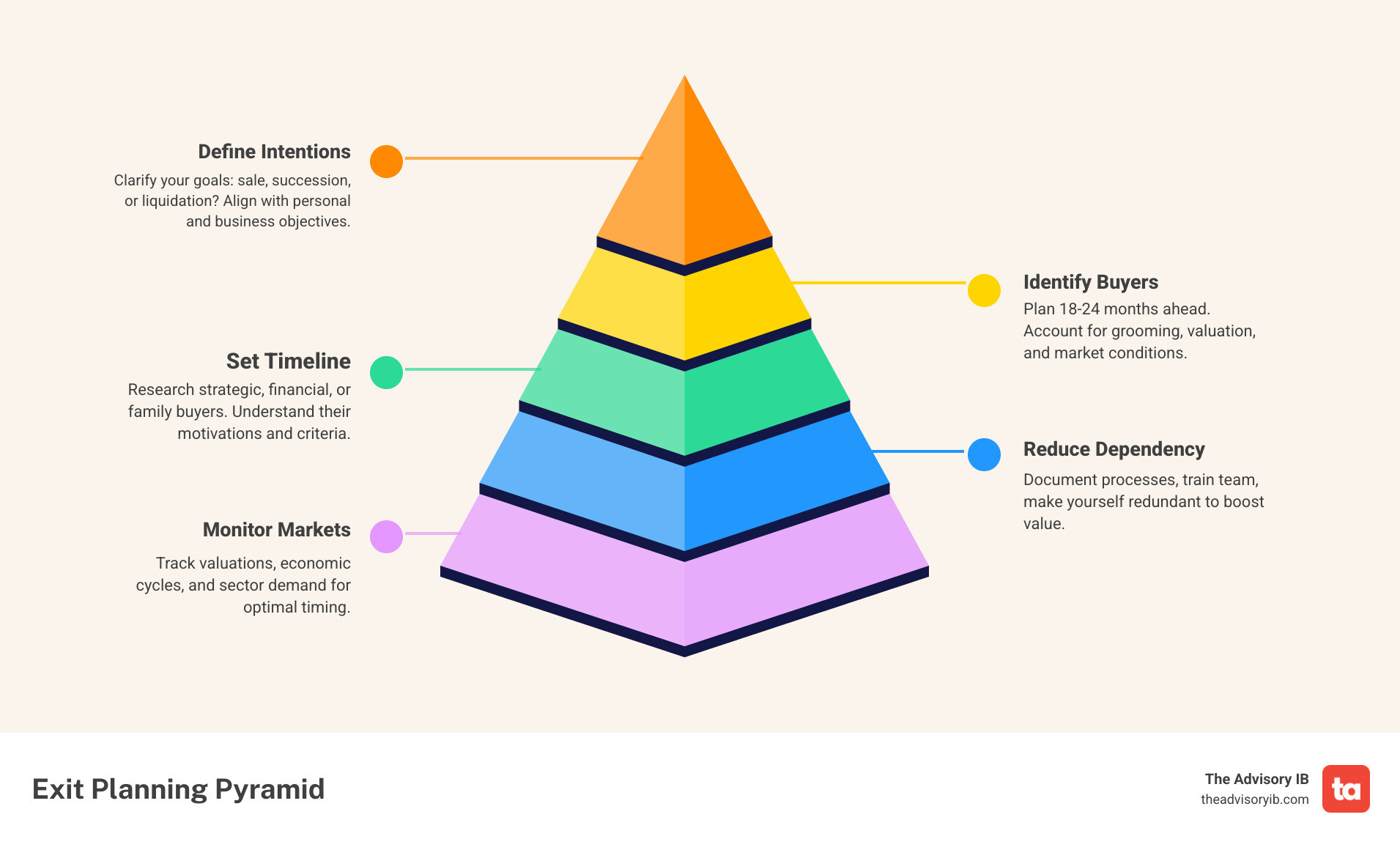
Understanding the Importance of an Exit Strategy for Small Business
Think of an exit strategy for small business as the “Final Boss” level of entrepreneurship. You’ve conquered the startup phase, survived the growth years, and now you need to stick the landing. At its core, an exit plan is a strategic roadmap that ensures the business can continue to thrive – and you can get paid – once you are no longer at the helm.
Without a Business Exit Strategy, you leave your legacy to chance. A well-crafted plan protects your stakeholders, including the employees who helped you build the dream and the customers who rely on your services. It also acts as a massive risk mitigation tool. If an unexpected health issue or market shift occurs, having a plan in place prevents a “fire sale” scenario where you’re forced to accept pennies on the dollar.
When to Start Developing an Exit Strategy for Small Business
We often hear owners say, “I’ll think about selling in five years.” The reality is that if you want to exit in five years, you should have started planning two years ago. Most experts recommend a lead time of at least 18 to 24 months, but the most successful entrepreneurs build their companies with the exit in mind from day one.
Early planning allows you to “groom” the business. This means cleaning up the books, diversifying your customer base, and ensuring your Entrepreneur Exit Services are aligned with current market demands. As your business matures, the focus shifts from survival to “saleability.” If your business can’t run for a month without you answering the phone, you don’t have a business to sell; you have a high-stress job.
Why Only 19% of Owners Have a Formal Plan
It’s a startling statistic: only 19% of small-to-medium enterprises have a formal succession plan. Why is the number so low? For many, it’s emotional. Your business is your “baby,” and imagining a world where you aren’t the CEO can be uncomfortable. For others, it’s simply a matter of being too busy “in” the business to work “on” the business.
This lack of preparation creates massive succession gaps. When an owner exits reactively – due to burnout or external pressure – the results are often messy. You don’t want to Leave Your Family a Mess because you failed to document who takes over or how the equity is distributed. Proactive management means treating your exit as a milestone, not a funeral.
Evaluating Common Exit Options and Their Outcomes
When you reach the crossroads of your entrepreneurial journey, several paths appear. Each has a different impact on your wallet, your legacy, and the future of your team.
| Exit Strategy | Best For… | Primary Benefit | Main Drawback |
|---|---|---|---|
| Family Succession | Keeping it in the family | Legacy preservation | Potential for family conflict |
| Management Buyout | Continuity & trust | Smooth transition | Lower sale price/financing problems |
| Third-Party Sale | Maximizing profit | Highest valuation | Loss of control/cultural shifts |
| Liquidation | Failing or “Lifestyle” firms | Fast closure | Lowest financial return |
| IPO | High-growth unicorns | Massive capital | High cost & public scrutiny |
Choosing the Right Exit Strategy for Small Business Goals
Your personal goals dictate your path. If your primary goal is legacy – seeing your name stay on the trucks and your children running the shop – then family succession is the answer. However, this often requires an “estate freeze” or other complex tax maneuvers to ensure the next generation isn’t crippled by tax debt.
If you are running a “lifestyle company” – one designed to provide a great income for you but not necessarily built for scale – liquidation might actually be the most honest exit. You sell the equipment, pay the debts, and walk away with the remaining cash. But for those looking to Sell My Business for the highest possible multiple, an external sale is usually the winner.
The Pros and Cons of Third-Party Acquisitions
Selling to a third party usually involves two types of buyers: Strategic and Financial.
- Strategic Buyers: These are often competitors or companies in adjacent industries (e.g., a large HVAC firm buying a local plumbing company). They pay a premium because they see “synergies” – they can use your customer list and cut redundant costs.
- Financial Buyers (Private Equity): These folks are looking for a return on investment. They want a business with a strong management team and “clean” numbers.
The pro? You get the biggest check. The con? There is often a Myth of the Perfect Time to Sell. If you wait for the “perfect” peak, you might miss the window when buyers are most aggressive.
Preparing Your Business for a Successful Transition
Preparation is where the real money is made. Buyers aren’t just buying your revenue; they are buying your systems. If your business processes are “all in your head,” the value of the business drops significantly the moment you walk out the door.
To get your business “exit-ready,” you need to focus on Business Sale Preparation. This includes:
- Standard Operating Procedures (SOPs): Document everything. How do you handle a service call? How is the inventory tracked?
- Making Yourself Redundant: If you are the lead salesperson, the lead tech, and the bookkeeper, you are a “key man” risk. Buyers want to see a management team that can function without the founder.
- Customer Diversification: If 60% of your revenue comes from one general contractor, your business is risky. Aim for a broad, diverse customer base.
Determining Business Valuation and Market Demand
How much is the “baby” worth? You might think it’s worth $10 million because that’s what you need to retire, but the market might say $5 million based on your EBITDA (Earnings Before Interest, Taxes, Depreciation, and Amortization).
A professional appraisal is essential. It looks at your earnings history, your equipment’s value, and market demand. In sectors like essential services, demand is often high because these businesses are “recession-proof” – people always need their toilets to flush and their AC to run. Understanding Exit Planning involves looking at market cycles; M&A activity is cyclical, and catching a wave of high demand can add a significant “multiple” to your sale price.
Steps to Untangle Personal and Business Finances
Many small business owners treat the company checkbook like a personal ATM. Before you sell, you must untangle these. This means:
- Removing personal expenses (like that family SUV or the trip to Hawaii) from the business ledgers.
- Conducting a full asset inventory.
- Ensuring three years of “clean” accounting records.
Professional fiduciary advisors can help you work through this “untangling” process, which can take months to do correctly.
Navigating Tax Implications and Professional Guidance
It’s not about what you sell the business for; it’s about what you keep after the taxman takes his cut. In the US, the structure of the sale – Asset Sale vs. Share (Stock) Sale – makes a world of difference.
- Asset Sale: The buyer buys the equipment, the customer list, and the brand. This is usually preferred by buyers because they can “step up” the basis of the assets for depreciation. For you, the seller, it can lead to higher tax liabilities.
- Share Sale: The buyer buys the entire corporation. This is often better for the seller because it may qualify for favorable capital gains treatment.
Understanding the 90/50 Asset Rule for Exemptions
While tax laws vary, a common hurdle for tax-efficient exits is the “active business asset” rule. Generally, to qualify for certain capital gains exemptions, at least 90% of the corporation’s assets must be used in active business at the time of sale. Furthermore, 50% or more must have been used in the active business for the 24 months preceding the sale. This prevents people from stuffing a “shell” company with cash and trying to sell it as a business. Proper Exit Planning ensures you meet these timelines well before the “For Sale” sign goes up.
The Role of M&A Advisors and Legal Counsel
You wouldn’t perform heart surgery on yourself, and you shouldn’t sell your $20 million business without professional help. M&A advisors (like us) and legal counsel play critical roles:
- Confidentiality: Ensuring your employees and competitors don’t find out you’re selling until the deal is done.
- Deal Structuring: Negotiating “earn-outs” (where you get paid more if the business hits certain targets) or seller financing.
- Due Diligence: Helping you survive the “proctology exam” that buyers perform on your books.
- Negotiation: Having an intermediary allows you to stay the “good guy” while your advisor plays hardball on the numbers. This is a core part of Entrepreneur Exit Services.
Ensuring a Smooth Handover for Stakeholders
The “day after” the sale is often the hardest. A poor transition can destroy the value of the business and ruin your reputation in the community. You need a communication plan that addresses everyone.
- Employees: They will be nervous about their jobs. Consistency in practices and policies is key.
- Customers: They need to know that the service quality they expect won’t drop.
- Stakeholders: Suppliers and partners need to know the “vision” remains aligned.
Post-Exit Planning isn’t just about what you do with your money; it’s about how you hand over the keys.
Managing Cultural Fit and Leadership Changes
One of the biggest pitfalls in an exit is a “culture clash.” If you run a family-oriented HVAC shop and sell to a cold, metric-driven private equity firm, your best techs might quit. When evaluating buyers, look for mission alignment. Are they going to take care of your people? If not, the transition will be rocky, and any “earn-out” you have might be at risk.
Avoiding Common Pitfalls in the Transition Phase
- Customer Concentration: As mentioned, if one client is your “everything,” the buyer will discount your price heavily.
- Emotional Bias: Don’t let your ego get in the way of a fair deal.
- Timing Errors: Don’t wait until you’re “burnt out” to start. A burnt-out owner often lets the business slide, which lowers the valuation right when you need it to be highest. Check out our guide on how to Not Leave Your Family a Mess for more on avoiding these traps.
Frequently Asked Questions about Exit Planning
How long does it typically take to sell a small business?
Typically, it takes 9 to 12 months. This includes the time to prepare the marketing materials, find a buyer, perform due diligence, and close the legal paperwork. Market conditions and the “cleanliness” of your books can speed this up or slow it down.
What is the difference between an asset sale and a share sale?
In an asset sale, the buyer picks and chooses what they want (trucks, lists, etc.), and you keep the legal entity (the corporation) and its liabilities. In a share sale, the buyer takes the whole “bucket,” including the legal entity and all its past liabilities. Share sales are often more tax-advantageous for the seller.
Can I exit my business if it is currently struggling?
Yes, but your options change. If the business is failing, liquidation (selling assets to pay back creditors) might be the only path. However, if the business has a good “core” but bad management, a turnaround buyer might be interested in an asset purchase at a lower price point.
Conclusion
Planning an exit strategy for small business is the ultimate act of leadership. It ensures that the hard work you’ve poured into your company continues to provide value long after you’ve moved on to your next chapter.
At The Advisory Investment Bank, we specialize in this transition. As a FINRA-licensed M&A firm based in Beverly Hills, we focus exclusively on essential services businesses with $2M to $100M in sales. We use a proprietary, AI-driven platform to connect you with private equity and strategic buyers, delivering faster and stronger offers than traditional methods. Our model is 100% success-based—we don’t get paid unless you get the exit you deserve.
Whether you’re in Houston, Chicago, Phoenix, or any of our other US locations, the time to start your Exit Planning is now. Don’t leave your legacy to chance; let’s build a plan that maximizes your value and honors your hard work.