
Why Boston Business Owners Can’t Afford to Ignore Exit Planning
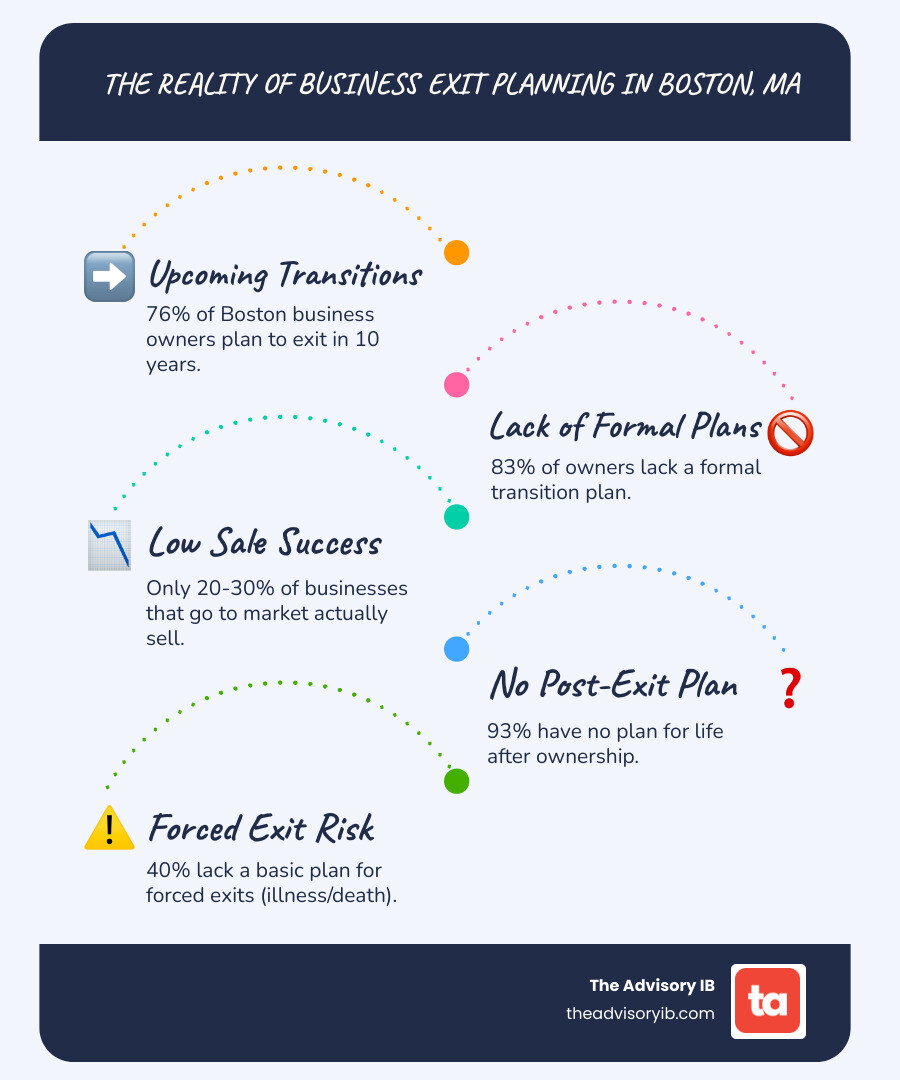
Business exit planning in boston, ma is becoming increasingly critical as a historic wave of ownership transitions reshapes the local business landscape. If you own a profitable essential services business in the Boston area, you’re likely among the 76% of business owners planning to transition within the next ten years—yet you may also be among the 83% who lack a formal transition plan. The consequences of this gap are severe: studies show that only 20-30% of businesses that go to market actually sell, leaving most owners without solid options to harvest their lifetime of work.
Quick Answer: Essential Steps for Business Exit Planning in Boston, MA
- Assess Your Business Value – Determine your current valuation and identify gaps between your perception and what buyers will pay
- Build a Transition Timeline – Start planning 3-5 years before your intended exit date
- Optimize Business Operations – Reduce owner dependency and strengthen intangible assets that drive 80% of buyer value
- Assemble Your Advisory Team – Engage M&A advisors, tax strategists, and wealth managers who understand the Boston market
- Develop Post-Exit Plans – Address the 93% gap in post-ownership life planning to avoid dissatisfaction after exit
Recent studies reveal that 66% of the American business market is owned by Baby Boomers transitioning over the next zero to ten years. In Boston’s competitive market, the stakes are even higher. Without proper planning, you risk being forced into a reactive sale due to burnout, health issues, or unfavorable business conditions—often accepting far less than your business’s true worth. The number one reason business exits fail is simply lack of planning on the owner’s part, leaving 40% of owners without even a basic plan for forced exits due to illness or death.
For Boston business owners seeking guidance on protecting their legacy while maximizing value, understanding your business succession options is the critical first step. When you’re ready to explore how to position your business for the best possible exit, connect with advisors who specialize in essential services businesses.
Why a Proactive Exit Plan is Non-Negotiable
We understand that running a business in Boston, MA, demands your full attention. You’re juggling operations, managing teams, and constantly looking for growth opportunities. With so much on your plate, it’s easy to push business exit planning in boston, ma to the back burner. Yet, ignoring this crucial aspect of your business journey can have significant, and often detrimental, consequences.
The statistics are stark: a staggering 83% of business owners currently have no formal transition plan in place. Even more concerning, 40% lack a plan for a forced exit due to unforeseen circumstances like illness or death. This lack of foresight often leads to reactive selling, where owners are compelled to sell their business due to burnout, health issues, marital problems, or deteriorating business conditions, rather than executing a strategic, well-thought-out plan. Such reactive sales typically result in significantly lower valuations and a rushed, stressful process.
Beyond the financial implications, consider the personal toll. For many entrepreneurs, their business is not just a source of income, but a lifetime of dedication, hard work, and personal identity. Yet, studies show that 93% of business owners have no post-ownership life plan. This often leads to deep dissatisfaction and a sense of aimlessness after exiting, even if the financial outcome was favorable. We believe your exit should be a celebration of your achievements, not a step into an unplanned void. A proactive approach to business exit planning in boston, ma allows you to maximize your wealth, protect your legacy, and ensure peace of mind for yourself and your family. Don’t leave your family a mess or your future to chance; your business succession plan starts here.
The High Cost of Waiting: Common Reasons Business Exits Fail
The journey to a successful business exit is fraught with potential pitfalls, and most of them stem from a single root cause: a lack of proactive planning. As experts in business exit planning in boston, ma, we’ve seen how waiting until the last minute can derail even the most promising sales.
One of the primary reasons exits fail is reactive selling. When owners are forced to sell due to external pressures—be it personal burnout, health crises, or an unexpected downturn in business conditions—they lose control of the narrative and the timeline. This often means accepting a less-than-ideal offer simply because time is running out.
Another significant hurdle is a lack of preparation. Many businesses are built to support the owner’s lifestyle, not to be optimized for sale. This can manifest in excessive owner dependency, where the business’s operations and success are inextricably linked to the owner’s personal involvement. Buyers are wary of such arrangements, as they present a high risk for continuity. Similarly, poor financial records or a lack of clear, auditable processes can be major red flags, making due diligence a nightmare and eroding buyer confidence.
Finally, unrealistic value expectations can kill a deal before it even starts. Owners often have an emotional attachment to their business, leading to an inflated sense of its worth. Buyers, however, approach valuation from a purely objective standpoint, focusing on sustainable cash flow, growth potential, and risk reduction. This creates a “value gap” between what a seller expects and what a buyer is willing to pay. We help bridge this gap by providing an objective assessment and preparing your business to meet buyer expectations. For a deeper dive into what can deter potential buyers, explore our insights on red flags that scare buyers.
The Tangible Benefits of a Well-Executed Transition
A well-thought-out and executed transition plan offers a multitude of benefits that extend far beyond simply selling your business. For Boston business owners, it’s about taking control of your future and maximizing the return on your life’s work.
First and foremost, a proactive plan allows you to control your timeline. Instead of being forced into a sale on someone else’s terms, you decide when and how you transition, whether that’s in a few months or several years. This control empowers you to make informed decisions about when to transition, whom to transition to, and when you’re truly ready to enter the next chapter of your life.
Secondly, a strategic plan helps you maximize transitional value. By preparing your business for sale, optimizing its operations, and enhancing its appeal to buyers, you can significantly increase the achievable sales price. This involves focusing on efforts that not only bring in cash quickly if you’re exiting soon but also on long-term growth projects if you have a longer runway.
Tax strategy optimization is another critical benefit. An early and comprehensive plan allows us to initiate a tax strategy that maximizes your future wealth and net proceeds from the sale. We can help reassess your tax and estate planning strategies to ensure your harvested wealth is protected and distributed efficiently, aligning with your personal financial plan.
Furthermore, a well-executed transition provides certainty for your employees and stakeholders. By clearly defining the future of the business, you create a legacy that ensures continuity and stability, which is invaluable for morale and operational smoothness. This also provides immense peace of mind for your family, knowing that your business is in good hands and your legacy is secured. Working with an experienced investment bank can bring these benefits and more; learn about the benefits of working with an investment bank. A comprehensive exit plan is about securing your personal financial future and ensuring a fulfilling post-ownership life.
Your Comprehensive Framework for Business Exit Planning in Boston, MA
Successfully navigating business exit planning in boston, ma requires more than just a vague idea of selling. It demands a structured, process-driven approach that carefully aligns your personal, financial, and business goals. We believe in creating individualized plans, because every business and every owner is unique. Our framework guides you through each critical stage, ensuring clarity, guidance, and flawless execution. Understanding how the M&A process actually works in plain English is the first step in this journey.
Phase 1: Findy and Valuation
The initial phase of our business exit planning in boston, ma process is all about understanding where you stand. We call this the Findy phase, and it’s where we get to know you and your business inside and out. This involves a thorough assessment of your current business value, which is crucial for establishing a baseline and setting realistic expectations. We look at your financials, operations, market position, and growth potential to determine what your business is truly worth in today’s market. If you’re curious about the mechanics, we have resources that explain how your business is valued.
But it’s not just about the business. We also conduct a personal asset assessment, evaluating your personal finances, tax records, and existing estate plans. This holistic view helps us understand how a potential exit will impact your overall financial picture and allows us to identify any risks or potential earnings that might be left on the table. A comprehensive estate plan review ensures that your wealth is protected and aligned with your long-term legacy goals. By defining your objectives early on, we can tailor the entire exit strategy to meet your specific aspirations for both your business and your life after ownership.
Phase 2: Preparation and Value Growth
Once we have a clear understanding of your current position, we move into the Preparation phase, where we focus on maximizing your business’s value and readiness for sale. This is where we transform plans into action.
We develop a detailed action plan, breaking down complex objectives into manageable 90-day sprints. This approach keeps us focused on immediate tasks, allows for flexibility to manage changes, and ensures tangible progress. For each sprint, we encourage the completion of both business objectives (e.g., improving operational efficiency, expanding market reach) and personal objectives (e.g., reducing your day-to-day involvement, developing a post-exit hobby).
Business optimization is key during this phase. We help you build intangible assets, which are critical because they account for approximately 80% of the value a buyer pays for a company. This includes strengthening your management team, improving systems and processes, diversifying your customer base, and securing intellectual property. Our goal is to reduce owner reliance, making your business an attractive, self-sustaining entity that can thrive without your constant presence. This not only increases its value but also improves your work-life balance. Find more about how to grow essential service business value beyond revenue & profit.
Throughout this phase, we coordinate workshops with your team to present progress, gather feedback, and encourage task completion. Monthly team accountability meetings ensure everyone stays on track, reviewing project status and addressing any challenges. Quarterly renewal workshops are held to review performance, celebrate successes, learn from missed opportunities, and set new priorities for the upcoming sprints. This continuous cycle of planning, execution, and review ensures your business is always moving towards its optimal value.
Phase 3: Decision and Execution
The final phase of our framework is Decision and Execution, where we bring all the preparation to fruition. This involves a crucial readiness assessment, an honest evaluation of your business’s status, and your personal preparedness to exit.
With your business optimized and your personal goals clarified, we then evaluate various exit options. This could involve selling to a third party, facilitating an internal transfer to key employees or family members, or pursuing a strategic sale to a larger entity. Each option has its own implications for value, timeline, and legacy, and we’ll guide you through the pros and cons of each. Our expertise helps you understand who will buy your business and what they look for.
Finally, we move to the execution, finalizing all legal, financial, and tax strategies to maximize your net proceeds and ensure a smooth transition. This stage requires meticulous attention to detail and expert negotiation to secure the best possible outcome. While the M&A process can be complex, great deals take time: understanding the modern M&A timeline is crucial for a successful closing. Our team is dedicated to guiding you through every step, ensuring your exit is not just successful, but truly transformative.
How to Maximize Your Business’s Sale Value
Maximizing the sale value of your business is at the heart of effective business exit planning in boston, ma. It’s not enough to simply want a high price; your business must be prepared to command it. A common challenge we encounter is the “value gap” – the disparity between a seller’s perception of their business’s worth and what a buyer is actually willing to pay.
Owners often build businesses to support their lifestyle and cash flow, inadvertently overlooking elements that buyers prioritize. Buyers, on the other hand, are focused on objective metrics: sustainable cash flow, clear growth potential, the ease of management transition, and a reduction of risk. They want to see a business that can generate predictable profits and expand, ideally without heavy reliance on the current owner. Our goal is to help you bridge this gap, ensuring your business is not only profitable but also undeniably attractive to potential acquirers. For more insights on this, you can explore how we help increase valuation for essential service businesses.
Understanding Your ‘Salability Score’
To objectively measure your business’s readiness and potential valuation, we use tools like a ‘Salability Score’. This isn’t just a subjective guess; it’s a scientific approach to valuation, often calculated using proprietary algorithms that analyze various aspects of your business.
A high Salability Score, typically above 82, indicates that your business is in a strong position to sell for a good price. It means you’ve built a robust, attractive enterprise that aligns with what buyers are looking for. However, if your score falls below this benchmark, selling prematurely could mean leaving substantial money on the table. This score helps us identify specific areas for improvement, allowing us to strategically improve your business’s appeal before it hits the market. Understanding your potential multiple is also key, and we can help you determine what your multiple will be. By understanding and improving your Salability Score, you ensure that when you decide to exit, you do so from a position of strength, not compromise.
The 7 Pillars of Value Creation for a Successful Business Exit in Boston, MA
To effectively transform a business built for lifestyle into a highly sellable asset, we often leverage frameworks like the ‘7 Pillars of Value Creation’. This structured approach guides you through critical areas of your business, systematically enhancing its appeal and value to potential buyers. While the specific pillars can vary, they generally focus on aspects such as financial performance, operational efficiency, human capital, customer diversification, legal and regulatory compliance, market strategy, and innovation.
By strengthening these pillars, you not only make your business more resilient and profitable but also significantly increase its “transferable value”—the value a buyer can realize post-acquisition. This systematic improvement can often increase the achievable sales value by a substantial margin, sometimes by 20-50%. The ultimate goal is to present a business that is so well-structured and attractive that it draws a network of qualified buyers, including private equity firms, family offices, and strategic investors, eager to invest. Understanding who buys your business (private equity) is crucial for tailoring your preparations.
Avoiding Valuation ‘Leaks’ in the Lower Middle Market
In the field of business exit planning in boston, ma, particularly for businesses in the lower middle market (typically those with EBITDA between $1 million and $5 million), avoiding valuation “leaks” is paramount. Companies with EBITDA between $1 million and $3 million are particularly vulnerable to these leaks compared to larger businesses with EBITDA between $5 million and $20 million.
The reason for this vulnerability lies in perceived risk. Smaller companies often present a higher perceived risk to buyers. This can be due to factors like customer concentration, reliance on a single product or service, lack of formalized systems, or a shallow management team. When buyers perceive higher risk, they tend to discount the valuation more heavily. This means that a business owner could potentially leave a significant portion of their hard-earned value on the table.
Professional preparation is your best defense against these leaks. By proactively identifying and mitigating these risks, strengthening your operational infrastructure, and demonstrating consistent, sustainable cash flow, you can significantly reduce buyer concerns. This strategic approach ensures that your business is presented in the best possible light, allowing us to defend your true business value: Main Street vs. Wall Street and achieve the valuation you deserve.
Assembling Your Boston Advisory Team
Navigating the complexities of business exit planning in boston, ma is not a solo endeavor. It requires a formidable team of experienced professionals, each bringing specialized expertise to the table. Think of it as assembling your dream team, a collaborative forum dedicated to achieving your optimal exit.
Your core advisory team should include seasoned M&A advisors who understand the local market dynamics and have a proven track record in your industry. These are the strategists who will guide you through the entire sale process, from valuation to negotiation. Alongside them, wealth managers play a crucial role in integrating your business exit with your personal financial planning, ensuring your newfound liquidity is managed effectively for your long-term goals. Business coaches can be invaluable in preparing your company for sale by optimizing operations and reducing owner dependency. Finally, legal and tax experts are essential to structure the deal efficiently, minimize tax liabilities, and ensure all regulatory requirements are met. The entire investment banker process relies on seamless coordination among these professionals. This integrated approach ensures every aspect of your exit is carefully planned and executed, safeguarding your interests and maximizing your returns.
The Role of Local Educational Resources
In a vibrant business hub like Boston, you’re fortunate to have access to a wealth of local educational resources specifically dedicated to business exit planning in boston, ma. Organizations like the Boston Exit Planning Consortium are solely focused on curating and creating timely and pertinent content to help business owners and the professionals who serve them.
Their “Open Architecture” Resource Library provides valuable information, offering insights on value acceleration and transition management through white papers, curated content links, and podcasts featuring thought leaders. These resources can help you stay informed about macro economic trends, including IPOs, private capital raises, and M&A activity, which were key topics discussed at a recent “Fireside” lunch event. By engaging with these local educational platforms, you can foster the adoption of best practices for the exit planning profession and gain a deeper understanding of the market. We encourage you to explore resources like the Boston Exit Planning Consortium website to improve your knowledge and connect with the local community.
Finding the Right Coach for Your Business Exit Planning in Boston, MA
Beyond the formal advisory team, a dedicated business coach can be a game-changer for business exit planning in boston, ma. Coaches like Len Bruskiewitz of Greater Heights Coaching specialize in assisting business owners, particularly those aged 55+, who are looking to transition out of their businesses within the next 2 to 10 years.
A coach can help you increase your company’s value by focusing on building intangible assets and reducing your reliance on the business. This separation not only makes your business more attractive to buyers but also improves your work-life balance in the present. Coaching services typically come in various forms:
- 1:1 Coaching: This is often the most effective, customized to your specific goals, creating awareness, developing action plans, and providing crucial accountability.
- Group Coaching: An economical way to make progress, working with like-minded, non-competing business owners over a typical 3-month period.
- Training & Workshops: These sessions, ranging from half a day to two full days, can be customized to help with change management, effective communication, and goal setting within your organization.
Engaging with a coach can help you articulate your vision, set clear financial goals, and build a strategic game plan for a successful exit, ensuring you work fewer hours, earn more, and reduce stress along the way.
Conclusion
As we’ve explored, successful business exit planning in boston, ma is not a luxury; it’s a necessity. From understanding the high cost of reactive selling to embracing a comprehensive, phased framework, every step is crucial for maximizing your legacy and financial future. We’ve highlighted the importance of objectively valuing your business, leveraging frameworks like the ‘7 Pillars of Value Creation’, and avoiding common valuation ‘leaks’ that can diminish your hard-earned wealth.
The “greatest wealth transfer” in U.S. history is underway, driven by the Baby Boomer exit wave. This presents an unprecedented opportunity for those who are prepared. As business owners in Boston look towards their next chapter, the time to act is now. The Advisory IB is committed to guiding essential services business owners through this journey. With our AI-driven platform, we deliver faster, stronger offers on a 100% success-based model, ensuring you achieve the best possible outcome for your lifetime of work. To steer the complexities of selling your business and achieve the best possible outcome, partner with experts who blend deep industry knowledge with powerful technology. Start your journey today.