
Why Most Businesses Never Sell (And How to Beat the Odds)
Prepare to sell my business is a decision most entrepreneurs face only once, yet for 80% to 90% of business owners, most of their wealth is tied to their businesses. The stakes are enormous, but the odds are daunting: 8 out of 10 businesses that go to market never sell, often because owners skip the critical groundwork that separates successful exits from failed attempts.
Quick Answer: How to Prepare Your Business for Sale
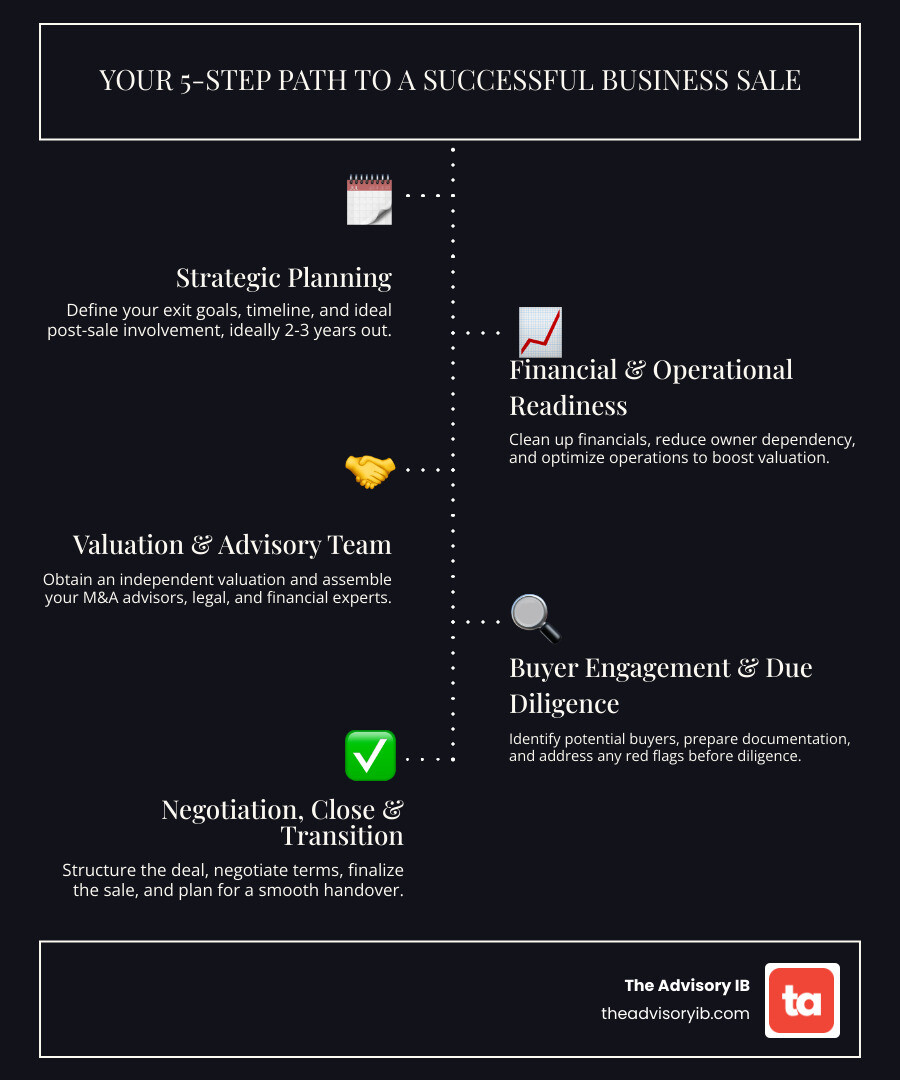
- Start planning 2-3 years early to maximize value and avoid rushed decisions
- Organize clean financials with 3+ years of tax returns, P&Ls, and normalized earnings statements
- Reduce owner dependency by documenting processes and building a capable management team
- Get an independent valuation to establish a data-backed asking price
- Assemble your advisory team including M&A advisors, CPAs, and legal counsel
- Prepare due diligence documents including contracts, customer lists, and operational manuals
- Identify and fix red flags that could scare away buyers or lower your valuation
- Develop a clear exit strategy defining your ideal buyer, timeline, and post-sale involvement
Whether you’re planning to retire, pursue new opportunities, or simply cash in on years of hard work, the preparation you do today determines the outcome you’ll see tomorrow. The selling process typically takes 6 months to over a year once you go to market, but the most successful exits begin with strategic preparation years in advance.
I’m Oliver Bogner, a two-time Forbes 30 Under 30 honoree and Managing Partner of The Advisory Investment Bank, where I help essential service business owners prepare to sell my business through expert M&A guidance after building and selling five companies myself with exits totaling over $150 million in revenue. My mission is to level the playing field between Wall Street buyers and Main Street sellers, ensuring founders achieve life-changing exits through proper preparation and competitive deal processes.
Essential Financial Steps to Prepare to Sell My Business
When you decide to prepare to sell my business, the first and most crucial step is to get your financial house in impeccable order. Think of your financial records as the storybook of your business’s health and potential; buyers need a clear, compelling narrative. Messy finances can introduce unnecessary risk and uncertainty, potentially costing you time and money, or even scaring off a potential buyer.
Our primary goal here is to present a transparent, accurate, and appealing financial picture. This means going beyond basic bookkeeping and focusing on what sophisticated buyers want to see. For a deeper dive into this initial phase, explore our guide on Business Sale Preparation.
Cleaning Up and Normalizing Your Books
Buyers will scrutinize your numbers closely. We recommend having at least three years of clean, accurate financial documents readily available, including income statements, balance sheets, and cash flow statements. You’ll also need tax returns for the past three to five years.
One of the most important tasks is normalizing your earnings. This involves adjusting your financial statements to reflect the true, ongoing profitability of the business for a new owner. Many owners run legitimate personal or non-operating expenses through the company, or pay themselves above or below market. These are often called “add-backs” or “discretionary expenses.”
For example, a personal vehicle expense that a new owner would not incur, above-market owner compensation, or one-time, non-recurring events may be added back to show a clearer picture of sustainable earnings. Buyers can live with “not perfect,” but they rarely live with “not explainable.” When financial statements align with tax returns and are clearly presented, diligence becomes confirmation instead of findy.
Understanding SDE vs. EBITDA
Two key metrics buyers use to evaluate small and mid-sized businesses are Seller’s Discretionary Earnings (SDE) and Earnings Before Interest, Taxes, Depreciation, and Amortization (EBITDA). It’s crucial to understand the difference and how they apply to your business.
| Feature | Seller’s Discretionary Earnings (SDE) | Earnings Before Interest, Taxes, Depreciation, and Amortization (EBITDA) |
|---|---|---|
| Definition | Cash flow available to a single owner-operator. | Profitability before non-operating expenses. |
| Includes | Net Profit + Owner’s Salary/Benefits + Discretionary Expenses + Rent | Net Profit + Interest + Taxes + Depreciation + Amortization |
| Owner’s Comp | Includes owner’s compensation, assumes owner-operator. | Excludes owner’s compensation, assumes manager replacement cost. |
| Use Case | Primarily for small businesses where owner is heavily involved. | Used for larger businesses with management teams. |
| Calculation | Annual Revenue – COGS – Expenses + Owner Salary = SDE | Annual Revenue – COGS – Expenses – Operating Manager Salary = EBITDA |
| Valuation Impact | Multiples typically 2-4x SDE for small businesses. | Multiples typically higher for larger businesses. |
Financial Forecasting and Tax Planning
Beyond historical performance, buyers want to understand the path forward. A well-reasoned financial forecast should be realistic, grounded in your past results, and supported by clear operational assumptions.
Also consider the tax implications of a sale early. The structure of the deal (for example, asset sale vs. stock sale) can materially affect after-tax proceeds. If you’re considering seller financing, understanding the IRS installment sale rules can help you plan how payment timing affects the recognition of gain. Your CPA should be involved before you go to market, not after an offer is already on the table.
Finally, remember the core principle: clean books, consistent reporting, and well-supported adjustments reduce buyer friction and help protect value when you prepare to sell my business.
Strategic Operational Fixes to Boost Your Valuation
Once your financials are sparkling, it’s time to look under the hood of your operations. Buyers are looking for a business that is not only profitable but also sustainable, scalable, and not overly reliant on one individual—especially you, the owner. This is where strategic operational fixes come into play, significantly boosting your valuation when you prepare to sell my business. For more insights on maximizing your business’s worth, visit our Value Maximization page.
Reducing Owner Dependency (Making Yourself Redundant)
This might sound counterintuitive, but one of the most attractive qualities a business can have is its ability to run smoothly without the owner’s constant, day-to-day involvement. If you’re working 60 hours a week just to keep the lights on, a buyer might see themselves buying a job, not a business.
Key Value Drivers for Buyers:
- Strong, independent management team: Develop capable employees who can take over critical functions. This makes you, the owner, somewhat redundant, which is a huge plus for buyers concerned about founder dependency.
- Documented Standard Operating Procedures (SOPs): Have clear, written processes for everything, from customer service to financial reporting. This demonstrates that the business is systematized and can be easily transferred and replicated. It’s not just about what you do, but how you do it, consistently.
- Delegation of critical functions: Gradually delegate responsibilities to your team. Automate, streamline, or reduce your workload where possible. This frees you up to focus on strategic growth and makes the business more appealing to a buyer looking for a passive income stream or a platform for growth.
Enhancing Business Attractiveness
Beyond owner independence, buyers look for certain characteristics that indicate future potential and stability.
- Recurring Revenue: Businesses with strong, predictable recurring revenue streams (e.g., subscriptions, service contracts) are highly valued. This signals stability and easier forecasting for a new owner.
- Customer Diversification: Avoid having a single customer or a handful of customers account for a significant portion of your revenue. Diversified customer bases reduce risk and make the business more resilient.
- Brand Reputation: A strong, positive brand reputation and a loyal customer base are intangible assets that add significant value. Buyers want to acquire a business that is well-regarded and has a built-in customer following.
- Employee Retention: Your team is a huge asset. High-performing, loyal employees are crucial for ongoing success. Implement retention strategies, sometimes referred to as “golden handcuffs” (like performance bonuses or share options), for valuable senior managers to ensure they stay with the business post-ownership. Buyers want to acquire a functioning team, not just assets.
- Infrastructure, Systems, and Processes: Does your business have the right infrastructure, systems, and processes to support continued growth? Well-maintained assets, up-to-date technology, and efficient workflows are all attractive to buyers.
- Growth Potential: Buyers are investing in the future. Clearly demonstrate past growth and outline clear strategies for future expansion, whether through new markets, products, or customer segments.
By focusing on these strategic operational fixes, you’re not just making your business more appealing; you’re actively increasing its inherent value. Ignoring these aspects can lead to Red Flags That Scare Buyers, potentially driving down your sale price or even derailing the deal entirely.
Why You Should Prepare to Sell My Business Early
The decision to prepare to sell my business is often a once-in-a-lifetime event, and timing can be everything. We cannot stress enough the importance of early planning, ideally years in advance, rather than months.
Many entrepreneurs who want to sell for more than book value—the value of their assets alone—should ideally devote as much as three to five years to getting their business in the best shape possible for sale. Why so long?
- Maximizing Value: Early preparation allows you to implement the financial and operational improvements discussed above, which directly impact your valuation. This isn’t about quick fixes; it’s about sustainable growth and profitability.
- Market Cycles: Businesses thrive and struggle with economic tides. Planning early gives you the flexibility to wait for favorable market conditions. Selling during an economic upswing, when deal volume and value are high, can yield a significantly better outcome. We’ve seen periods where median sale prices, revenue multiples, and cash flow multiples hit all-time highs. While there’s The Myth of the Perfect Time to Sell, being prepared allows you to capitalize on opportunistic windows.
- Performance Upswings: Selling when your business is on an upward trajectory, with consistent year-on-year revenue and EBITDA growth, is far more attractive to buyers. Early planning allows you to engineer these upswings rather than being forced to sell during a downturn.
- Personal Readiness: Selling a business is a monumental personal decision. Early Exit Planning gives you time to define your motivations, involve your family, and prepare for the personal transition that comes with a life-changing liquidity event. It ensures you’re selling on your terms, not out of necessity.
The overall process from initial exit planning to closing the deal can take around three years. So, while the transactional phase might be months, the strategic groundwork is a marathon, not a sprint. This proactive approach ensures you’re not leaving money on the table.
Identifying the Right Buyer When You Prepare to Sell My Business
Not all buyers are created equal, and understanding the different types of buyers and what they look for is key to finding the best fit and maximizing your sale price when you prepare to sell my business. For more on who might be interested, explore our insights on Who will buy my business?.
The three main categories of buyers are:
- Trade Buyers (Strategic Buyers): These are often larger companies in your industry or a related one. They acquire businesses to achieve strategic synergies, such as expanding market share, acquiring new technology, eliminating competition, or integrating your operations into their existing structure. Trade buyers often justify paying a premium because they can realize efficiencies or growth that a standalone business cannot. They look for strong market position, recurring revenue, and a clear path for integration.
- Private Equity (PE) Firms: PE firms acquire businesses with the goal of growing them and selling them for a profit in three to seven years. They typically provide capital for growth, strategic guidance, and operational improvements. PE buyers are often interested when owners want to raise capital for expansion, de-risk their personal wealth, or gain access to expertise to scale. They look for scalable businesses with stable cash flows, strong management teams, and clear growth opportunities. Understanding Deal Structure: Private Equity Secrets can be particularly useful here.
- Family Offices: These are private wealth management advisory firms that serve ultra-high-net-worth individuals or families. They often seek steady returns, long-term investments, and continuity of management. Family offices can be patient investors who value businesses with a strong legacy, consistent profitability, and a stable, independent management team.
Buyer Vetting: Regardless of the type, thoroughly vetting potential buyers is crucial. You want serious, financially capable prospects who understand your business and its potential. We help qualify buyers early to filter out non-serious prospects, protecting your time and sensitive business information. This involves assessing their business acumen, experience, leadership potential, and, critically, their financial capacity and sources of financing.
Navigating the Deal: Valuation, Structure, and Due Diligence
The actual transaction phase, where offers are made and due diligence takes place, is a complex dance of numbers, negotiations, and legalities. Being prepared for this stage is paramount to securing a favorable outcome when you prepare to sell my business.
Business Valuation: What is Your Business Really Worth?
Determining a fair and defensible asking price is one of the most challenging aspects of selling a business. While the ultimate answer to “how much is my business worth” is whatever someone is willing to pay for it, a professional valuation provides a data-backed foundation. For more detailed information on this, explore our Business Valuation guide.
We typically use several methods, often in combination:
- Earnings Multiples: This is a common approach, especially for essential service businesses. It involves multiplying your normalized SDE or EBITDA by an industry-specific multiple. For example, the national average earnings multiple is around 2.5 times annual discretionary earnings, but this varies widely by sector.
- Market-Based Valuation: Comparing your business to similar businesses that have recently sold (precedent transactions) or are currently on the market (comparable companies) provides a realistic benchmark.
- Income-Based Valuation: Methods like Discounted Cash Flow (DCF) analysis project your business’s future cash flows and discount them back to a present value.
- Asset-Based Valuation: This method calculates your business’s worth based on the value of its tangible and intangible assets minus liabilities.
The fastest way to slow a sale is to float a number you cannot defend. A credible, independent valuation helps anchor your asking price and gives buyers confidence.
Deal Structure: Asset Sale vs. Stock Sale
The structure of your sale has significant implications for taxes and liabilities.
- Asset Sale: The buyer purchases specific assets of the business (e.g., equipment, customer lists, intellectual property) but not the legal entity itself. This is often preferred by buyers because they can pick and choose assets, avoid assuming historical liabilities, and may receive tax benefits (e.g., depreciation write-offs). For sellers, an asset sale can sometimes result in higher tax liability, as inventory is typically taxed at the regular income tax rate.
- Stock Sale: The buyer purchases the ownership shares of the company. This means they acquire the entire legal entity, including all its assets and liabilities (known and unknown). Stock sales are generally simpler from a legal perspective but can be riskier for buyers due to inherited liabilities. For sellers, a stock sale often results in more favorable capital gains tax treatment.
The choice between an asset or stock sale is a critical negotiation point and should be discussed thoroughly with your M&A advisor, attorney, and CPA. For asset sales where goodwill or going concern value attaches, the IRS expects both parties to report the allocation using Form 8594.
The Letter of Intent (LOI)
Once a buyer is interested, they’ll typically submit a Letter of Intent (LOI). This is a non-binding document outlining the proposed terms of the sale, including the purchase price, deal structure (asset vs. stock), timeline, and contingencies. A good LOI should clearly state price and structure, what is included and excluded, the timeline, and the contingencies. It should also define the working capital peg conceptually so you don’t find later that you and the buyer meant different things by “normal.” Exclusivity in an LOI should be tied to milestones and a timeline to avoid market pauses without progress.
The Due Diligence Process
After signing an LOI, the buyer enters the due diligence phase. This is a comprehensive investigation where they verify all the information you’ve provided about your business. Angel investors who invest 20 hours or more in due diligence are five times more likely to get a return, highlighting its importance.
Buyers will scrutinize:
- Financials: Detailed review of all financial statements, tax returns, bank records, and projections.
- Legal: Contracts, leases, intellectual property, litigation history, permits, and licenses.
- Operational: Processes, systems, customer lists, supplier agreements, inventory.
- Human Resources: Employee contracts, compensation, benefits, organizational structure.
We help you manage diligence systematically by treating it as a set of workstreams (finance, legal, operations, HR, technology, commercial), assigning owners, setting a weekly update cadence, and keeping a shared diligence tracker. The goal is to make it easy for the buyer to say “yes” by having all documents organized and readily available in a digital data room. This proactive approach prevents delays and builds buyer confidence.
Negotiation Beyond Price
While price is often the focus, many other aspects of the deal are negotiable. These include:
- Earn-outs: A portion of the purchase price is contingent on the business achieving certain performance milestones post-sale. These can bridge valuation gaps but require tightly defined metrics.
- Seller Financing: You, the seller, provide a loan to the buyer for a portion of the purchase price. This can make the deal possible, improve buyer commitment, and, in some cases, create tax planning options via installment treatment. Partially-financed sales typically result in a price that is more than 15% higher than their cash sale counterparts.
- Working Capital Adjustments: Ensuring the business has sufficient cash and current assets to operate normally at closing.
- Your Post-Sale Role: Will you stay on as a consultant, an employee, or exit completely?
- Non-Compete Agreements: Buyers will often require you to sign an agreement restricting you from starting a competing business for a certain period in a defined geographic area.
Our Negotiation Secrets: Advisor Tips You Won’t Hear emphasizes that the best deals are win-win situations.
Closing Documents
The final stage involves signing the definitive purchase agreement and other closing documents, such as a bill of sale, corporate resolutions, and tax forms. Funds are typically held in escrow until all conditions are met. A clean handoff at closing requires a detailed checklist including wire instructions, bill of sale, IP assignments, and more.
Frequently Asked Questions about Selling a Business
How long does the selling process typically take?
The entire journey from deciding to prepare to sell my business to closing the deal can be extensive. While the transactional phase (from listing to closing) can take several months, often 6 to 11 months, or even a year or more depending on the complexity, the strategic preparation phase should ideally begin years in advance. From exit planning to finalizing the sale, the process typically takes around three years. This extended timeline allows for value maximization, operational improvements, and waiting for optimal market conditions. For a deeper understanding of the timeline, explore Why Great Deals Take Time: Understanding the Modern M&A Timeline.
What are the benefits of using an M&A advisor vs. selling independently?
While some owners consider selling independently, the complexities of M&A typically favor using an expert. The benefits of partnering with an M&A advisor, like us, are substantial:
- Higher Sale Price: Advisors can significantly increase the final sale price, anywhere from 6% to 25%, by creating a competitive bidding environment and leveraging negotiation expertise.
- Time Savings: Selling a business is a full-time job. M&A advisors can save business owners 30+ hours a week, allowing you to continue focusing on running your business.
- Confidentiality: Advisors maintain strict confidentiality, using blind listings and NDAs to protect your business’s sensitive information and prevent disruption to operations.
- Access to Qualified Buyers: We have extensive networks of private equity firms, strategic buyers, and family offices, ensuring your business is presented to the most suitable and financially capable prospects.
- Accurate Valuation: We use multiple valuation methodologies to provide an accurate and defensible asking price.
- Impartial Guidance: We offer objective advice throughout the emotional and complex process.
- Negotiation Power: We leverage our experience to negotiate favorable terms beyond just price, including deal structure, earn-outs, and working capital adjustments.
For more insights into the value we bring, read What are the benefits of working with an investment bank?.
How can I ensure a smooth transition after the sale?
A smooth transition is vital for maintaining the value of your business and ensuring its continued success under new ownership. It’s a key part of your overall Business Exit Strategy.
- Training Periods: Agree to a reasonable training and handover period with the new owner. This could range from a few weeks to several months, or even a year, where you provide guidance on operations, customer relationships, and industry nuances.
- Management Handover: If you have an existing management team, ensure a clear handover plan is in place. Buyers are often keen to retain key employees to ensure continuity.
- Clear Communication: Develop a clear communication plan for your employees, customers, and suppliers regarding the transition. Transparency (within reason, and at the appropriate time) helps alleviate anxiety and maintains morale.
- Golden Handcuffs: As mentioned earlier, retaining key employees through incentives like “golden handcuffs” (performance bonuses, share options) can be crucial for business continuity and a smooth transition.
- Post-Sale Involvement: Clearly define your post-sale role, whether it’s a short-term consulting gig or a complete departure. This manages expectations for both you and the buyer.
Conclusion
The journey to prepare to sell my business is undoubtedly one of the most significant undertakings for any entrepreneur. It’s a complex process that demands meticulous planning, strategic execution, and expert guidance. By focusing on financial cleanliness, operational efficiency, early preparation, and understanding your buyer, you can dramatically increase your chances of a successful and lucrative exit.
At The Advisory Investment Bank, we understand the immense effort you’ve poured into building your business. Our mission is to ensure that your hard work translates into a life-changing exit. Leveraging our AI-driven M&A platform, we specialize in selling essential services businesses to private equity firms, delivering faster, stronger offers on a 100% success-based model. We level the playing field, ensuring you’re not selling short.
Ready to explore how we can help you achieve your exit goals in New York, NY, Chicago, IL, Houston, TX, Phoenix, AZ, Philadelphia, PA, San Antonio, TX, San Diego, CA, Dallas, TX, San Jose, CA, Austin, TX, Jacksonville, FL, Fort Worth, TX, Columbus, OH, Charlotte, NC, San Francisco, CA, Indianapolis, IN, Seattle, WA, Denver, CO, Washington, DC, Boston, MA, Nashville, TN, Detroit, MI, Portland, OR, Memphis, TN, or Louisville, KY?