
Why Preparation Is the Difference Between a Good Exit and a Great One
Maximize business value before sale isn’t just a smart strategy—it’s the difference between leaving millions on the table and achieving the exit you’ve worked decades to earn. Most business owners who put their company on the market without proper preparation discover a painful truth: 70-80% of businesses listed for sale never actually close. The reason is simple: buyers pay for predictable cash flow, operational independence, and growth potential—not just for past performance.
To maximize business value before sale, focus on these critical actions:
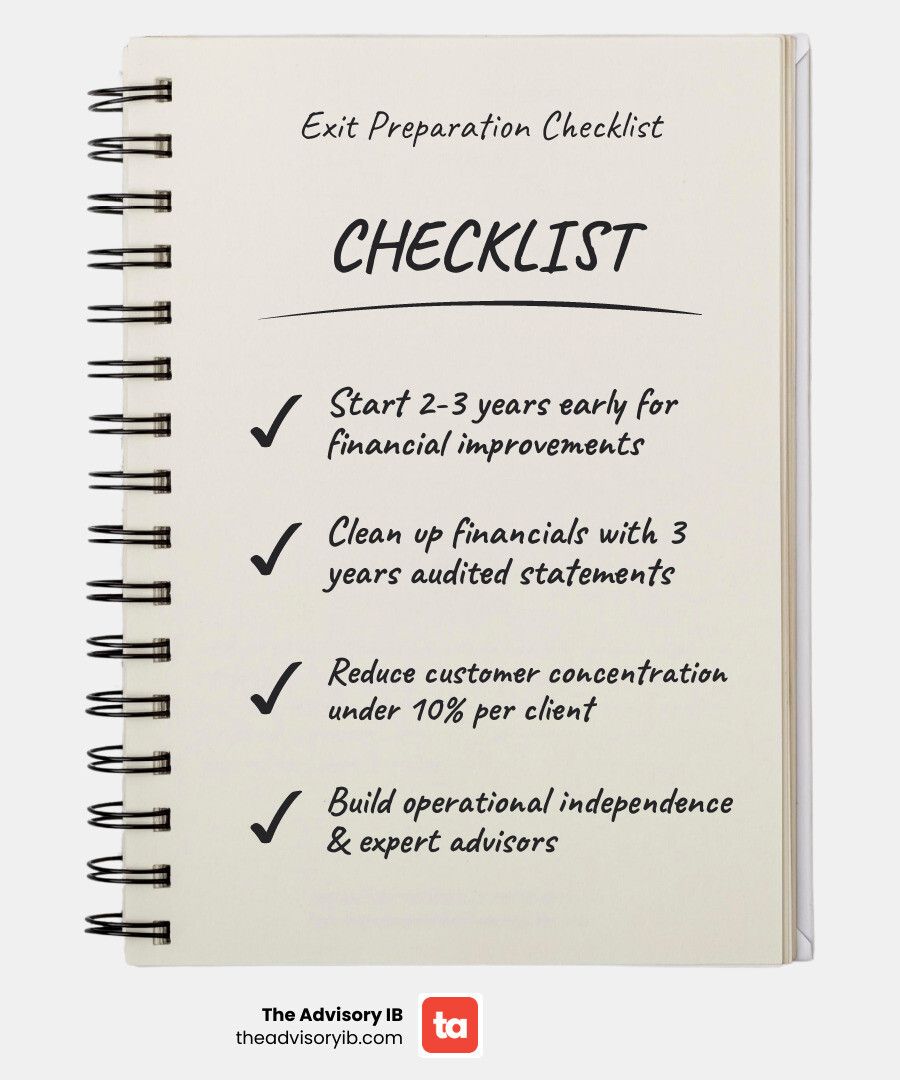
- Start 2-3 years early to allow financial improvements to reflect in historical statements
- Clean up financials with GAAP-compliant, audited statements for at least three years
- Reduce customer concentration to under 10% from any single client, 25% from top five
- Build operational independence by documenting processes and reducing owner dependency
- Secure recurring revenue through long-term contracts and diversified customer base
- Assemble expert advisors (M&A advisor, accountant, lawyer) to guide the process
- Get a professional valuation to identify gaps and establish baseline metrics
Strategic preparation typically adds 25-50% or more to final sale price. Business owners who work with M&A advisors sell for 25% more than those who go it alone, according to industry research. The key is understanding that buyers price risk—every red flag in due diligence translates to lower offers, tighter terms, or deals that fall apart entirely.
I’m Oliver Bogner, a two-time Forbes 30 Under 30 honoree and Managing Partner of The Advisory Investment Bank, where I’ve guided hundreds of essential service business owners through successful exits after building and selling five companies of my own. My mission is to help founders maximize business value before sale by applying the same systematic preparation strategies that transformed my own exits—and to level the playing field between Wall Street buyers and Main Street sellers.
Strategic Preparation to Maximize Business Value Before Sale
Selling a business is the ultimate financial event of an entrepreneur’s life. However, many owners treat it like a real estate transaction—clean the carpets, paint the walls, and list it next week. In M&A, that approach is a recipe for a “no-sale” or a heavily discounted price.
To truly Increase Business Value, you must view your company through the lens of a sophisticated buyer. They aren’t just buying your past; they are buying your future. A proactive 2-3 year window allows you to implement changes that show up in your EBITDA (Earnings Before Interest, Taxes, Depreciation, and Amortization) and, more importantly, in your valuation multiple. Research shows that a majority of pre-exit value-creation plans project EBITDA improvements of 10% to 60% within three to five years. By focusing on exit readiness early, you can exit when the market is hot, rather than being forced to sell when you’re simply “burnt out.”
Why You Must Start 2-3 Years Early to Maximize Business Value Before Sale
According to the Exit Planning Institute, only 20% to 30% of businesses that go to market actually sell. This staggering 70-80% failure rate occurs because owners wait until they are ready to leave before they start making the business attractive.
Buyers typically look at three years of historical financials. If you make a major operational improvement today, its full impact won’t be reflected as a “trend” for another 24 to 36 months. Starting early allows you to:
- Establish a Trend: One year of growth is a fluke; three years is a trajectory.
- Fix Structural Issues: Issues like messy Business Sale Preparation or legal disputes take time to resolve cleanly.
- Optimize the Balance Sheet: It takes time to pay down debt, collect aging receivables, and normalize inventory levels.
By the time you hit the “market” button, you want a business that is a well-oiled machine, not a project for the next owner.
Creating a Compelling Growth Story for Strategic Buyers
A buyer doesn’t just want to know what you did last year; they want to know how they will make their money back. This is where you craft your “Growth Story.” You need to demonstrate how the business can scale under new ownership.
To understand How Essential Service Businesses Maximize Valuation: What Buyers Pay Top Dollar For, look at your competitive moats. Do you have proprietary technology? A dominant local market share? Exclusive contracts? Strategic buyers pay a premium for “defensible” revenue. If your value is built on a “secret sauce” that only you know, the business isn’t sellable. If it’s built on intellectual property, a robust sales pipeline, and a clear path to expansion into new territories, you’ve just added a turn or two to your multiple.
Fortifying Financials and the Quality of Earnings
Messy books kill deals. Period. When a buyer sees personal expenses mixed with business costs, or inconsistent revenue recognition, they don’t just see a “fixable” problem—they see risk. And in M&A, risk equals a lower price.
To Maximize Business Value Before Sale, your financials must be “audit-ready.” This means moving beyond simple tax-basis accounting to GAAP (Generally Accepted Accounting Principles). Buyers want to see at least three years of clean income statements and balance sheets. If you haven’t had a Business Valuation recently, you might be surprised at how much “hidden value” or “hidden risk” is tucked away in your ledger.
The Role of the Quality of Earnings (QoE) report
You might wonder, “How is my business valued?” Most businesses are valued on a multiple of EBITDA, but not all EBITDA is created equal. A Quality of Earnings (QoE) report is a deep-dive analysis—often performed by an outside accounting firm—that verifies the sustainability of your earnings.
It strips away one-time events (like a legal settlement or a PPP loan) and normalizes the numbers to show what the business would look like under new ownership. Knowing What will my multiple be? starts with a QoE. By commissioning your own “Sell-Side QoE” before going to market, you uncover potential landmines before the buyer does, allowing you to control the narrative and maintain your leverage.
Eliminating Financial Red Flags
Buyers are on the lookout for Red Flags That Scare Buyers. The most common? Personal expenses run through the business. While “writing off” your personal SUV or family vacations might save you on taxes today, it lowers your reported profit and can significantly reduce your valuation multiple.
Other red flags include:
- Customer Concentration: If one client is more than 10% of revenue, the buyer sees a cliff.
- Inconsistent Margins: If your COGS (Cost of Goods Sold) fluctuates wildly without explanation, it signals poor management.
- Aged Receivables: If your customers aren’t paying you on time, the buyer assumes they never will.
De-Risking Operations: Reducing Concentration and Dependency
A business that depends entirely on its owner is a job, not an asset. To Increase Valuation: Essential Service Business, you must prove that the company can thrive without you. This “de-risking” process is one of the fastest ways to move from a 3x multiple to a 5x or 6x multiple.
Customer concentration is the most cited “deal-killer.” The golden rule is that no single customer should account for more than 10% of revenue, and your top five should not exceed 25%. If your biggest client leaves the day after the sale, the buyer’s investment is ruined. Diversifying your client base and securing long-term, transferable contracts turns “risky” income into “predictable” cash flow.
Operational Levers to Maximize Business Value Before Sale
Efficiency and scalability are the names of the game. To Grow Essential Service Business Value Beyond Revenue & Profit, you must implement systems that allow for growth without a linear increase in overhead.
- Standard Operating Procedures (SOPs): Every task, from answering the phone to fulfilling a complex order, should be documented.
- Automation: Use CRM and ERP systems to track every customer interaction and inventory movement.
- Supplier Diversity: Don’t rely on a single vendor for critical parts or services.
When a buyer sees a “playbook” for how the business runs, they feel confident they can step in (or hire someone to step in) and keep the momentum going.
Reducing Owner Dependency and Building Management Depth
Can you take a three-week vacation without checking your email? If the answer is no, your business value is suffering. This is the “Vacation Test.” To achieve true Value Maximization, you need a management team that owns the day-to-day operations.
Key personnel should have retention plans in place, such as stay-bonuses or “double-trigger” equity acceleration, ensuring they won’t jump ship the moment a new owner arrives. Transferable leadership means moving client relationships from the owner’s cell phone to the company’s CRM. If the customers only buy because they like you, the buyer won’t pay top dollar for the business.
Assembling Your M&A Dream Team
Selling a business is a full-time job on top of the full-time job of running the business. You need a team of specialists to ensure you don’t get distracted or bullied during negotiations.
| Role | Primary Responsibility | Value Added |
|---|---|---|
| M&A Advisor | Market the business, find buyers, lead negotiations | Typically 25% higher sale price; saves 30+ hours/week |
| Specialist Lawyer | Draft purchase agreements, manage “change of control” | Protects against future litigation; ensures contract assignability |
| CPA / Accountant | Tax optimization, QoE preparation, financial cleanup | Maximizes “walk-away” cash by reducing tax liability |
| Wealth Manager | Personal estate planning, post-sale investment strategy | Aligns business exit with personal financial goals |
Working with an M&A firm is essential for Business Sale Preparation. An advisor doesn’t just “find a buyer”—they create a competitive auction environment where multiple buyers bid against each other, driving up the price and improving the terms.
Navigating Due Diligence Without Losing Value
Due diligence is the “proctology exam” of the business world. The buyer will look at every contract, every bank statement, and every employee file. If you are unprepared, this process can drag on for months, leading to “deal fatigue” or “re-trading” (where the buyer lowers the price because they found a skeleton in the closet).
To protect yourself:
- Set up a Virtual Data Room (VDR): Have all your documents organized and ready before you even sign a Letter of Intent.
- Audit Your IP: Ensure all intellectual property is properly owned by the company and that employee/contractor “work-for-hire” agreements are signed.
- Confidentiality is Key: Do not tell your employees you are selling until the deal is nearly closed. Uncertainty leads to turnover, which lowers value.
Frequently Asked Questions about Business Value
What is a Quality of Earnings (QoE) report and why is it important?
A QoE report is an analysis that validates the financial information provided by a seller. It is more detailed than a standard audit. It’s important because it confirms “Adjusted EBITDA”—the actual cash flow a buyer can expect—by removing non-recurring expenses and owner-specific costs. Having a sell-side QoE ready shows buyers you are transparent and professional.
How much value can realistic preparation add to a final sale?
Strategic preparation over a 2-3 year period can realistically add 25% to 50% or more to the final sale price. This comes from two places: increasing the actual profit (EBITDA) and increasing the “multiple” (e.g., moving from 4x profit to 6x profit) by reducing risks like owner dependency and customer concentration.
When is the best time to sell my business based on market conditions?
The best time to sell is when your business is on an upward trend, but still has “room to grow” for the next owner. Ideally, you want to sell when interest rates are stable and there is high demand from private equity in your specific industry. However, internal readiness is usually more important than external market timing; a “perfect” business will sell in a bad market, but a “messy” business won’t sell even in a great one.
Conclusion
Maximizing the value of your business is not an overnight task—it is a deliberate, strategic process of de-risking and optimization. By starting 2-3 years early, cleaning your financials, and building a management team that can operate without you, you transform your company from a daily burden into a high-value asset.
At The Advisory Investment Bank, we specialize in helping essential service businesses navigate this journey. Our AI-driven M&A platform is designed to connect businesses with $2M to $100M in sales to the most aggressive private equity buyers in the country. We operate on a 100% success-based model, meaning our goals are perfectly aligned with yours: to get the highest possible price on the best possible terms.
If you’re ready to Increase Business Value and see what your exit could look like, let’s start the conversation today. Your legacy deserves a pro-level exit.