
What Every Business Owner Needs to Know About Exit Planning
Exit planning is the process of preparing your business — and yourself — for an ownership transition that maximizes value and happens on your terms.
Here’s a quick overview of what it involves:
| Element | What It Means |
|---|---|
| What it is | A strategic process to prepare your business for sale, transfer, or succession |
| Who it’s for | Any business owner — 100% of owners will exit at some point |
| When to start | 3-5 years before your target transition date |
| Key goals | Maximize sale value, minimize taxes, protect your legacy |
| Common exit paths | Third-party sale, family transfer, management buyout, ESOP |
| Who helps | M&A advisors, tax professionals, attorneys, valuation experts |
Most business owners spend years building something valuable — then spend almost no time planning how to leave it. That gap is costly. According to industry data, 81% of business owners want to stop working within the next 10 years, yet only 20% have a written plan to make that happen. Meanwhile, every single one of them will exit eventually, whether by choice or by circumstance.
Exit planning isn’t just about the day you hand over the keys. It’s a multi-year process of strengthening your business, aligning your personal and financial goals, and positioning yourself to capture the full value you’ve worked to build. Done right, it’s one of the highest-leverage decisions you’ll ever make as an owner. Done wrong — or not done at all — it can mean leaving hundreds of thousands, or even millions, of dollars on the table.
The stakes are especially high right now. Every day, 10,000 Baby Boomers turn 65, and nearly 75,000 businesses are expected to change hands annually as a result. But business brokers only successfully sell around 10% of those businesses each year. That means the majority of owners who wait too long, or plan too little, walk away with far less than they deserve — or don’t walk away at all.
I’m Oliver Bogner, Managing Partner of The Advisory Investment Bank, and having built and sold five companies myself before advising hundreds of business owners through their exits, I’ve seen what separates a life-changing exit from a missed opportunity — and exit planning is almost always the deciding factor. In this guide, I’ll walk you through everything you need to know to get it right.
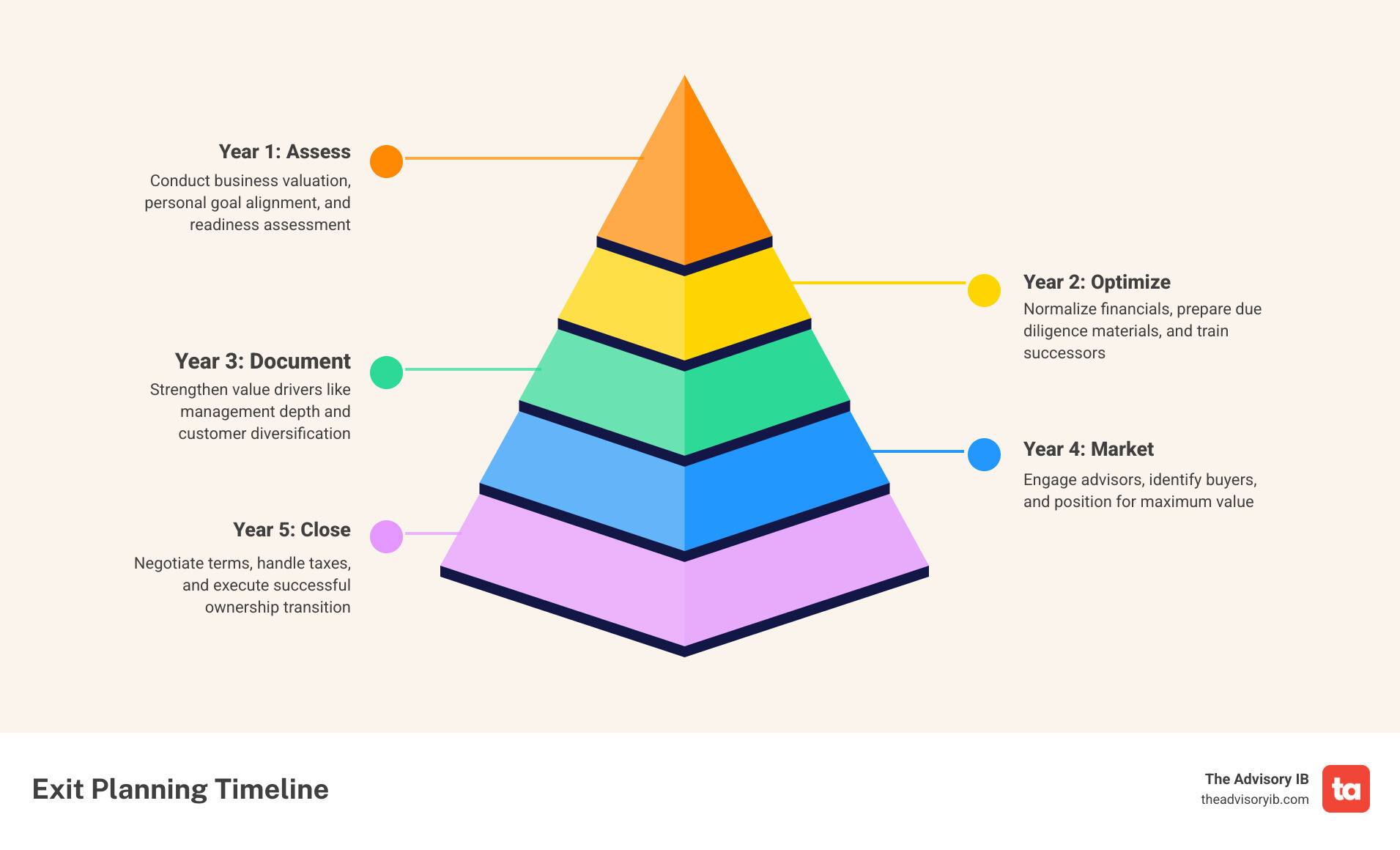
Exit planning further reading:
What is Exit Planning and Why Does It Matter?
At its core, exit planning is a comprehensive business strategy. It isn’t just a folder you pull out when you’re tired of working; it is a results-driven process that builds “transferable value.” We often see owners who confuse a profitable business with a sellable one. A business can generate a great income for the owner but still be worth very little to a buyer if the owner is the “secret sauce” that makes everything run.
The urgency for this planning has never been higher. We are currently witnessing The Boomer Exit Wave is Real and So is the Opportunity. With 10,000 Baby Boomers turning 65 every day, the market is about to be flooded with companies for sale. If you haven’t prepared your business to stand out, you risk being part of the 80% of owners who fail to find a buyer. This is exactly Why Most Business Owners Will Miss the Greatest Wealth Transfer in US History. Without a roadmap, you are essentially leaving your legacy to chance.
Exit Planning vs. Succession Planning
While these terms are often used interchangeably, they are distinct concepts. Think of exit planning as the “macro” strategy and succession planning as a “micro” component within it.
- Exit Planning: This is the broad, strategic roadmap. It encompasses financial goals, tax mitigation, legal structures, and the ultimate transfer of ownership to any party (internal or external).
- Succession Planning: This is specifically focused on the “people” side of the transition. It involves identifying, hiring, and training a successor—whether that’s a family member or a key manager—to take over the CEO role.
As we discuss in Don’t Leave Your Family a Mess: Your Business Succession Plan Starts Here, a failure to distinguish between the two often leads to emotional turmoil. You might have a great successor (succession planning) but a terrible tax structure (poor exit planning), which results in the IRS taking half of your hard-earned equity.
The High Cost of Delaying Your Exit Strategy
Waiting until you are “ready to go” is the most common mistake we see. Proper exit planning typically takes 3 to 5 years to execute effectively. If you wait until you’re burnt out, you lose your leverage.
When you delay, you often fall victim to the Myth of the Perfect Time to Sell. Owners think they can time the market perfectly, but the “perfect time” is actually when your business is performing at its peak, the economy is stable, and you have no urgent need to leave.
Furthermore, If You’re Over 50 and Own a Service Business, Watch This Immediately. The risk of “owner reliance” grows every year you don’t delegate. If the business can’t run without you, it isn’t an asset; it’s a job. Buyers don’t want to buy your job—they want to buy a self-sustaining cash-flow machine.
Evaluating Your Business Exit Options
Choosing the right exit path is a deeply personal decision that must align with your financial needs and your vision for the company’s future. We help owners navigate these Entrepreneur Exit Services by weighing the pros and cons of each route.
| Exit Option | Best For… | Major Pro | Major Con |
|---|---|---|---|
| Third-Party Sale | Maximizing cash at closing | Typically the highest valuation | High due diligence scrutiny |
| Family Transfer | Maintaining legacy | Keeps the business “in the family” | Can be emotionally complex; lower liquidity |
| Management Buyout | Continuity of culture | Minimal transition risk; buyer knows the business | Often requires seller financing (you wait for your money) |
| ESOP | Rewarding employees | Significant tax benefits for the seller | Complex and expensive to set up |
Developing a clear Business Exit Strategy early allows you to groom the business for the specific type of buyer you want to attract.
Selling to Strategic vs. Financial Buyers
If you decide to sell to an outside party, you’ll likely encounter two types of buyers. Strategic buyers are often competitors or companies in related industries. They pay “synergy premiums” because they can integrate your business into theirs to save costs or expand market share.
Financial buyers, such as private equity groups, are looking for a return on investment. They might view your company as a “platform” to build upon or an “add-on” to an existing portfolio. When you Sell My Business to a financial buyer, they may want you to stay on for a few years or keep a small equity stake (a “second bite of the apple”).
Internal Transfers and Employee Ownership
For many, the goal is about more than just the check—it’s about the people. We’ve worked with owners on Beyond the Business: Crafting Your Entrepreneurial Exit Plan in Jacksonville who prioritized keeping the business local and rewarding long-term staff.
Internal transfers, like an Employee Stock Ownership Plan (ESOP), allow for a phased exit. This can be a great way to transition slowly while ensuring your culture remains intact. However, these require a highly capable management team that is ready to step up into ownership roles.
Maximizing Value Through Strategic Exit Planning
The goal of exit planning is to close the “value gap”—the difference between what your business is worth today and what you need it to be worth to fund your next chapter.
We utilize Exit Planning frameworks that focus on “EBITDA normalization.” This means cleaning up your financials to show a buyer the true earning power of the business. If you’re running your personal vehicle or family vacations through the business, those expenses need to be “added back” to show the real profit. Through our Business Owner Advisory services, we help identify these opportunities long before the sale process begins.
Key Drivers of Exit Planning Success
What makes one service business worth a 3x multiple and another worth 6x? It usually comes down to the “intangibles.” In our experience with Exit Strategy Excellence: Planning Your Business’s Next Chapter in Austin, we focus on these four value drivers:
- Management Depth: Can the business thrive if you take a three-month vacation?
- Customer Diversification: Does any single customer represent more than 10-15% of your revenue? (This is known as the “Switzerland Structure”—being neutral and not over-reliant on any one party).
- Recurring Revenue: Do you have service contracts or subscription models that make next month’s sales predictable?
- Structural Capital: Are your processes documented? Do you have “clean” systems that a new owner can easily take over?
Preparing Your Financials for Due Diligence
If you want to Sell Business Next 12 Months, your books must be bulletproof. Due diligence is the “home inspection” of the business world. If a buyer finds inconsistencies in your revenue reporting or discovers that your working capital is tied up in 90-day-old receivables, they will either walk away or “re-trade” (lower the price).
We recommend having at least three years of clean, CPA-reviewed financial statements. Transparency builds trust, and trust builds value.
The Roadmap to a Successful Business Sale
You shouldn’t go through this alone. Building a “Transition Team” is essential. This team typically includes an M&A advisor (like us), a tax-focused CPA, an M&A attorney, and a wealth manager for Post-Exit Planning.
Tax Considerations in the Exit Process
It’s not about what you sell the business for; it’s about what you keep after the IRS takes their cut.
- Asset Sale vs. Share Sale: Generally, buyers prefer asset sales because they can “step up” the basis of the assets for depreciation. Sellers usually prefer share (stock) sales because they often result in lower capital gains taxes.
- Capital Gains: Understanding the difference between short-term and long-term capital gains can save you millions.
- Estate Planning: For larger exits, you may want to move shares into trusts before the sale to minimize future estate taxes.
Proactive tax mitigation is a cornerstone of any professional exit planning engagement.
Frequently Asked Questions about Exit Planning
When is the ideal time to start the planning process?
The ideal time is 3 to 5 years before you want to leave. This gives you enough time to fix operational red flags, diversify your customer base, and implement “value-building” strategies that can significantly increase your eventual sale price.
How is a business valued during an exit?
Most middle-market businesses are valued based on a multiple of EBITDA (Earnings Before Interest, Taxes, Depreciation, and Amortization). However, that multiple is influenced by your industry, your growth rate, and your “intangible” drivers like management depth and recurring revenue. A formal business valuation is often the first step in the exit planning journey.
What are the most common pitfalls to avoid?
The “Big Three” pitfalls are:
- Owner Centricity: The business can’t function without you.
- Customer Concentration: One or two clients hold the power to bankrupt you if they leave.
- Poor Financial Records: If a buyer can’t verify your numbers, they won’t buy.
Conclusion
Exit planning is the most important “project” you will ever undertake as a business owner. It is the difference between simply closing your doors and securing a legacy that provides for your family for generations.
At The Advisory Investment Bank, we specialize in helping owners of essential services businesses ($2M – $100M in sales) navigate this complex landscape. Our AI-driven platform is designed to find the right private equity buyers faster and secure stronger offers, all on a 100% success-based model. We have a presence in major hubs across the country—from New York and Chicago to Houston, Phoenix, and Los Angeles—ensuring we have the local market knowledge and global reach to handle your exit with excellence.
Ready to see what your business is truly worth and start your journey? Let’s talk about your Exit Planning strategy today.