
What Is an Exit Planning Strategy — and Why It Matters for Your Business
An exit planning strategy is the structured process of preparing your business — financially, operationally, and personally — for an eventual ownership transition, whether that means selling to a strategic buyer, passing the business to family, or partnering with private equity.
Here is a quick overview of what an effective exit planning strategy involves:
- Start early – Ideally 3 to 5 years before your target exit date
- Know your value – Get a professional business valuation to understand what buyers will actually pay
- Choose the right exit route – Strategic sale, private equity, management buyout, ESOP, or family succession
- Clean up your financials – Audited books, documented processes, and reduced owner dependency
- Build your advisory team – M&A advisor, CPA, attorney, and financial planner
- Understand your tax position – Asset sale vs. share sale, capital gains implications, and available exemptions
- Go to market at the right time – Align personal goals with market conditions and business performance
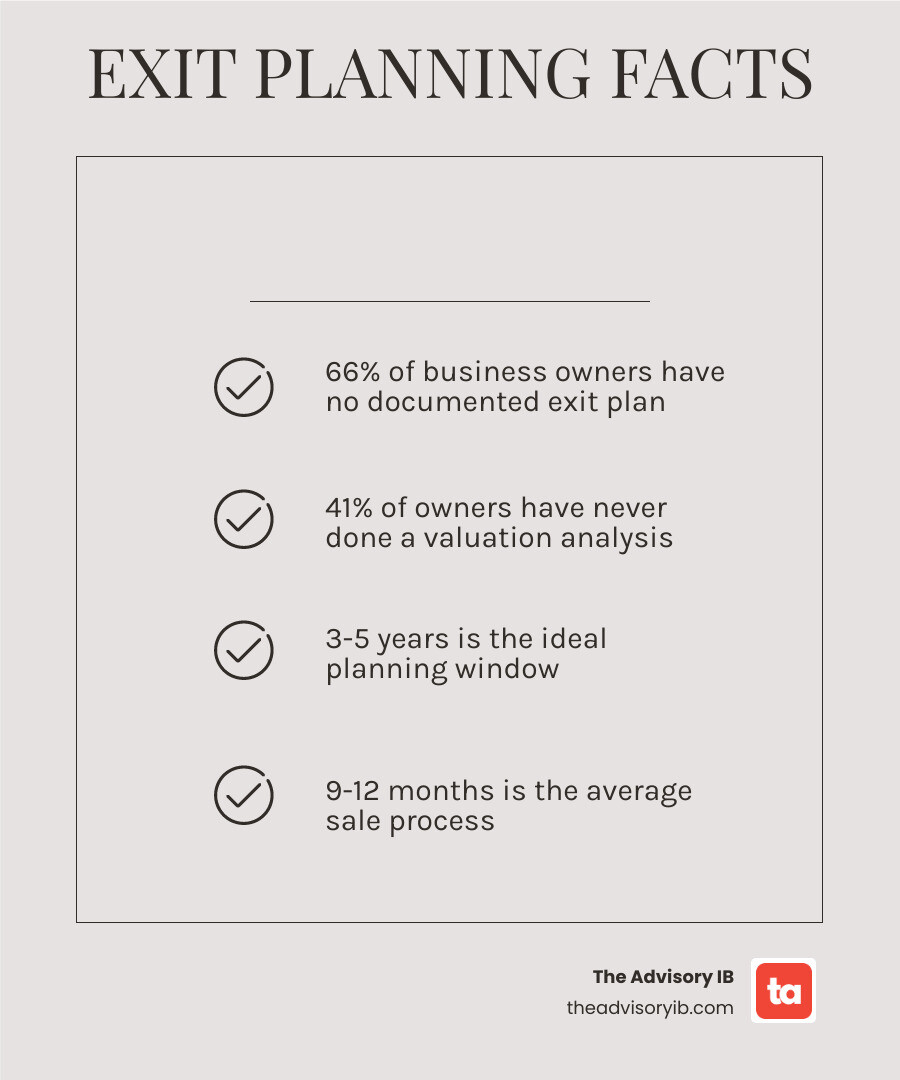
You’ve spent years — maybe decades — building a business that generates real revenue, employs real people, and delivers real value. But here’s the uncomfortable truth: two-thirds of business owners have no documented plan for how they’ll eventually exit, and 41% have never completed any kind of valuation analysis to know what their business is actually worth.
That’s a problem. Not just for the day you decide to sell, but for every decision you make between now and then.
A sale process can take anywhere from 9 to 12 months once you go to market — and that’s assuming your business is ready. Most aren’t. The owners who walk away with the best outcomes are the ones who started preparing three to five years in advance, long before a buyer ever showed up at the door.
Whether you’re actively planning to sell in the next few years or simply want to understand your options, this guide will walk you through every step of the exit planning process — from valuation and deal structure to due diligence and tax strategy.
I’m Oliver Bogner, Managing Partner of The Advisory Investment Bank, and having personally built and sold five companies — with exits to Fortune 500s, private equity firms, and strategic acquirers — I’ve lived every stage of the exit planning strategy process from both sides of the table. That experience now drives how my team helps essential service business owners achieve competitive, life-changing exits.
Why an Exit Planning Strategy is Essential for Every Business Owner
Many entrepreneurs view their business as an extension of themselves. While that passion is what fuels growth, it can become a liability when it’s time to move on. An exit planning strategy isn’t just about leaving; it’s about protecting the legacy you’ve built and ensuring the business can thrive without you.
According to the Exit Planning Institute, exit planning is a critical concept for business owners who want to ensure a smooth transition. It’s a mindset shift from simply generating annual income to creating long-term, transferable value. Without a plan, you risk a “forced exit” due to health issues, burnout, or market shifts, which almost always results in a lower valuation.
Statistics show that 66% of business owners lack a documented plan, and 41% have no idea what their business is worth. By formalizing a Business Exit Strategy, you mitigate these risks and gain the peace of mind that comes from knowing exactly how your hard work will eventually pay off.
Choosing the Right Exit Planning Strategy for Your Goals
There is no one-size-fits-all approach to exiting. Your choice depends on whether you want a clean break, a phased retirement, or to see your employees take the reins.
- Strategic Buyer: Usually a competitor or a company in a related industry looking for synergies.
- Private Equity: Firms looking to invest capital, professionalize operations, and grow the business over a 3-7 year horizon.
- Family Succession: Passing the torch to the next generation, often requiring years of training and mentorship.
- Liquidation: If the business cannot be sold as a going concern, liquidation involves selling off assets to pay creditors.
- IPO: While rare for most small to mid-sized firms, startup exit trends show that while M&A dominates, public offerings remain a high-profile (though arduous) goal for some.
The Benefits of Starting Your Exit Plan Early
Starting 3 to 5 years early isn’t just about the final check; it’s about making the business better today. When you focus on “value acceleration,” you naturally fix the things that are holding your business back.
Using a framework like the Value Acceleration Methodology™, you can identify “value killers”—like over-reliance on a single customer or messy financial records—and resolve them. This process creates operational independence, meaning the business can run (and grow) even when you’re on vacation. A business that doesn’t need its owner is worth significantly more to a buyer.
Common Types of Business Exit Strategies
Choosing your path requires balancing financial needs with emotional goals. Below is a comparison of the most frequent routes:
| Strategy | Ideal For | Pros | Cons |
|---|---|---|---|
| Strategic Sale | Maximizing price | Highest valuation due to synergies | High scrutiny; cultural shift |
| Private Equity | Growth-minded owners | Professional expertise; “second bite” at the apple | Loss of full control; 3-7 year exit horizon |
| MBO (Management Buyout) | Continuity | Preserves culture; less due diligence | Funding hurdles; lower cash upfront |
| ESOP | Legacy & Employees | Tax benefits; rewards staff | Complex legal setup; lower valuation |
| Family Succession | Keeping it in the family | Legacy preservation | Family drama; long transition |
In the current market, M&A activity remains the primary driver for transitions, accounting for over 85% of venture-backed exits in recent years. If you want to Sell My Business, understanding these nuances is step one.
Selling to a Strategic Buyer or Private Equity Firm
Strategic buyers are often willing to pay a premium because they see “1+1=3.” They might want your customer list, your proprietary technology, or your geographic footprint.
Private equity (PE), on the other hand, is increasingly active in the $2-100M revenue space. PE firms typically have a 3-7 year horizon. They may want you to stay on for a few years to help scale the business, offering you a chance to retain a minority stake and profit again when they eventually sell the larger entity. For many, this is the ultimate entrepreneur exit service because it provides immediate liquidity while keeping a foot in the door.
Internal Transitions: MBOs, ESOPs, and Family Succession
If your goal is to protect the “soul” of the company, an internal transition might be best. A Management Buyout (MBO) allows your key lieutenants to take over. Since they already know the business, the due diligence process is much faster.
However, financing is the biggest hurdle here; your managers may not have the cash, often requiring seller financing or bank loans. Family succession is another path, but it requires a clear training plan. As we often say, Don’t Leave Your Family a Mess: Your Business Succession Plan Starts Here—without a documented plan, intergenerational transfers can lead to both business and family friction.
Determining and Maximizing Your Business Value
How much is your business actually worth? It’s rarely the number the owner has in their head. Professional Exit Planning starts with an objective valuation.
Common methodologies include:
- EBITDA Multiples: The most common for mid-market firms. Stable service businesses might trade at 4-6x, while high-growth tech firms can hit 10-15x+.
- Discounted Cash Flow (DCF): Valuing the business based on the present value of its future projected earnings.
- Asset-Based Valuation: Summing up the fair market value of all company assets (best for liquidation or heavy-equipment industries).
Intangible Drivers of a Premium Valuation
While the numbers matter, the “intangibles” are what drive the multiple up. A buyer will pay more for a “de-risked” business. Key drivers include:
- Recurring Revenue: Contracts and subscriptions are worth more than one-off sales.
- Customer Diversification: If one client makes up 40% of your revenue, you’re high-risk.
- Strong Management Team: If you are the only one who can close a sale or fix a problem, the business isn’t transferable.
- Standard Operating Procedures (SOPs): Documented workflows prove the business is a repeatable machine.
Understanding the Tax Implications of Your Exit
It’s not about what you sell for; it’s about what you keep. Tax strategy can be the difference between a comfortable retirement and a stressful one.
- Asset Sale vs. Share Sale: Buyers usually prefer asset sales (to step up the basis for depreciation), while sellers prefer share sales (for better capital gains treatment).
- Capital Gains: In the US, capital gains rates vary significantly based on income.
- Exemptions: Depending on your jurisdiction and business structure (like QSBC shares in certain regions), you may be eligible for significant exemptions.
- Estate Freeze: A strategy used in family successions to lock in the current value for the owner while allowing future growth to accrue to the heirs, minimizing future estate taxes.
Working with a business owner advisory team early allows you to structure these tax-saving vehicles years before the deal closes.
The Step-by-Step Roadmap to a Successful Transition
Once you’ve decided to move forward, the “grooming” phase begins. This is where you prepare the business for the intense scrutiny of a buyer. If you want to Sell Business Next 12 Months, you need to be running at peak efficiency today.
Grooming Your Business for an Exit Planning Strategy
Think of this as “curb appeal” for your company. You wouldn’t sell a house with a leaky roof and overgrown weeds; don’t try to sell a business with messy books.
- Financial Cleanup: Ensure you have at least three years of clean, preferably audited, financial statements.
- Operational Independence: Gradually remove yourself from daily operations. If the phone stops ringing when you leave for a week, you’re ready.
- Documentation: Assemble your contracts, leases, employee agreements, and IP filings into an organized “Virtual Data Room.”
- Timeline Management: The actual sale process takes 9-12 months. If you want to be out by December, you need to be on the market by January.
Navigating Due Diligence and Market Conditions
Due diligence is the 30-to-90-day period where the buyer looks under every rug. They will verify every dollar of revenue and every legal contract. If they find surprises, they will “re-trade” (lower the price) or walk away.
Market conditions also play a huge role. While it’s tempting to wait for the “peak,” the Myth of the Perfect Time to Sell often leads to owners missing good windows because they were waiting for a perfect one that never came. Interest rates, industry trends, and M&A cycles are external factors you can’t control—focus on what you can control: your business’s readiness.
Frequently Asked Questions about Exit Planning
When is the right time to start exit planning?
The best time was the day you started the business. The second best time is today. Ideally, you should begin formal Exit Planning 3 to 5 years before you want to step away. This gives you enough time to fix “value killers,” implement tax strategies, and find the right successor without being in a rush.
What is the single biggest mistake owners make during an exit?
Letting emotions drive the deal. Many owners overvalue their business because of the “sweat equity” they’ve put in, or they try to handle negotiations themselves without professional help. Going it alone often leads to deal fatigue and leaving significant money on the table.
How do I build the right professional advisory team?
You need a “deal team” that talks to each other. This includes:
- M&A Advisor/Investment Banker: To market the business and manage the sale process.
- CPA: To handle the financial due diligence and tax structuring.
- Attorney: To draft the legal documents and protect your interests.
- Financial Planner: To ensure the proceeds of the sale align with your post-exit life goals. Our Business Owner Advisory services can help coordinate these moving parts to ensure nothing falls through the cracks.
Conclusion
Exiting your business is likely the most significant financial event of your life. It shouldn’t be left to chance. At The Advisory IB, we understand that for owners of essential services businesses, the legacy is just as important as the liquidity.
Our AI-driven platform is designed specifically for businesses with $2-100M in sales, connecting you with private equity and strategic buyers faster than traditional methods. We operate on a 100% success-based model, meaning we are completely aligned with your goal of achieving the strongest possible offer.
Ready to see what your next chapter looks like? Let’s start your Exit Planning journey today and turn your years of hard work into a lasting legacy.