
Why Professional Guidance Matters When Selling Your Business
To sell business with broker means hiring a professional intermediary who manages the entire sale process—from valuation and buyer identification to negotiation and closing. Here’s what you need to know:
Key Benefits:
- Higher Sale Price – Brokered businesses sell for 15-20% more on average than owner-sold companies
- Confidential Process – Brokers protect sensitive information through NDAs and blind listings
- Qualified Buyers – Professional screening eliminates tire-kickers and unqualified prospects
- Time Savings – Focus on running your business while your broker handles the sale
- Expert Negotiation – Skilled advisors create competitive tension to maximize your final price
When to Hire:
- Businesses valued above $2M typically benefit most from professional representation
- Essential services companies seeking private equity buyers need specialized M&A expertise
- Owners without prior exit experience avoid costly mistakes with professional guidance
More than 50% of small businesses fail to sell, often due to poor preparation, unrealistic valuations, or lack of market exposure. The right professional dramatically increases your chances of a successful exit while protecting your confidentiality and maximizing your business value.
I’m Oliver Bogner, and I’ve been on both sides of the table—as a founder who sold five companies and now as an investment banker helping essential services business owners achieve life-changing exits. Having navigated the decision to sell business with broker multiple times, I’ve seen how the right advisor transforms outcomes, especially for companies in the $2M-$100M revenue range targeting private equity buyers.
The Role of a Professional When You Sell Business With Broker
When you decide to sell business with broker, you aren’t just hiring a “salesperson.” You are engaging a project manager for one of the most complex financial transactions of your life. A professional advisor acts as a buffer between you and the market, ensuring that your daily operations aren’t derailed by the grueling demands of a sale.
The process begins with a comprehensive Business Valuation. This isn’t a simple “guess” based on what you think the business is worth; it involves a deep dive into your financial history, market trends, and comparable sales. A skilled advisor identifies “add-backs”—discretionary expenses that can be added back to your profit to show the true earning power of the company.
Beyond the numbers, your advisor handles the heavy lifting of buyer screening. Nothing kills a deal faster than a “tire-kicker” who lacks the funds to close. By vetting buyers upfront, an advisor ensures that only serious, qualified parties see your sensitive data. They also facilitate the M&A Process by managing the flow of information, structuring the deal to minimize your tax burden, and guiding both parties through the obstacle course of due diligence.
Maximizing Value Through a Brokered Sale
One of the most significant advantages of choosing to sell business with broker is the creation of competitive tension. When an owner sells a business themselves (FSBO), they often negotiate with one buyer at a time. This gives the buyer all the leverage.
In contrast, a professional advisor runs a Competitive Business Auction. By reaching out to a wide database of strategic buyers and private equity firms simultaneously, they create an “auction effect.” When multiple buyers know they are competing for a high-quality asset, it drives up the sale price and improves the deal terms. Statistics show that this competitive environment can drive up the sale price by 10% to 20% compared to non-brokered sales.
Maintaining Confidentiality During the Process
Confidentiality is the lifeblood of a successful business sale. If your employees, customers, or competitors find out you are selling before the deal is done, it can cause immediate instability. Employees might start looking for new jobs, and competitors may use the news to steal your clients.
To prevent this, professionals use “blind listings”—marketing materials that describe the business and its financial highlights without revealing its name or exact location. Before any specific details are shared, prospective buyers must sign a legally binding Non-Disclosure Agreement (NDA). This ensures that your trade secrets and financial data remain secure within a private digital deal room, allowing you to maintain customer stability and employee retention until the ink is dry.
Choosing Between Main Street Brokers and M&A Advisors
Not all intermediaries are created equal. The professional you choose should match the size and complexity of your company.
For small, local businesses—like a single-location dry cleaner or a small retail shop—a Business Broker is often the right choice. These “Main Street” brokers typically handle businesses valued under $5 million. They focus on individual buyers looking to buy themselves a job or a local lifestyle business.
However, if your business has reached a certain scale—typically between $2 million and $100 million in annual sales—you have moved into the “Middle Market.” In this arena, you need an M&A (Mergers and Acquisitions) advisor or an investment bank. These firms deal with strategic buyers and private equity groups. Working with an Investment Bank provides access to institutional capital and a sophisticated deal team capable of handling complex tax structures and legal hurdles that Main Street brokers aren’t equipped for.
When to Sell Business With Broker vs. M&A Firm
The decision often comes down to your revenue thresholds and your industry. If you are in an essential services industry—such as HVAC, plumbing, or healthcare—private equity firms are likely very interested in your company. These institutional buyers expect a high level of financial reporting and professional representation.
If you want to Sell My Business to a buyer who will pay a premium for your market share, an M&A firm is essential. They have the market reach to find buyers across the country, whereas a local broker might only have a local network. For businesses with multi-million dollar valuations, the sophistication of the advisor directly impacts the “multiple” (the price-to-earnings ratio) you receive at closing.
Understanding Success-Based Fee Structures
How do these professionals get paid? Most reputable advisors work on a contingent fee basis, often called a “success fee.” This aligns your interests perfectly: they only get paid a significant amount if the business actually sells.
While commission models vary, you may also encounter upfront retainers. These are not typically profit-centers for the advisor; rather, they ensure the seller is serious and committed to the lengthy process. You should also be aware of “tail clauses.” These are standard terms (usually lasting 1-2 years) that ensure the advisor is paid if you sell the business to a buyer they introduced, even if the formal agreement has ended. This protects the advisor’s investment of time and resources into your sale.
Preparing Your Company for a Successful Exit
Preparation is the difference between a deal that closes and one that falls apart. You cannot decide to sell business with broker on a Monday and expect to be on the market by Friday.
Business Sale Preparation involves a rigorous financial clean-up. Buyers will want to see at least three years of clean, easy-to-read tax returns and profit and loss statements. If your personal expenses are tangled up with your business expenses, it’s time to separate them. Beyond financials, you need to look at operational efficiency. A business that can run without the owner being present 40 hours a week is worth significantly more to a buyer.
Key Documents Needed to Sell Business With Broker
Before your advisor can even begin a valuation, you’ll need to gather a “data room” of documents. This includes:
- Profit and Loss (P&L) Statements: Usually for the last 3-5 years.
- Balance Sheets: To show assets and liabilities.
- Lease Agreements: Buyers need to know they can stay in the current location.
- Customer Contracts: Especially those that provide recurring revenue.
- Employee Handbooks: To show documented processes and culture.
- Inventory Lists: A detailed account of equipment and stock.
Having these ready shows buyers that you are a professional who runs a tight ship, which builds the trust necessary to reach a closing.
Identifying Red Flags and Choosing the Right Partner
Choosing the wrong partner can be a costly mistake. It is vital to distinguish between reputable advisors and predatory practices.
| Feature | Reputable Advisor | Predatory Broker |
|---|---|---|
| Valuation | Based on market data and comps | Unrealistically high to “buy” the listing |
| Fees | Success-based (contingent) | High upfront fees with no guarantee |
| Experience | Proven track record in your industry | Vague about past deals or “generalist” |
| References | Happy to provide client references | Hesitant or provides none |
| Communication | Transparent and timely | Rare updates or high-pressure tactics |
Look for professional certifications like the CBI (Certified Business Intermediary) or M&AMI (M&A Master Intermediary). These indicate a commitment to ethics and ongoing education. Most importantly, ensure the firm’s size matches yours—you want to be a priority for your advisor, not a small fish in a big pond.
Frequently Asked Questions about Business Brokers
How long does the selling process typically take?
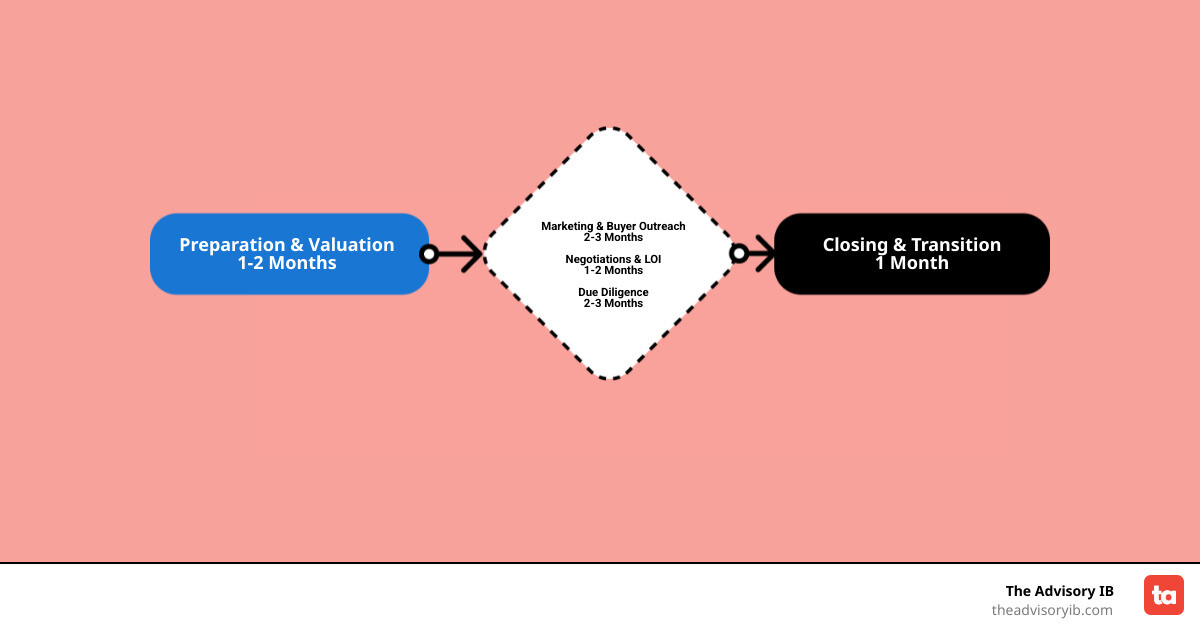
The timeline for selling a business is longer than most owners anticipate. According to the International Business Brokers Association (IBBA), the average sale takes between 7 and 12 months. This includes the time spent on valuation, marketing, vetting buyers, negotiating the Letter of Intent (LOI), and the 60-90 day due diligence period. Whether you are seeking Business Broker Services in Boston, MA or elsewhere, the market pulse remains consistent: a quality exit takes time to cook.
What is the difference between buy-side and sell-side engagements?
In a sell-side engagement, the advisor represents the owner. Their fiduciary duty is to you—the seller—to get the highest price and best terms. A buy-side engagement is when a professional is hired by an acquirer (like a private equity firm) to find and vet potential companies to buy. If you are selling, you want a sell-side advisor who is 100% focused on your goals. For instance, firms offering Business Broker Services in Charlotte, NC often specialize in one or the other to avoid conflicts of interest.
Can I sell my business without a professional?
You can, but the risks are high. FSBO (For Sale By Owner) sales have a much lower success rate. Without an intermediary, you lose confidentiality the moment you tell a potential buyer who you are. You also lose the “buffer” during negotiations; it is very hard to stay objective when a buyer is critiquing the business you built over decades. Furthermore, without a professional to manage the process, the time commitment often causes the owner to neglect the business, leading to declining sales just when you need them to be strongest. Owners who use Business Broker Services in Jacksonville, FL and other major hubs generally find that the increased sale price more than covers the advisor’s fee.
Conclusion
Deciding to sell business with broker or an M&A firm is the most important step in your exit strategy. At The Advisory Investment Bank, we specialize in helping owners of essential services businesses—those with $2M to $100M in sales—transition to their next chapter.
Based in Beverly Hills but serving major markets like New York, Chicago, Houston, Phoenix, and beyond, we combine deep industry expertise with a cutting-edge, AI-driven platform. Our technology identifies the most aggressive private equity buyers and strategic acquirers, delivering faster, stronger offers than traditional methods.
We believe so strongly in our process that we operate on a 100% success-based model. We don’t get paid unless you achieve the exit you deserve. If you are ready to explore what your business is worth in today’s market, Contact us to start your business sale. Let’s turn your years of hard work into a legacy.