
The Shifting Tides of Healthcare Dealmaking
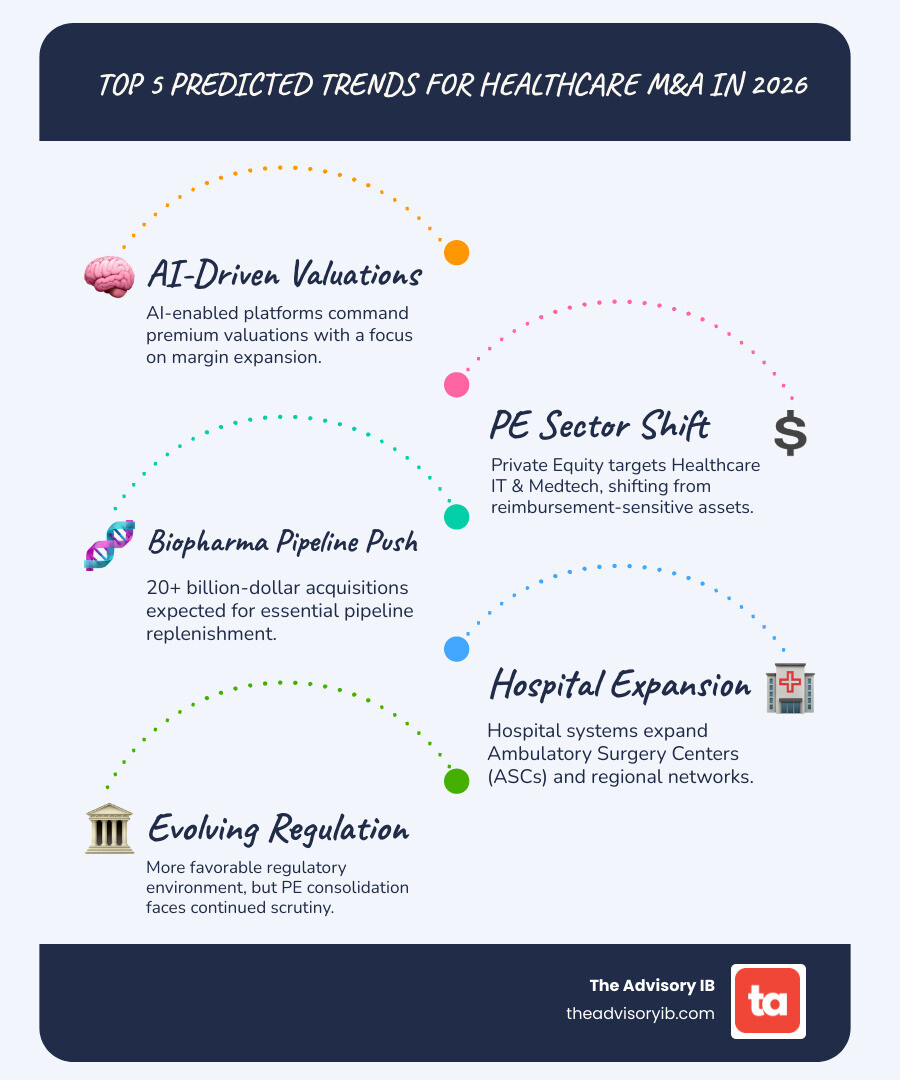
Healthcare M&A 2026 is ready for a significant rebound after a turbulent 2025. Industry experts and market analyses predict that deal volume and value will accelerate, driven by artificial intelligence adoption, regulatory clarity, and the strategic needs of hospitals, private equity, and biopharma companies facing patent cliffs.
Quick Answer: What to Expect in Healthcare M&A 2026
- Deal Volume Increase: Expect more transactions as regulatory uncertainty from 2025 clears
- AI as a Differentiator: Platforms with proven AI capabilities will command premium valuations
- Hot Sectors: Ambulatory surgery centers, behavioral health, revenue cycle management, and cardiometabolic drugs
- Private Equity Shift: Moving away from reimbursement-heavy assets toward healthcare IT and medtech
- Biopharma Activity: Over 20 acquisitions exceeding $1 billion predicted, driven by pipeline gaps
- Regulatory Environment: More favorable under pro-business administration, but scrutiny remains
Healthcare M&A experienced a notable slowdown in 2025, with deal value dropping from $62 billion in 2024 to roughly $46 billion through November. However, the fourth quarter of 2025 saw a dramatic surge—deal value jumped from $7 billion in Q3 to $22 billion in Q4—signaling renewed confidence. This momentum is expected to carry into 2026 as buyers gain clarity on FDA procedures, pricing policies, and reimbursement frameworks.
Several powerful forces are converging to reshape the landscape. Hospital systems face mounting financial pressures and are targeting ambulatory service centers and regional network expansion. Biopharma companies confront $300 billion in revenue loss through patent expirations by 2030, making strategic acquisitions essential. Meanwhile, private equity firms are sitting on substantial dry powder and pivoting toward less-regulated sectors like healthcare technology and AI-enabled platforms.
The biotech sector hit bottom in spring 2025, but the XBI index rebounded 75% by December, reaching its highest level since 2021. This recovery, combined with improving IPO conditions and mega-funds returning to the market, creates a favorable environment for dealmaking. First movers who pair policy foresight with AI-driven execution will set the pace for the sector’s deals in 2026.
Key Drivers and Headwinds for Healthcare M&A 2026
This section analyzes the primary forces expected to shape the healthcare M&A 2026 landscape, from catalysts driving a market rebound to the persistent challenges that buyers and sellers must steer.
Tailwinds Fueling the Rebound
After a period of cautious dealmaking, several powerful tailwinds are converging to propel healthcare M&A 2026 forward. We’re seeing a perfect storm of factors that encourage both strategic and financial buyers to open their wallets and pursue growth.
Firstly, financial pressures continue to mount on many healthcare providers, particularly hospitals. Thin margins and rising operational costs often make consolidation an attractive, if not necessary, path to financial stability. This inherent need for scale and efficiency often translates into a willingness to engage in M&A. This is a significant factor influencing hospital M&A, as they seek ways to optimize operations and secure their future.
This leads directly to the second tailwind: hospital consolidation. It’s an ongoing trend that shows no signs of slowing down. As smaller or financially strained hospitals look for partners, larger systems are eager to expand their footprint, gain market share, and leverage economies of scale. We expect this dynamic to drive a significant portion of the M&A activity in 2026.
Private equity dry powder is another major force at play. Private equity firms have accumulated substantial capital, often referred to as “dry powder,” that needs to be deployed. After holding many high-quality healthcare assets for longer than usual—an average of 5.5 years in 2024—these investors are now looking to monetize their portfolios and make new investments. This backlog of assets needing to come to market, coupled with fresh capital, creates a strong impetus for dealmaking. We’ve certainly seen this in the broader market, where private equity’s strategic investments are a key driver.
In the biopharmaceutical sector, biopharma patent cliffs loom large. The industry faces an estimated $300 billion in revenue loss through product exclusivity expirations by 2030. This creates an urgent need for companies to rebuild their product pipelines. M&A becomes a critical strategy for acquiring innovative therapies and technologies to offset these losses and secure future revenue streams. This pressure to maintain a robust pipeline is a direct driver of pipeline replenishment needs.
The improving IPO market also provides a significant boost. After a frozen period, particularly for health tech, the IPO window is beginning to reopen. The biotech sector’s XBI index, for example, rebounded by an impressive 75% by December 2025, reaching its highest price since 2021. This renewed investor confidence in public markets offers a clearer exit path for private equity and venture-backed companies, making M&A more attractive as a precursor or alternative to an IPO.
Finally, AI as a value driver is perhaps the most exciting tailwind. Artificial intelligence is no longer just a buzzword; it’s emerging as a genuine differentiator in healthcare. Investors are increasingly viewing AI as a core driver for margin expansion and top-line growth, rather than just a bolt-on improvement. Companies that can demonstrate proven AI capabilities will attract premium valuations, making AI integration a critical component of successful M&A strategies in healthcare M&A 2026.
Expert predictions suggest that hospital and private equity M&A are both expected to rise in 2026, further fueling this anticipated surge.
Headwinds and Regulatory Problems
While the tailwinds are strong, we would be remiss not to acknowledge the persistent headwinds and regulatory complexities that will continue to shape the healthcare M&A 2026 landscape. Navigating these challenges requires careful planning and strategic foresight.
One of the most significant factors remains increased regulatory scrutiny. Buyer discipline has undeniably sharpened due to intensified regulatory and political oversight. This scrutiny is particularly focused on areas like private equity consolidations, physician practice consolidation, and cross-market health system mergers. While the concern that states would block all deals hasn’t materialized, the threat of stricter oversight from federal bodies like the FTC and DOJ remains a powerful deterrent for some. This means that while the overall environment may be more favorable, specific types of deals will still face a tough climb.
Site-neutral payment policies also present a notable headwind. In 2025, CMS finalized some of these policies, aiming to align outpatient pay across different care settings. This can impact the financial models of certain providers, making some acquisitions less attractive if they rely on differential reimbursement rates. The ongoing debate around these policies will likely continue to influence deal valuations and strategic decisions.
Reimbursement pressures are a perennial challenge in healthcare, and 2026 will be no exception. The uncertain regulatory and reimbursement environment is consistently cited as the biggest headwind for healthcare M&A 2026. Policy shifts, including potential cuts to Medicaid and the expiration of Affordable Care Act (ACA) subsidies, could create further financial instability for providers, impacting their attractiveness as acquisition targets or their ability to acquire others.
Finally, tariff and trade policy uncertainty continues to influence deal timing and valuation, especially in sectors like MedTech. While perhaps less direct than healthcare-specific regulations, broader economic policies can still create ripples that affect cross-border integration and the overall investment climate. Companies must adopt scenario-based diligence and flexible integration strategies to mitigate potential disruptions from these uncertainties.
Understanding these headwinds is crucial for any organization contemplating M&A. It’s not just about finding a good deal; it’s about finding a good deal that can withstand the scrutiny and adapt to the evolving regulatory landscape. This is where strategic expertise becomes invaluable, helping businesses steer these complex waters and capitalize on opportunities, much like how private equity sees the enduring value in essential service businesses, as explored in Why Private Equity Loves Essential Service Businesses.
Hot Subsectors: Where the M&A Action Will Be
As the healthcare M&A 2026 market heats up, certain subsectors are ready to experience a surge in activity. Buyers, both strategic and financial, are becoming increasingly selective, targeting areas that promise growth, efficiency, and resilience against regulatory shifts. We’re seeing a clear preference for innovation-driven segments and those that offer scalable solutions to systemic healthcare challenges.
Health Services: A Focus on Tech and Efficiency
The health services sector is undergoing a significant change, driven by technological advancements and the urgent need for greater efficiency. This makes it a prime target for M&A activity in 2026.
One of the hottest areas is AI-based telehealth platforms. The pandemic accelerated the adoption of telehealth, and now AI is taking it to the next level. These platforms offer attractive opportunities for buyers looking to expand access to care, improve patient engagement, and streamline operations. They represent a scalable model that can address labor shortages and improve care delivery.
Similarly, Revenue Cycle Management (RCM) tools are highly attractive. As financial pressures on providers intensify, efficient RCM solutions are critical for optimizing cash flow and reducing administrative burdens. AI-powered RCM can significantly improve billing accuracy, claims processing, and collections, making these companies valuable assets.
Workforce optimization tools are also gaining traction. With ongoing labor shortages and burnout across the healthcare system, solutions that help manage, deploy, and retain staff more effectively are in high demand. These tools can offer substantial operational efficiencies and improve the quality of care.
Beyond software, we’re seeing continued interest in specific care delivery models. Ambulatory Surgery Centers (ASCs) are a key focus for hospital systems. They offer a lower-cost setting for many procedures compared to inpatient hospitals, aligning with value-based care trends and patient preferences. Hospitals are actively looking to grow their ASC offerings and scale regional networks.
Regional network scaling by hospitals is a strategy to create more integrated, efficient care delivery systems, enhancing patient access and improving population health management. This often involves acquiring smaller practices or facilities to build out a comprehensive local presence.
Behavioral health is another high-growth subsector. The increasing awareness and demand for mental health services, coupled with significant unmet needs, make behavioral health platforms attractive targets. These businesses often benefit from strong patient demand and innovative care models.
Lastly, home-infusion services are experiencing robust growth. As healthcare shifts towards more home-based care, companies providing complex therapies in the comfort of a patient’s home are highly valued. This trend supports both patient convenience and cost-effectiveness.
We believe that companies operating in these areas, especially those leveraging technology, will see aggressive capital flows. For more insights into the diverse opportunities within healthcare, explore More info about our Industries.
Biopharma: The Race for Innovation and Growth
The biopharmaceutical industry is gearing up for a major M&A surge in 2026, driven by the critical need for innovation and pipeline replenishment. After a period of volatility, the market has gained clarity, and companies are making “very specific thematic bets” to fill gaps and secure future growth.
We’re observing intense activity in several hot therapeutic areas:
- Neurology: This area saw significant transactions in 2025, with major players making substantial purchases to acquire late-stage neurology assets. The complexity of brain disorders and the high unmet medical need continue to make it a compelling investment.
- Cardiometabolic (GLP-1s): The “GLP-1 gold rush” has shifted significant attention and capital into cardiometabolic assets, particularly those targeting obesity and related conditions. The fierce competition for promising companies in this space, involving bids from industry giants, underscores the immense value placed on these assets. For example, a multi-billion dollar acquisition of a company with a promising candidate for Metabolic Dysfunction-Associated Steatohepatitis (MASH) is a prime example of this trend. Such deals highlight the strategic importance of MASH candidates in the cardiometabolic space.
- Oncology (ADCs, bispecifics): Oncology remains a cornerstone of biopharma M&A. Specifically, Antibody-Drug Conjugates (ADCs) and bispecifics (and even tri-specifics and tetra-specifics) are top targets due to their precision and efficacy in cancer treatment. Notably, certain global innovation hubs have emerged as significant sources for new developments in this space, with many licensing deals for oncology candidates originating from them.
The overarching driver for this biopharma M&A frenzy is pipeline rebuilding strategies. With the looming patent cliffs threatening billions in revenue, companies are under immense pressure to acquire new drugs and technologies to ensure their long-term viability. This isn’t just about growth; it’s about survival and maintaining a competitive edge. Experts predict over 20 acquisitions exceeding $1 billion in 2026, a clear indicator of the scale of anticipated dealmaking.
Medtech: Precision, AI, and Portfolio Discipline
Medtech dealmaking is entering 2026 with strengthening momentum, characterized by a highly strategic and disciplined approach to capital allocation. We are seeing buyers focus on specific capabilities and innovation, rather than broad-stroke acquisitions.
The emphasis is on targeted acquisitions that build specific capabilities, even though larger, changeal deals might still emerge if strategic and financial alignment is perfect. Key areas attracting significant investment include:
- Diagnostics: Innovations in diagnostics are crucial for personalized medicine and early disease detection.
- Surgical robotics: This high-growth segment offers precision, improved patient outcomes, and efficiency in operating rooms.
- Cardiovascular devices: Continuous innovation in devices for heart health remains a critical focus.
Buyers are prioritizing growth opportunities driven by digital innovation, AI adoption, and differentiated technology platforms. This aligns with the broader trend of technology-enabled healthcare solutions.
Investor activism is also playing a significant role, reinforcing portfolio discipline. Activists pressure management teams to accelerate portfolio divestitures and redirect capital towards higher-growth, innovation-led segments. This leads to a more streamlined and focused Medtech landscape.
However, tariff and trade policy uncertainty remains a central factor. This can influence deal timing, valuation, and cross-border integration. Medtech companies are adopting scenario-based diligence and flexible integration strategies to mitigate these risks.
Despite these challenges, the Medtech sector’s fundamentals remain strong, supported by consistent procedure demand and sustained investor interest in healthcare innovation. The outlook for Medtech dealmaking remains positive, with a focus on strategic growth and innovation.
The Evolving Role of AI and Private Equity in Healthcare M&A
Two of the most significant forces redefining dealmaking in healthcare M&A 2026 are the integration of artificial intelligence and the strategic maneuvers of private equity firms. They are not just participants; they are shaping the very fabric of how deals are conceived, executed, and valued.
How AI is Reshaping Healthcare M&A in 2026
Artificial intelligence is rapidly moving from a futuristic concept to a fundamental driver in healthcare M&A. We are witnessing a profound shift in how AI is perceived and valued within the industry.
AI is no longer just a “nice-to-have” add-on; it’s seen as a core growth driver. Investors are increasingly treating AI as a fundamental component that can open up substantial value. This means that companies with robust AI capabilities embedded in their operations will command premium valuations.
The impact of AI is multifaceted: it drives margin expansion by automating tasks, improving efficiency, and reducing operational costs. We’re talking about AI streamlining everything from administrative processes to supply chain management. Simultaneously, it fuels top-line growth by enabling new services, enhancing patient engagement, and improving clinical outcomes. Think AI-powered diagnostics or personalized treatment plans.
AI’s influence extends even to the deal process itself. It’s reshaping how acquirers approach AI in due diligence, allowing for more sophisticated analysis of target companies’ operations, market potential, and risks. This means that platforms with proven operations leveraging real data will be highly sought after.
Valuing AI-enabled platforms will become a more sophisticated exercise. Acquirers will look beyond traditional metrics, focusing on the measurable impact of AI on productivity gains and sustainable value creation. First movers who combine policy foresight with AI-driven execution are expected to set the pace for the sector’s deals in 2026. This dynamic is a key takeaway from recent industry analyses.
Private Equity Strategies for Healthcare M&A in 2026
Private equity (PE) firms continue to be a dominant force in healthcare M&A, but their strategies are evolving. We’re seeing a more nuanced approach, driven by regulatory scrutiny and a desire for more predictable returns.
A key trend is the shift to less regulated sectors. PE firms are moving away from investments highly susceptible to reimbursement or regulatory pressure. This means less emphasis on areas with direct exposure to government pay rates and more focus on segments that offer greater control over revenue streams.
This pivot is directing significant capital towards healthcare IT and MedTech. These sectors offer solutions that improve efficiency, data management, and device innovation, often with more stable revenue models and less direct exposure to reimbursement changes. We expect to see robust PE investment in areas like revenue cycle software, pharmaceutical management technology, and digital health platforms.
PE strategies will also heavily feature bolt-on acquisitions and carve-outs. Bolt-ons involve acquiring smaller companies to integrate into existing portfolio platforms, enhancing capabilities and expanding market reach. Carve-outs, on the other hand, involve purchasing non-core assets from larger health systems or corporations. This allows PE firms to acquire specialized businesses that might be undervalued within a larger entity and then optimize them for growth.
Furthermore, the return of mega-funds to the market is intensifying competition for high-quality assets. These large funds, with their substantial capital, can accelerate deal timelines and challenge traditional mid-market investors. This dynamic means that sellers of attractive businesses will likely see strong interest and competitive offers.
When we consider what makes an attractive target for private equity, several characteristics stand out. Generally, PE firms are drawn to businesses with:
- Recurring Revenue: Predictable income streams are always a plus.
- Non-Cyclical Demand: Essential services, like those in healthcare, tend to be recession-resistant.
- Fragmented Market: Opportunities for consolidation and market leadership.
- Scalability: The potential to grow the business significantly, often through bolt-on acquisitions or operational improvements.
For more on how private equity evaluates potential acquisitions, you might find our insights on Who Buys My Business? Private Equity particularly useful.
Strategic Imperatives: How to Succeed in the 2026 M&A Landscape
To capitalize on the opportunities in healthcare M&A 2026, healthcare organizations must adopt forward-thinking strategies that go beyond traditional M&A playbooks. The market is too dynamic for a “wait and see” approach; proactive and disciplined execution will be key.
The Rise of ‘Transact-to-Build’ and Strategic Partnerships
A significant shift we’re observing is the emphasis on ‘transact-to-build’ M&A. This isn’t just about buying market share; it’s about strategically acquiring and scaling assets with differentiated capabilities to launch, build, and grow new businesses. It’s a proactive approach to building new capabilities that align with evolving patient needs and market demands.
This strategy often involves vertical integration, where companies acquire businesses along their value chain to gain greater control, improve efficiency, and capture more value. For instance, a health system might acquire a home health agency to extend its care continuum.
Joint ventures and asset realignments are also becoming increasingly popular. In a highly scrutinized regulatory environment, partnerships allow organizations to achieve growth objectives without the full regulatory burden of an outright acquisition. Targeted asset realignments, where non-core assets are divested and strategic ones are acquired, help organizations optimize portfolios and focus on their strengths. This disciplined approach to M&A is crucial for navigating tighter policy and reimbursement constraints.
Understanding how to leverage M&A to build and scale new businesses is paramount. It’s about reshaping core business models and earnings profiles to thrive in the next era of healthcare.
Maximizing Success: An M&A Blueprint for 2026
For organizations looking to maximize their M&A success in 2026, we recommend a structured approach—an M&A blueprint, if you will. This blueprint moves beyond opportunistic dealmaking to a more strategic, intentional process.
First, proactive deal sourcing is essential. Instead of merely reacting to opportunities that come across our desk, we must actively seek out targets that align with our strategic goals. This involves a comprehensive market view, a consistent evaluation framework, and custom outreach.
Second, defining the end-state operating model early in the diligence phase is critical. This means having a clear vision of how the acquired business will integrate and operate within our existing structure. This clarity guides integration, building, and scaling decisions, minimizing post-acquisition surprises and accelerating value capture.
Third, we must plan to invest beyond the purchase price. True value creation often requires additional capital for integration, technology upgrades, and talent development. Underestimating these post-acquisition investments can jeopardize the deal’s success. It’s not just about the initial outlay; it’s about nurturing the asset to open up its full potential.
Fourth, tailoring performance metrics to the deal thesis is vital. For high-growth assets or those acquired for strategic capabilities, traditional short-term return on invested capital (ROIC) or return on equity (ROE) might not capture the full picture. We need metrics that align with the strategic intent of the acquisition.
Finally, and perhaps most importantly, dedicate meaningful time to cultural integration. Mergers and acquisitions often fail not due to financial miscalculations, but due to cultural clashes. Understanding the cultural nuances of the target company and planning for effective integration—or even careful separation if warranted—is paramount. Talent and culture are leadership’s responsibility, and they require as much rigor as financial due diligence.
For a deeper understanding of how businesses are valued, which is foundational to any M&A blueprint, we encourage you to read How Is My Business Valued?.
Conclusion: Navigating the Next Era of Healthcare Change
The healthcare M&A 2026 market is set for a dynamic rebound, driven by technological innovation, strategic necessity, and a clearer regulatory picture. While challenges remain, organizations that are proactive, disciplined, and strategically agile will be best positioned to thrive. For owners of essential service businesses within the broader healthcare ecosystem, understanding these trends is crucial for maximizing value. The Advisory IB uses its proprietary AI-driven platform to connect high-quality businesses with the right private equity partners, navigating the complexities of the modern M&A landscape. Learn more about our process and how we can help you achieve your goals.