
Why Growing Your Business the Right Way Matters More Than Growing Fast
Grow your business the right way, and you’ll build something valuable, sustainable, and eventually sellable at a premium-rush it without strategy, and you risk burning out while leaving millions on the table.
Quick Answer: The 4 Core Ways to Grow Your Business
- Market Penetration – Sell more to existing customers and reduce churn by delivering consistently on your promises
- Market Development – Expand into new geographic areas or customer segments with your current offerings
- Product Development – Innovate new services or products for your existing customer base
- Diversification – Launch new products or services in entirely new markets (highest risk, highest reward)
Most essential service business owners I meet are stuck in the day-to-day grind of operations. They know their business could be worth more. They sense there’s a better way to scale. But between managing crews, handling customer complaints, and keeping cash flow positive, strategic growth planning falls to the bottom of the list.
Here’s what the research shows: sustainable growth isn’t just about increasing revenue-it’s about maintaining or improving profitability while you scale. Industry growth benchmarks emphasize this balance, and it’s exactly what private equity buyers look for when they’re writing eight-figure checks.
Whether you’re running an HVAC company doing $5 million annually or a multi-location plumbing operation approaching $50 million, the fundamentals of strategic growth remain the same. You need a framework that lets you expand without sacrificing the quality and customer relationships that built your business in the first place.
The challenge? Most business owners try to grow in all directions at once. They chase new markets while launching new services, hiring aggressively, and wondering why profitability tanks. According to the Ansoff Matrix-a strategic planning tool developed in 1957 that’s still relevant today-each growth strategy carries different levels of risk and requires different capabilities.
I’m Oliver Bogner, and I’ve built and sold five companies across multiple industries before founding The Advisory Investment Bank, where I now help essential service business owners grow your business strategically and position it for a life-changing exit. After scaling my own ventures to over $150 million in combined revenue and navigating the M&A process from both sides of the table, I learned that the businesses that sell for the highest multiples aren’t always the biggest-they’re the ones that grew intelligently, with systems, profitability, and strategic positioning baked into every expansion decision.
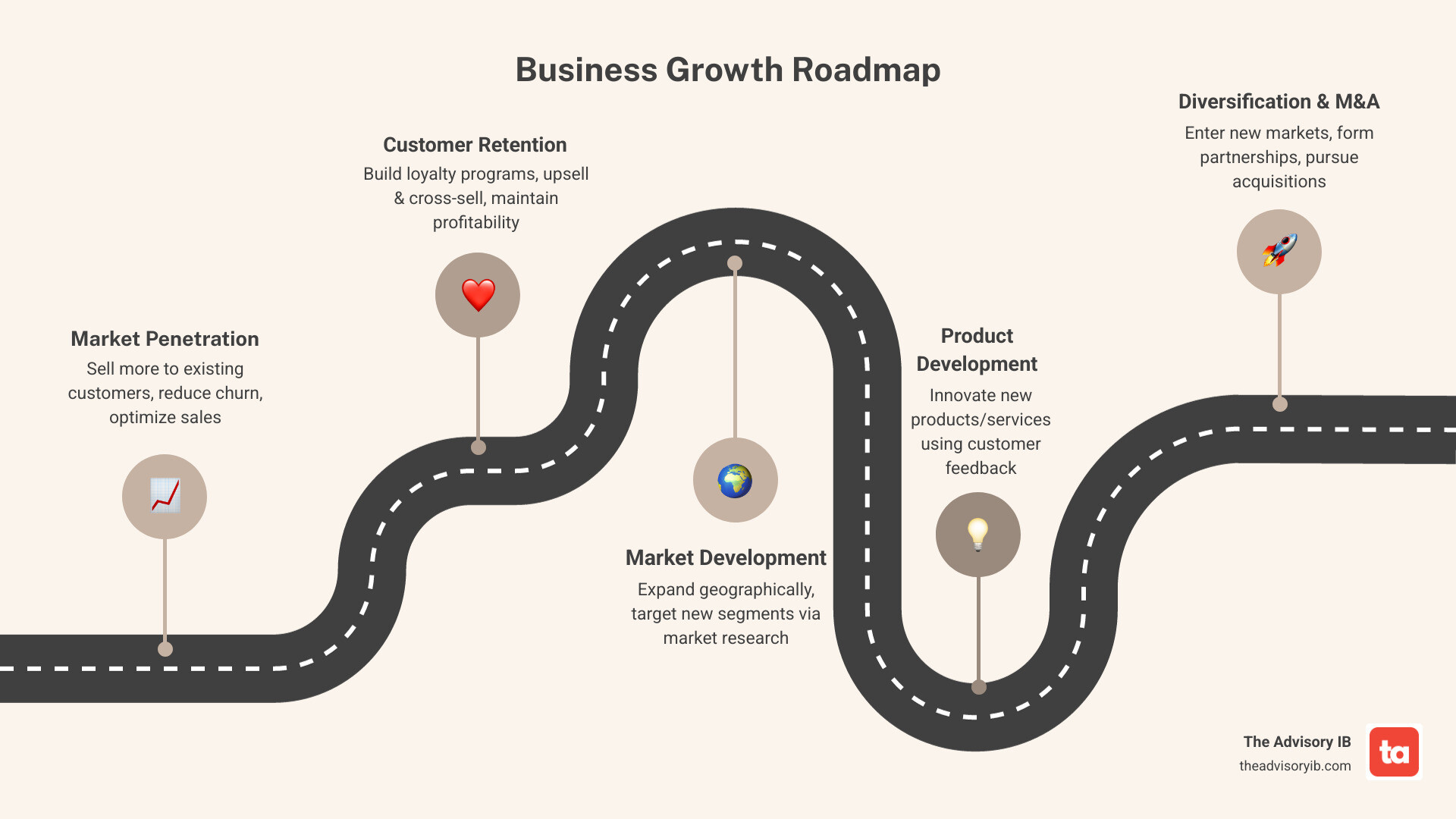
Core Strategies to Grow Your Business
To grow your business effectively, we have to look at the four quadrants of growth. These are rooted in the Ansoff Matrix, an influential framework that helps us categorize growth by risk and opportunity.
1. Market Penetration (The “Low Hanging Fruit”)
This is the safest path. You are selling your existing services to your existing market. The goal here is to increase business value by gaining more market share. It’s about becoming the dominant player in your current zip codes.
2. Market Development (The “New Horizon”)
Here, you take your proven services into new geographic markets or customer segments. If you’ve mastered residential HVAC in Houston, moving into commercial maintenance or expanding into Austin represents market development.
3. Product Development (The “Innovation Play”)
This involves creating new services for your loyal customers. For a plumbing business, this might mean adding water filtration systems or smart home leak detection. By adding these, you increase business value because you’re increasing the “wallet share” of every customer you already paid to acquire.
4. Diversification (The “Big Swing”)
The most aggressive strategy is offering entirely new products to entirely new markets. While it offers the highest potential for massive expansion, it also carries the most risk because you are operating outside your “circle of competence.”
Maximizing Sales to Existing and New Customers
Growth starts with “plugging the holes in your customer bucket.” Many owners focus so much on new lead generation that they ignore the goldmine sitting in their CRM.
- Reducing Churn: Fulfillment is your best marketing. If you promise a 4-hour window for a repair, hit it. Consistency builds trust, and trust builds advocacy.
- Loyalty Programs: Reward your repeat customers. In the essential services world, “membership clubs” for annual maintenance are the ultimate growth tool. They provide recurring revenue—something buyers value immensely.
- Sales Optimization: Train your technicians to look for opportunities to help the customer, not just “sell.” Upselling a more efficient system or cross-selling a service agreement during a routine call can significantly move the needle on your bottom line.
Innovative Ways to Grow Your Business with New Products
Innovation doesn’t always mean inventing a new machine; it often means improving the delivery of your service. When you grow essential service business value beyond revenue profit, you focus on how your services meet evolving customer needs.
- Product Modification: Can you offer different “quality levels”? Perhaps a “Good, Better, Best” tiering for equipment installations? This allows you to capture different segments of the market.
- Idea Generation and Prototyping: Listen to your customers. If they keep asking about air purification, that’s your signal. Test the service with a small group of loyal clients, get feedback, and refine it before a full rollout.
- Customer Knowledge: Your data is your most valuable asset. Use it to understand what your customers actually need next.
Expanding Reach and Scaling Operations
Once you’ve maximized your current footprint, it’s time to look at geographic expansion. Whether you’re moving from Dallas to Fort Worth or expanding from Phoenix into the surrounding rural areas, expansion requires a new set of tools.
Geographic Expansion and Market Research
Don’t guess where to go next. Use data. Sources like Statistics Canada (for our northern neighbors) or local chambers of commerce in cities like Chicago or Philadelphia can provide demographic data. If you are looking to export services or expand abroad, Export Development Canada and the Trade Commissioner Service offer excellent resources for international scaling.
The real test of a new market is “boots on the ground.” Send a small team to a new city, show your services, and see if customers are willing to sign a purchase order on the spot.
Leveraging Specialized Resources to Grow Your Business
There is a wealth of support available specifically for different types of owners. The SBA Grow your business guide is a fantastic starting point for US-based companies.
- Women and Minority-Owned Businesses: There are specific federal contracting opportunities and grants designed to level the playing field.
- Veteran-Owned Resources: Veterans can use Google Search to find specific veteran job resources or use a Google Business Profile to highlight their veteran-led status, which many customers actively look for.
- Rural Business Support: Small businesses in rural areas are the backbone of their communities and often have access to unique SBA training and counseling.
Managing Operational Challenges and Talent
Scaling is often a “people problem.” As you grow your business, your role must shift from “Chief Everything Officer” to a true leader.
| Strategy | Organic Growth | Acquisition |
|---|---|---|
| Speed | Slower, steadier | Immediate scale |
| Culture | Easier to maintain | Hardest part of the deal |
| Cost | Spread over time | Significant upfront capital |
| Risk | Lower financial risk | High risk of integration failure |
To manage this, focus on implementing structured management systems and operational workflows. Utilizing professional development resources and management tools, such as those offered by Grow with Google, can help your office staff and leadership team streamline operations. This approach allows you to maintain service quality and operational efficiency as you scale, ensuring the business remains a high-value asset without relying solely on the owner’s daily involvement.
Financial, Legal, and Regulatory Scaling
You cannot grow your business without a firm grasp of the numbers. Growth consumes cash. You need to manage your cash flow carefully to ensure that a spike in sales doesn’t lead to a “growth trap” where you run out of money to pay your technicians.
Funding Options for Expansion
When you’re ready to increase valuation of an essential service business, you might need external capital. This could come from:
- New Investors: Bringing in private equity or silent partners.
- SBA Loans: Utilizing SBA Data Sources to find the right loan programs for existing businesses.
- Internal Cash Flow: Reinvesting profits (the “bootstrapping” method).
Navigating Legal Structures and Tax Obligations
As you grow, your legal needs will change.
- Tax Registration: You must monitor your state-specific sales tax nexus and federal tax obligations as your turnover increases. It is important to consult with a tax professional to ensure you meet all mandatory registration points.
- Legal Structure: Is a sole proprietorship still right, or should you move to an S-Corp or LLC? Consult the SBA.gov Growing your business resources or your local state department for guidance on how your structure affects your liability and taxes.
Protecting Intellectual Property During Expansion
Your “secret sauce”—whether it’s a proprietary software for scheduling or a unique brand name—needs protection.
- Trademarks and Patents: These must be registered to claim ownership.
- Copyright: This is often automatic for written materials and software code, but registration provides extra protection.
- Design Rights: Protect the unique look of your products or even your branded service trucks.
Strategic Partnerships and M&A
Sometimes, the fastest way to grow your business isn’t to build it, but to buy it or partner with someone who has already built what you need.
The Power of Strategic Alliances
A strategic partnership can open up new markets and boost brand visibility. Before entering one, ensure you share similar goals and values. Clear communication about roles and success metrics is the only way to avoid a messy “business divorce” later.
Strategic partnerships allow you to maximize value by leveraging someone else’s strengths to shore up your weaknesses. If you’re looking for a partner or a buyer, we often help firms find buyers who can provide the resources needed for the next level of growth.
Growth Through Mergers and Acquisitions
In private equity, “buy and build” is a common strategy. Large firms make a “platform investment” in a strong company and then pursue “add-on acquisitions” to expand.
When you look at how essential service businesses maximize valuation, you’ll see that buyers pay top dollar for companies that have successfully integrated acquisitions.
- Corporate Carveouts: Buying a specific division of a larger company.
- Cultural Integration: This is the hardest part. You must introduce the new culture slowly to avoid losing the “tribal knowledge” of the acquired team.
Frequently Asked Questions about Business Growth
When must I register for sales tax?
In the US, requirements vary by state based on economic nexus. Generally, you are required to register for sales tax once your revenue or transaction volume exceeds a specific state threshold. It is important to monitor your turnover monthly to ensure you don’t miss these mandatory registration points.
How do I protect my ideas when developing new products?
You should register trademarks for your brand names, patents for new inventions, and design rights for the look of your products. While copyright and circuit layout rights are often automatic, formal registration provides the legal teeth needed to defend your ownership in court.
What are the risks of strategic partnerships?
The primary risks include limits on your decision-making power, unequal contributions where one partner does all the heavy lifting, and potential exposure of your intellectual property. Clear, written contracts and shared values are the best defense against these risks.
Conclusion
At The Advisory Investment Bank, we believe that every essential service business owner deserves to see their hard work reflected in a premium valuation. Whether you are in New York, Houston, or Seattle, the path to grow your business is paved with strategic decisions, not just hard work.
We specialize in helping businesses with $2M to $100M in sales steer the complex world of M&A. Our AI-driven platform is designed to deliver faster, stronger offers by connecting you with the right private equity buyers who understand the value of what you’ve built. We operate on a 100% success-based model—we don’t win unless you do.
If you’re ready to stop grinding and start scaling, it’s time to Grow Your Business with a partner who knows how to steer the ride. From our offices in Beverly Hills to our teams across the US, we are here to help you turn your business into a high-value asset.