
Why Post-Exit Planning Matters More Than the Exit Itself
Post-exit planning is the process of preparing for life after selling your business—addressing financial management, personal identity, legacy protection, and lifestyle design before, during, and after your exit. Here’s what successful post-exit planning includes:
- Financial reconciliation: Closing books, settling debts, structuring proceeds, and creating sustainable spending plans (typically 1-4% of investable assets annually)
- Wealth management: Diversifying investments, mitigating inheritance tax, and protecting realized value through estate planning
- Personal priorities: Establishing goals for travel, family time, philanthropy, new ventures, or mentorship
- Psychological transition: Addressing identity loss, finding new purpose, and managing the emotional shift from business owner to retiree
- Legacy protection: Ensuring business continuity, preserving brand reputation, and planning family wealth transfer
Most entrepreneurs spend years planning their business exit but almost no time planning for what comes after. Research shows that 70% of business owners don’t plan for post-exit life before selling, and 89% of newly wealthy individuals need guidance on managing their newfound wealth responsibly. The result? Despite achieving financial success, many post-exit entrepreneurs report feeling adrift, with 59% still searching for purpose years after their sale. The happiest outcomes happen when owners start planning 1,000 days before their exit—not three months after the wire hits their account.
I’m Oliver Bogner, and I’ve lived both sides of this transition—I’ve built and sold five companies across multiple industries before founding The Advisory Investment Bank to help essential service business owners steer their exits. Through hundreds of conversations with post-exit entrepreneurs and my own experience, I’ve learned that post-exit planning isn’t an afterthought—it’s the difference between a successful exit and a fulfilling one.
The Fundamentals of Post-Exit Planning
When we think about a business exit, we often focus on the “number”—the final sale price. But once the champagne is finished and the wire has cleared, you are left with a new reality: a sudden abundance of capital and a sudden lack of schedule. Successful post-exit planning requires us to treat our personal lives with the same strategic rigor we applied to our businesses.
This isn’t just about money; it’s about lifestyle design. For years, your business likely dictated your time, your social circle, and your sense of worth. Without a structured roadmap, the transition from “business-centric” to “lifestyle-centric” living can lead to a “paradox of success” where you are financially wealthy but emotionally bankrupt. We encourage our clients in cities like Austin, TX, and Jacksonville, FL, to view their post-exit life as their “Next Act,” requiring a clear vision for how they will allocate their most precious asset: time.
When to Start Your Post-Exit Planning Journey
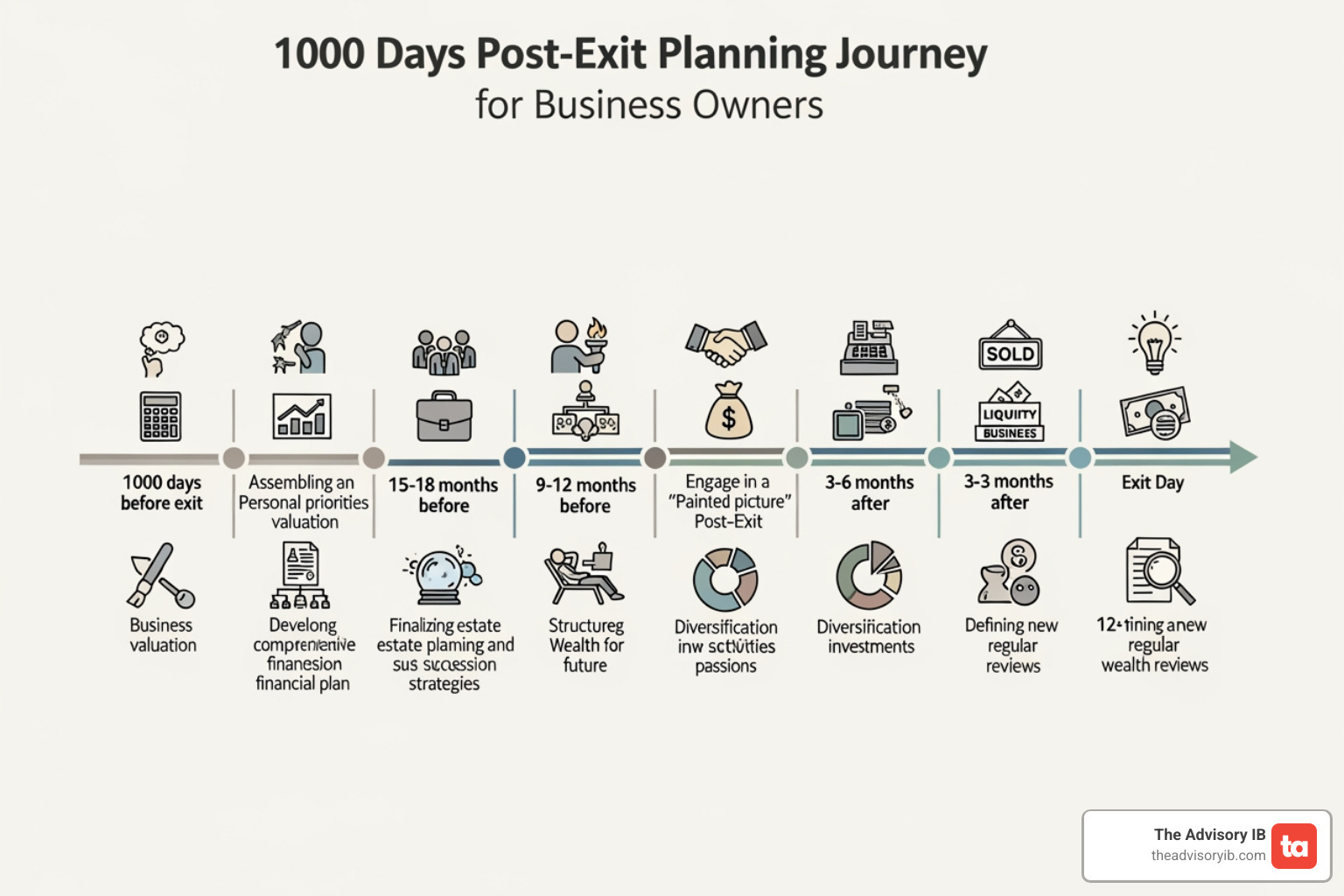
The ideal time to start post-exit planning is at least 1,000 days before you intend to sell. This proactive window allows you to align your business operations with your personal goals. If you know you want to remain involved as a consultant, we can structure the deal that way. If you want a “clean break” to travel the world, we need to build a management team that makes you redundant.
Starting early also helps you avoid being blindsided by a “UFO”—an Unexpected Flattering Offer. As my friend and banker James Marciano points out, smaller acquisitions often happen when you least expect them. If you haven’t done the internal work to know what you want next, you might say “yes” to a check but “no” to your future happiness. We recommend obtaining a business valuation 3-5 years before an exit to understand the “gap” between what your business is worth today and what you need to fund your dream life.
Establishing Personal Priorities and Goals
How do you find your “why” when you no longer have a “how”? We suggest two practical exercises to gain clarity:
- The Painted Picture Exercise: Set aside two hours with a notebook. Describe a typical day in your life three years after the exit. Who are you with? What does your morning look like? What are you working on? This “vivid vision” helps you negotiate deal terms—like avoiding long earn-outs if your painted picture involves living on a boat in the Caribbean.
- The 30-Second Practice: Every morning for 30 days, complete the sentence: “Work worth doing today is __________.” Over time, patterns emerge. You might realize you miss mentoring but don’t miss managing payroll. These insights guide your next steps, whether that’s angel investing, philanthropy, or starting a new venture.
Financial Reconciliation and Wealth Management
Once the transaction closes, your financial profile shifts overnight from high-income/low-liquidity to zero-income/high-liquidity. This is where Entrepreneur Exit Services become vital. You are no longer living off a paycheck; you are living off your principal.
We recommend creating a conservative cash flow model. While it’s tempting to buy the “exit Ferrari” or a third home in Scottsdale, AZ, capital preservation is the name of the game. Most successful post-exit entrepreneurs adopt a sustainable spending rate of 1-4% of their investable assets. This ensures your wealth outlasts your lifespan and accounts for inflation.
DIY vs. Professional Wealth Management
One of the biggest decisions you’ll face is whether to manage your new wealth yourself or hire a team.
| Feature | DIY Management | Professional Advisory Team |
|---|---|---|
| Cost | Lower (mostly transaction fees) | Higher (typically % of AUM) |
| Complexity | Simple (Index funds/ETFs) | High (Private Equity, Tax Structuring) |
| Time Commitment | High (if doing it right) | Low (oversight only) |
| Emotional Bias | High (hard to sell in a crash) | Low (objective discipline) |
| Access | Standard markets | Exclusive deals/Institutional research |
Research from the Post-Exit Navigator suggests that while many entrepreneurs initially pursue complex, high-risk deals, they often find more peace of mind in simple, diversified portfolios.
Tax Mitigation and Estate Protection
In the US, tax planning is a cornerstone of post-exit planning. You need to structure your proceeds to minimize the “tax drag” on your new wealth. This includes utilizing trusts, gifting strategies, and understanding the implications of different exit options.
For our clients with international interests or those keeping an eye on global trends, it’s worth noting that 89% of those new to wealth feel they need more guidance on the responsibility of having it. Whether you are in San Diego, CA, or Charlotte, NC, the goal is to not leave your family a mess. This means setting up your estate plan before the liquidity event. For example, gifting shares to a trust before a sale can significantly reduce your future estate tax bill.
Closing the Books: Post-Exit Operations
The “exit” isn’t a single moment; it’s a process that continues weeks after the closing. You must perform a thorough financial reconciliation:
- Settling Receivables: Ensure all outstanding invoices are collected.
- Debt Reconciliation: Pay off any business lines of credit or equipment leases.
- Final Payroll: Handle severance or stay-bonuses for your loyal team.
- Data Sanitization: Ensure personal data is removed from company servers before the new owners take over.
Protecting Your Legacy and Business Continuity
Your legacy isn’t just the money you leave behind; it’s the health of the company you built. Ensuring continuity for your employees and customers is a key part of exit planning excellence. If the business fails six months after you leave, it tarnishes your reputation and may even trigger “clawback” provisions in your sales contract.
Navigating the Psychological Challenges of Post-Exit Planning
The “Identity Crisis” is real. For decades, you were “The Boss.” Now, you’re just a person with a large bank account. Many founders experience a sense of loss similar to grief. To overcome this, we recommend the PROT Framework:
- Pause: Don’t commit to new big projects for 3-6 months.
- Reflect: Use the “painted picture” to see what truly brings you joy.
- Operationalize: Build a “portfolio of life”—a mix of leisure, family, and perhaps a board seat.
- Think: Focus on your new purpose. Are you a mentor? A philanthropist? A student?
Increasing Business Value Before the Final Handover
To ensure you have enough for your post-exit life, you must maximize your value now. We focus on the “8 Key Drivers of Value,” including:
- The Switzerland Structure: Ensuring your business isn’t overly dependent on one customer, one vendor, or you.
- Recurring Revenue: Buyers love predictability.
- Management Depth: If the business can’t run without you, it’s not an asset; it’s a job.
Frequently Asked Questions about Post-Exit Planning
What is the “Wealth Gap” and how does it affect my exit?
The wealth gap is the difference between what you currently have in non-business assets and what you need to fund your post-exit lifestyle. If your “dream life” costs $200k a year, and you only have $1M in savings, your business sale needs to bridge that gap. We also look at the Profit Gap (how your margins compare to peers) and the Value Gap (the difference between your current valuation and its potential).
How do I handle the emotional “identity crisis” after selling?
Start by acknowledging that your business is what you did, not who you are. Engaging in mentorship or joining a peer group of other post-exit entrepreneurs in cities like Seattle, WA, or Nashville, TN, can provide a new community. Use the “PROT” framework to decompress before jumping into a new venture.
What are the immediate financial steps after the liquidity event?
- Park the Cash: Put the proceeds in a secure, liquid account (like a bond ladder or high-yield sweep account) for at least six months.
- Assemble Your Team: If you haven’t already, hire a tax strategist, an estate attorney, and a wealth manager.
- Settle Liabilities: Clear any personal debts that might create “mental drag.”
- Don’t Make Big Purchases: Avoid buying the jet or the yacht until the “liquidity euphoria” has faded.
Conclusion
Exiting your business is one of the most significant milestones of your life, but it is just that—a milestone, not the finish line. Successful post-exit planning ensures that your “Next Act” is as rewarding and impactful as the company you built. By establishing your priorities early, managing your wealth with discipline, and protecting your legacy, you can transition from a successful entrepreneur to a fulfilled individual.
At The Advisory IB, we don’t just help you sell; we help you prepare for everything that comes next. Whether you are in Philadelphia, PA, or San Antonio, TX, our AI-driven platform and expert team are here to ensure your exit is just the beginning of your greatest adventure.
Are you ready to start your post-exit planning? Let’s build your roadmap together.