
What It Really Takes to Get a Business Ready to Sell
Getting a business ready to sell is one of the most consequential things a founder will ever do — and most owners start too late, underprepared, and without the right team around them.
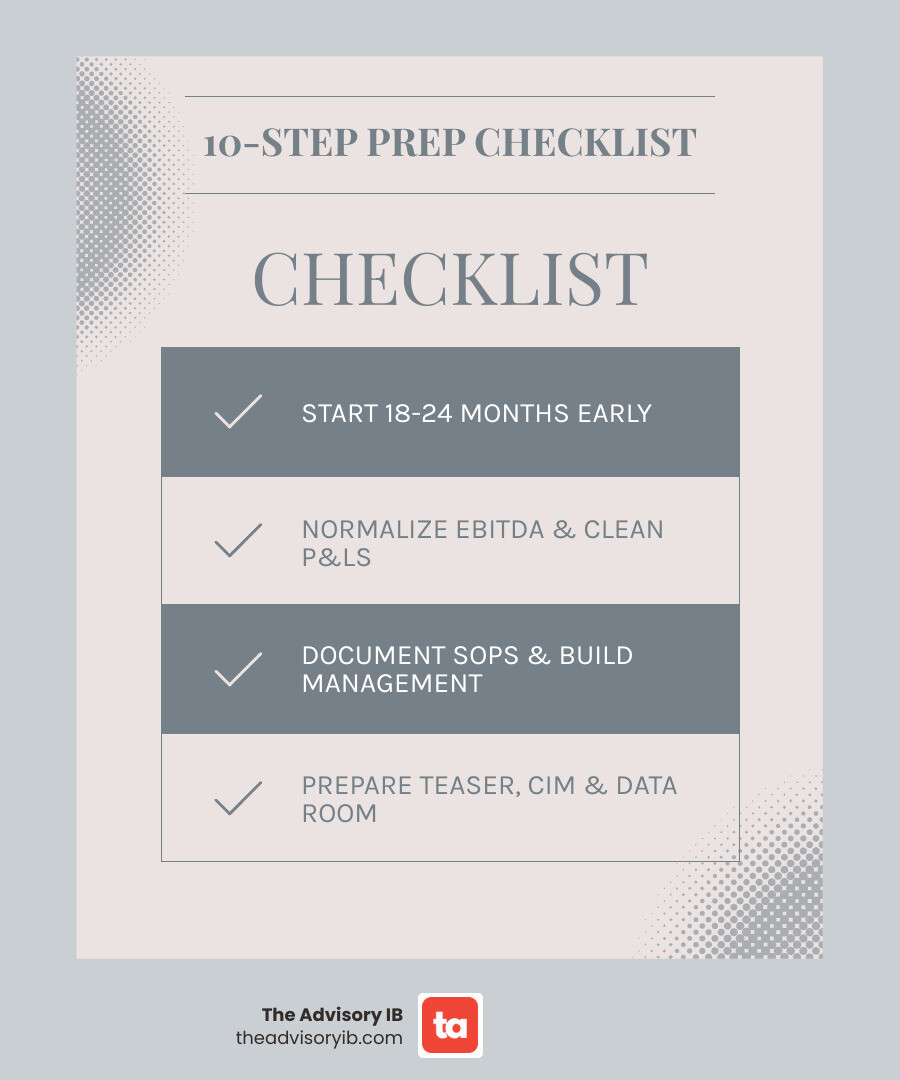
Here is a quick overview of the core steps:
- Start early — Begin preparation 18-24 months before your target sale date
- Clean up your financials — Normalize EBITDA, document add-backs, and have 3 years of clean P&L ready
- Reduce owner dependence — Document SOPs and build a management team that runs without you
- Get a formal valuation — Use DCF, trading comparables, or transaction comparables to set a defensible price
- Conduct sell-side due diligence — Find and fix problems before buyers do
- Prepare your marketing materials — Build a teaser, NDA package, and Confidential Information Memorandum (CIM)
- Screen buyers carefully — Qualify for intent, capital, and strategic fit before sharing sensitive information
- Negotiate a strong LOI — Lock in price, structure, exclusivity, and timeline before entering full diligence
- Run diligence like a checklist — Organize documents into workstreams so nothing stalls the deal
- Plan your handover — A 30-90 day transition plan protects your legacy and closes the deal cleanly
The reality is that selling a business takes an average of 10 to 12 months from start to close — and that clock does not start until you are already prepared. Owners who skip the groundwork often find themselves accepting lower offers, losing deals in diligence, or walking away from the table entirely. In fact, 68% of business owners who received offers but did not complete a sale said simply that it was not the right time — a problem that early preparation directly solves.
I’m Oliver Bogner, Managing Partner of The Advisory Investment Bank, and I’ve been on both sides of this process — as a founder who built and sold five companies, and as an M&A advisor who has guided essential service business owners through getting a business ready to sell at the highest possible value. In the guide below, I’ll walk you through exactly what it takes to prepare, position, and close a deal with confidence.
The Strategic Timeline for Getting a Business Ready to Sell
When we talk to business owners in cities like New York, Chicago, or Los Angeles, the most common question is: “When should I start?” The answer is almost always “sooner than you think.” We recommend a lead time of 18 to 24 months for a truly successful Exit Planning process.
Why such a long runway? Because a business is like a high-performance engine; you can’t just polish the hood and expect it to win a race. You need time to tune the internal components. This window allows you to address “red flags” that might scare off private equity buyers or strategic competitors.
During this 18-24 month period, we focus on:
- Market Timing: Aligning your exit with industry cycles.
- Strategic Objectives: Deciding if you want a clean break, a partial exit, or an earnout.
- Personal Readiness: Ensuring your post-sale life is funded and planned.
By engaging in Business Sale Preparation early, you move from a position of “needing to sell” to “choosing to sell.” This shift in leverage is worth millions. 68% of owners who didn’t close a deal blamed poor timing. Don’t let that be you.
Maximizing Value Through Financial and Operational Cleanup
A buyer isn’t just buying your current revenue; they are buying your future cash flow and the systems that produce it. If the business relies entirely on you to answer every phone call or approve every invoice, you haven’t built a business—you’ve built a very demanding job.
To achieve true Value Maximization, you must focus on management autonomy. Buyers pay a premium for businesses that run on autopilot. This means creating a comprehensive library of Standard Operating Procedures (SOPs). Whether it’s how you dispatch technicians in Houston or how you handle payroll in Phoenix, every process should be documented.
To Increase Business Value, we look at three pillars:
- Sales Diversification: Reducing reliance on a single large client.
- Operational Efficiency: Using technology to lower overhead.
- Recurring Revenue: Shifting from one-off projects to service contracts.
For those in the home services or commercial maintenance sectors, you can Grow Essential Service Business Value Beyond Revenue Profit by proving your “stickiness” with customers. If 80% of your revenue is contracted or repeat, your valuation multiple climbs significantly.
Standardizing Financials for Getting a Business Ready to Sell
The fastest way to kill a deal is “messy books.” When getting a business ready to sell, your financials must be beyond reproach. Buyers will ask for at least three years of profit and loss (P&L) statements, balance sheets, and tax returns.
One of the most critical steps we take is calculating Normalized EBITDA. Small business owners often run personal expenses—like a car lease, family cell phone plans, or club memberships—through the business to reduce tax liability. While common, these “add-backs” must be meticulously documented.
How is My Business Valued? It starts with a clean Business Valuation based on your core operating cash flow. If you can’t defend an add-back with a receipt and a clear explanation, a buyer will simply strike it from the calculation, effectively lowering your sale price.
By working with us to Increase Valuation Essential Service Business, we help you “clean house” financially. This ensures that when a private equity firm from Dallas or San Diego looks at your books, they see a professional, transparent operation.
Accurate Valuation Methods for Small and Mid-Sized Companies
We don’t guess what your business is worth. We use data-backed methodologies to ensure your Business Exit Strategy is grounded in reality. There are three primary ways we value companies:
- Discounted Cash Flow (DCF): This looks at your projected future earnings and “discounts” them back to today’s value. It’s great for high-growth companies.
- Trading Comparables: We look at what similar public companies are trading for (though we apply a “private company discount”).
- Transaction Comparables: This is the “gold standard.” We look at what similar businesses in your specific industry and geography (like an HVAC firm in Charlotte or a plumbing company in Seattle) have actually sold for in the last 12-24 months.
Most essential service businesses sell for a multiple of EBITDA. Depending on your size, growth rate, and geographic footprint, that multiple can vary wildly. Our job is to position you at the top of that range.
Navigating the Sale Process: From Marketing to the LOI
Once the business is “buyer-ready,” it’s time to go to market. This is where many owners get overwhelmed. You still have to run your company while trying to Sell My Business.
We start by identifying and screening motivated buyers. We aren’t looking for “tire-kickers” who just want to see your trade secrets. We look for strategic buyers or private equity groups with “dry powder” (cash) ready to deploy.
Confidentiality is our top priority. We never blast your business name across the internet. Instead, we use a tiered disclosure process:
- The Teaser: An anonymous one-page summary.
- The NDA: A legally binding Non-Disclosure Agreement.
- The CIM: A deep dive into your operations, only shared with qualified parties.
We also keep a sharp eye out for Red Flags That Scare Buyers, such as pending litigation, expiring leases, or high employee turnover. We address these before the buyer finds them.
Creating Compelling Materials for Getting a Business Ready to Sell
To get a premium price, you need premium marketing. What Materials Do I Need to Provide? You’ll need to work with your advisors to build a “Data Room.” This is a secure online folder containing every document a buyer will need for due diligence.
The centerpiece is the Confidential Information Memorandum (CIM). Think of this as the “story” of your business. It explains why you are successful, where the growth opportunities are, and why the buyer should pay a premium. A well-crafted CIM can be the difference between one offer and a bidding war.
Structuring the Deal: Asset vs. Stock Sales
How you sell is often as important as how much you sell for. The structure of the deal has massive tax implications.
| Feature | Asset Sale | Stock Sale |
|---|---|---|
| What is Sold | Individual assets (equipment, lists, etc.) | The entire legal entity |
| Buyer Preference | High (Step-up in basis for depreciation) | Low (Inherits all past liabilities) |
| Seller Preference | Low (Potential “double tax” for C-corps) | High (Capital gains treatment) |
| Liability | Buyer picks and chooses | Buyer assumes all |
In many small-business deals, we see a structure of roughly 90% cash at close and 10% seller financing. This “skin in the game” reassures the buyer that the business is sound. Other options include earnouts (where you get more money if the business hits certain targets post-sale) or ESOPs (selling to your employees).
The process culminates in a Letter of Intent (LOI). This document outlines the price, structure, and timeline. It also usually includes an “exclusivity period” where you agree not to talk to other buyers. We ensure your LOI has clear milestones so a buyer can’t just “tie up” your business indefinitely.
Mastering Due Diligence and the Final Handover
Due diligence is the “proctology exam” of the business world. The buyer will verify everything you’ve told them. This is where 12% of deals fall apart because of issues uncovered in the books.
To prevent this, we often recommend sell-side due diligence. We hire a third party to perform a Quality of Earnings (QofE) report before we even list the business. By finding the skeletons in the closet ourselves, we can fix them or disclose them upfront, which builds immense trust with the buyer and speeds up the closing process.
As you approach the finish line, we develop a 100-day transition plan. This covers:
- Knowledge Transfer: How you will train the new owner.
- Stakeholder Communication: When and how to tell your employees in Columbus or your customers in Indianapolis.
- Legacy Protection: Ensuring the brand you built stays intact.
Business Sale Preparation doesn’t end until the wire hits your account and the keys are handed over.
Frequently Asked Questions about Selling a Business
Why should I start preparing 18-24 months in advance?
Selling a business isn’t like selling a house. You need time to “normalize” your earnings, document your processes, and potentially replace yourself with a management team. If you wait until you’re burned out, you’ll likely sell for 20-30% less than you could have achieved with proper planning.
What is the difference between an M&A advisor and a business broker?
While both help sell businesses, brokers typically handle “Main Street” businesses (restaurants, dry cleaners) using basic multiples. M&A advisors, like us, handle larger, more complex transactions ($2M-$100M). We use sophisticated financial modeling, AI-driven buyer matching, and deep private equity networks to drive higher multiples. On average, M&A advisors generate a 6% to 25% higher purchase price.
How do I ensure the business runs without me after the sale?
This is about “de-risking” the transition. You need to document every SOP and empower your middle management. If you are the only one who knows the “secret sauce” or holds the key relationships in San Antonio or Jacksonville, the buyer will likely insist on a long, painful earnout. By making yourself redundant, you earn the right to walk away with more cash at close.
Conclusion
Getting a business ready to sell is a marathon, not a sprint. It requires meticulous financial cleanup, operational discipline, and a strategic partner who understands the nuances of the M&A world.
At The Advisory Investment Bank, we specialize in helping owners of essential services businesses navigate this journey. Based in Beverly Hills but serving clients from Boston to Nashville, we use a proprietary AI-driven platform to connect you with the right private equity buyers faster than traditional methods. Our 100% success-based model means we are completely aligned with your goals—we only win when you win.
Don’t leave your legacy to chance. Start your business sale preparation today and let us help you secure the exit you deserve.