
Why Investment Bank Deals Matter for Business Owners
Investment bank deals are the high-stakes transactions that help companies raise capital, merge with other businesses, or prepare for acquisition by strategic buyers and private equity firms. At their core, these deals involve investment banks serving as advisors and intermediaries to facilitate major financial transactions—from multi-billion dollar mergers to initial public offerings (IPOs) that take companies public.
What Investment Bank Deals Include:
- Mergers & Acquisitions (M&A) – Advisory services for buying, selling, or merging companies
- Capital Raising – Helping businesses secure funding through equity offerings, debt issuance, or IPOs
- Sell-Side Representation – Positioning a business for sale and finding qualified buyers
- Buy-Side Advisory – Helping companies identify and acquire strategic targets
- Underwriting – Managing the issuance of securities to investors
- Valuation & Due Diligence – Determining fair market value and verifying business financials
If you’re a founder of an essential services business looking to sell, understanding how investment bank deals work is critical to maximizing your valuation and finding the right buyer. These transactions typically involve complex negotiations, extensive due diligence, and careful structuring to align the interests of sellers, buyers, and investors. The best deals don’t just happen—they’re orchestrated by experienced advisors who know how to create competitive environments, manage multiple bidders, and negotiate terms that protect founders while delivering life-changing exits.
The stakes have never been higher. In recent years, top investment banks have earned hundreds of millions in M&A advisory fees, with deal volumes reaching hundreds of billions of dollars. Landmark transactions regularly involve multi-billion dollar acquisitions, high-profile IPO valuations, and significant strategic investments, showcasing the scale and complexity of modern investment banking, where geopolitical events, AI-driven market analysis, and strategic positioning all play crucial roles.
For middle-market business owners—those running companies with $2-100 million in sales—navigating investment bank deals can feel overwhelming. Unlike the largest corporations with in-house M&A teams, essential services founders often face their first and only exit without the expertise to maximize value or protect their interests. That’s where specialized advisory becomes invaluable. The difference between a mediocre exit and a changeal one often comes down to having the right advisor who understands your industry, knows the buyer landscape, and can run a disciplined process that creates competition and drives up your valuation.
I’m Oliver Bogner, Managing Partner of The Advisory Investment Bank, and I’ve spent my career on both sides of investment bank deals—first as a founder who built and sold five companies to large corporations and private equity firms, then as a licensed investment banker helping essential services business owners achieve life-changing exits. My mission is simple: defend Main Street, protect founders, and level the playing field when Wall Street comes calling.
What Are Investment Bank Deals? The Core Functions
At the heart of the financial world, investment bank deals represent the intricate mechanisms through which businesses grow, transform, and achieve their strategic objectives. These deals are not just about numbers; they’re about strategic vision, market positioning, and open uping future potential. We operate at the intersection of capital and opportunity, guiding clients through complex transactions.
Investment banking activities are broadly categorized into two main sides: “sell-side” and “buy-side.” On the “sell-side,” we advise companies looking to issue securities or sell their businesses, helping them find investors or buyers. This includes activities like underwriting new stock or bond issues, providing market-making services, and conducting equity research. On the “buy-side,” we advise institutional investors and firms looking to acquire other companies or purchase investment services. This involves identifying target companies, performing due diligence, and structuring acquisition deals.
We serve as crucial intermediaries, facilitating connections between those who need capital and those who have it, or between companies looking to expand and those seeking to exit. The benefits of working with an investment bank extend beyond mere transaction facilitation; we bring deep market knowledge, extensive networks, and a structured approach that can significantly improve a deal’s outcome.
Mergers & Acquisitions (M&A): The Art of the Deal
Mergers and Acquisitions (M&A) advisory is arguably the most recognized function of investment banking, often representing a significant portion of our revenue. Before the 2008 financial crisis, M&A advisory frequently accounted for up to 40% of investment banking revenue. Our role here is multifaceted, involving strategic advice, valuation, negotiation, and deal structuring.
When a business owner decides to sell, we provide “sell-side representation.” This means we help position the business attractively to potential buyers, manage the marketing process, and negotiate on behalf of the seller to achieve the best possible terms. For example, we’ve seen major private equity firms acquire data center providers for staggering multi-billion dollar sums, demonstrating the scale of these transactions. Another significant deal involved the acquisition of a healthcare services company in a deal worth nearly $9 billion, showcasing the impact of private equity in various sectors.
For companies looking to grow through acquisition, we offer “buy-side advisory,” helping them identify suitable targets, assess their value, and steer the complexities of integration. Regardless of the side we’re on, thorough due diligence is paramount—a meticulous examination of the target company’s financials, operations, and legal standing to ensure no surprises post-deal. Effective M&A consulting services are vital for navigating these complex waters. Navigating the Deal: Why You Need an M&A Consulting Service
Capital Raising: Fueling Growth and Innovation
Beyond M&A, capital raising is another cornerstone of investment bank deals. Businesses, whether large corporations or growing middle-market firms, constantly need capital to fund expansion, innovate, or refinance existing debt. We facilitate this through various avenues, primarily equity offerings and debt issuance.
Equity offerings involve selling shares of a company to investors, either through private placements or public markets. Initial Public Offerings (IPOs), where a private company first offers its shares to the public, are a prime example. The US IPO market continues to be dynamic, with companies in sectors from fintech to blockchain seeking multi-billion dollar valuations in their eagerly awaited public offerings. These examples highlight the significant capital raised through IPOs.
Debt issuance involves companies borrowing money from investors by issuing bonds or other debt instruments. This can range from corporate bonds to more specialized offerings like green bonds, which fund environmentally friendly projects. For instance, we’ve observed the facilitation of green bond offerings in various regions, demonstrating innovative approaches to capital raising. Preparing a business for sale or for a capital raise requires meticulous planning and execution. Business Sale Preparation
The Role of an Investment Bank in Capital Raising
Our role in capital raising is comprehensive. We act as underwriters, taking on the risk of purchasing newly issued securities from a company and then reselling them to investors. This ensures the company receives its desired capital, even if all securities aren’t immediately sold to the public. Alternatively, we can act as agents, helping companies find investors for their securities without directly purchasing them ourselves.
Effectively, we connect corporations and governments with a vast network of institutional investors, private equity firms, and high-net-worth individuals. We also specialize in structuring debt, designing financial products that meet the specific needs of both the issuer and the investors. This might involve crafting complex derivatives or other instruments to achieve particular financial objectives.
Here’s a list of common capital raising methods where investment banks play a pivotal role:
- IPOs (Initial Public Offerings): Taking a private company public.
- Secondary Offerings: Issuing additional shares by an already public company.
- Private Placements: Selling securities directly to a small number of investors, often institutional.
- Debt Issuance: Issuing bonds, notes, or other debt instruments to raise capital.
The Modern Landscape of Investment Bank Deals
The landscape of investment bank deals is constantly evolving, shaped by global economic forces, technological advancements, and shifting market dynamics. From the towering “bulge bracket” firms that dominate global finance to specialized middle-market players and niche boutiques, the industry offers a spectrum of services custom to different client needs.
Today, market trends are heavily influenced by factors like the rise of AI and significant geopolitical events. For instance, the emerging-market stock index recently hit a five-year high, largely driven by AI bets, signaling the technology’s profound impact on investor sentiment and market activity. Geopolitical events, such as trade tariffs, can introduce significant uncertainty, causing companies to pause or reconsider transactions, particularly those with complex global supply chains. As recent industry analysis has highlighted, tariff noise, while not as disruptive as the initial COVID-19 shock, still creates a “wait and see” attitude in the M&A environment, affecting transaction timelines and structuring.
How Technology and AI are Reshaping the Industry
Technology, particularly artificial intelligence (AI), is not just influencing market trends; it’s actively reshaping the operations and strategies of investment banks. For us, an AI-driven platform is a game-changer. It allows us to analyze vast amounts of data more quickly and accurately than ever before, leading to faster deal sourcing and improved valuation models. This is especially crucial for our focus on essential services businesses, where identifying the right private equity buyers requires sophisticated data analysis.
AI-powered tools enable us to identify strategic buyers and financial sponsors more efficiently, create competitive bidding environments, and deliver stronger offers for our clients. The integration of AI also improves efficiency across the entire deal process, from initial analysis to due diligence, helping us streamline workflows and focus on high-value advisory tasks. The investment banker process itself is becoming increasingly augmented by technology. Investment Banker Process
Key Revenue Streams and the Future Outlook
The primary revenue streams for investment banks traditionally include advisory fees (from M&A and capital raising), underwriting fees (for issuing securities), and trading revenue (from market-making and proprietary trading). While advisory and underwriting fees remain central, the rise of private equity firms and the increasing sophistication of financial markets have influenced revenue generation.
Private equity, for example, is playing an ever-larger role in M&A activity. As discussed in recent market updates, financial sponsors are projected to account for a larger proportion of M&A activity (30-35%), driving take-private transactions and providing significant capital. This shift also highlights the growth of private credit, which has become a substantial source of M&A financing, particularly when traditional debt markets are less robust.
The future outlook for investment bank deals is characterized by continued AI integration, a dynamic regulatory environment, and ongoing market volatility. While challenges exist, the ability to leverage technology for deeper insights and more efficient execution will be key to success. For business owners considering an exit, having an advisor who understands these trends and can apply cutting-edge tools is invaluable for developing a sound strategy. Business Exit Strategy
Understanding the Spectrum of Investment Banks
The investment banking industry is diverse, comprising firms of various sizes and specializations. This spectrum is generally categorized into three tiers:
-
Bulge Bracket Firms: These are the largest, globally recognized investment banks. They handle the biggest, most complex, multi-billion-dollar deals for multinational corporations and governments. They offer a full suite of services, from M&A advisory to sales and trading, and have extensive global reach.
-
Middle Market Players: These firms focus on transactions involving mid-sized companies, typically with enterprise values ranging from tens of millions to several hundred million dollars. They often provide M&A advisory, capital raising, and restructuring services. These firms are prominent in this space, often managing billions in commitments and focusing on middle-market control transactions.
-
Boutique Investment Banks: These are smaller, highly specialized firms that focus on specific industries, transaction types, or geographic regions. They often offer deeply personalized service and unconflicted advice, as they typically don’t engage in trading or lending activities that could create conflicts of interest. Our firm, for example, specializes in essential services businesses ($2-100M sales) and leverages an AI-driven platform.
Each tier plays a vital role in the financial ecosystem, catering to different client needs and transaction sizes. For middle-market business owners, understanding which type of firm best aligns with their specific needs is a critical first step.
A Look Back: How Crises and Criticisms Shaped the Industry
The history of investment banking is not without its dramatic turns, marked by financial crises and persistent criticisms that have reshaped its structure and regulatory environment. These events underscore the high stakes involved in investment bank deals and the constant need for ethical conduct and robust oversight. Planning for an exit requires understanding not just the current market but also the historical context that has shaped it. Exit Planning
The Long Shadow of the 2008 Financial Crisis
The 2008 financial crisis stands as a watershed moment for the investment banking industry. Driven by excessive risk-taking, particularly in the securitization of subprime mortgage debt, the crisis led to unprecedented turmoil. Major institutions collapsed, while others were acquired in distress. Even some of the largest surviving firms had to convert into traditional bank holding companies to access government aid and stabilize their operations.
In the aftermath, the industry faced intense scrutiny and a wave of regulatory reforms. The Dodd-Frank Wall Street Reform and Consumer Protection Act, enacted in 2010, aimed to prevent a recurrence of the crisis. Key provisions, such as the Volcker Rule, sought to limit proprietary trading by banks, mandating a degree of separation between traditional commercial banking and riskier investment banking activities. This period led to significantly increased oversight and a re-evaluation of business models across the sector.
Navigating Conflicts of Interest and Other Criticisms
Beyond major crises, the investment banking industry has long grappled with criticisms concerning conflicts of interest, compensation practices, and a perceived lack of transparency.
One prominent criticism revolves around the “Chinese wall” – the theoretical barrier meant to prevent the sharing of sensitive, non-public information between different departments within an investment bank (e.g., between M&A advisory and equity research). Critics argue that this wall doesn’t always hold, potentially leading to situations where research analysts, for instance, might issue positive ratings to secure investment banking business, as was alleged in the 1990s. Regulations have since been put in place to improve the independence of research analysts.
Compensation has also been a continuous point of contention. The enormous pay packages awarded to investment banking executives, particularly in the years leading up to the 2008 crisis, drew widespread public outrage, especially when contrasted with subsequent government bailouts.
Furthermore, investment banks have been accused of practices like “IPO underpricing,” where shares in an initial public offering are priced below their true market value, potentially benefiting favored institutional clients at the expense of the issuing company. These criticisms highlight the ethical complexities inherent in the industry and the ongoing efforts to ensure fairness and integrity in investment bank deals.
The Anatomy of a Successful Deal
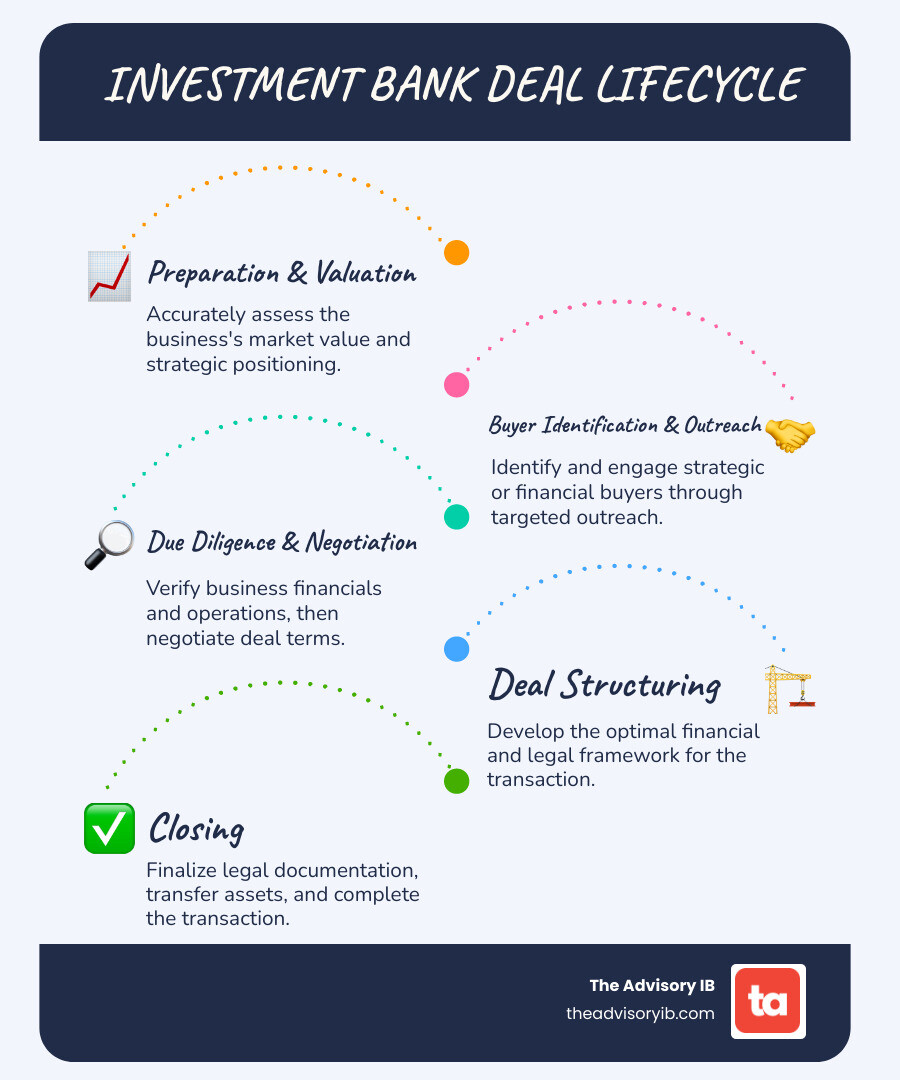
A successful investment bank deal is a carefully orchestrated process, moving through distinct phases from initial preparation to final closing. Each stage requires expertise, precision, and a deep understanding of market dynamics. For business owners looking to sell, navigating this process effectively is key to achieving a life-changing exit. Sell My Business
Preparation and Valuation: Setting the Stage for Success
The journey to a successful deal begins long before any buyer is approached. It involves rigorous preparation and an accurate valuation of the business. We start with a comprehensive financial analysis, scrutinizing every aspect of the company’s performance and projections. This forms the basis for understanding its strategic positioning within its market.
A crucial document created at this stage is the Confidential Information Memorandum (CIM). This detailed prospectus provides prospective buyers with an in-depth look at the business, its operations, financial health, market opportunities, and management team. Crafting a compelling CIM is an art form, designed to highlight strengths while providing transparency. Simultaneously, we work to set realistic expectations for the business’s value, ensuring that both sellers and potential buyers are aligned on a credible baseline. A thorough business valuation is indispensable here. Business Valuation
Finding the Right Partner: The Search for Buyers
Once prepared, the focus shifts to identifying and engaging the right potential buyers. This involves a strategic search that considers both “strategic buyers” (companies in the same or related industries looking for synergies) and “financial buyers” (private equity firms and other investment vehicles seeking financial returns).
For essential services businesses, private equity firms are often key players. These firms, which often focus on middle-market control transactions, bring not only capital but also operational expertise to help companies grow. Our AI-driven platform plays a pivotal role here, allowing us to efficiently identify and vet a broad spectrum of qualified buyers, including private equity groups, who are actively seeking investments in the essential services sector. The goal is to create a competitive environment, attracting multiple interested parties to drive up the offer price and improve deal terms for our clients. Effectively finding the right buyers can make all the difference. Find Buyers
Executing on High-Stakes Investment Bank Deals
With interested buyers identified, the deal moves into the execution phase, a period of intense negotiation and meticulous due diligence. We manage the delicate process of negotiating terms, which can include purchase price, payment structure, earn-outs, and post-closing liabilities. This requires seasoned expertise to protect our clients’ interests and maximize their value.
Simultaneously, buyers conduct their own extensive due diligence, verifying the information provided in the CIM and scrutinizing every aspect of the business. Our role is to facilitate this process, providing organized data and responding to inquiries efficiently. As the deal progresses, we work with legal teams to finalize complex legal documents, ensuring all agreements are airtight. Finally, we assist with planning for post-merger integration, helping to ensure a smooth transition and continued success for the acquired business. Utilizing the right tools throughout this process is crucial. Tools
Conclusion
Investment bank deals are the engines of corporate growth and change, facilitating everything from the smallest middle-market acquisition to the largest global merger. We’ve explored their core functions, the dynamic modern landscape shaped by technology and geopolitical events, and the historical lessons learned from past crises.
The complexity of these deals cannot be overstated, requiring strategic partnerships and expert guidance at every turn. Technology, particularly AI, is increasingly impacting deal-making, offering new efficiencies and insights that are reshaping how transactions are sourced, valued, and executed. Our AI-driven platform, combined with our 100% success-based model, ensures our essential services business clients in cities like New York, Chicago, Houston, Dallas, San Francisco, Boston, and many others across the US, receive faster, stronger offers.
The future of M&A and capital raising will undoubtedly continue to evolve, but the fundamental need for skilled advisors who can steer these intricate processes remains constant. We are committed to defending Main Street, protecting founders, and leveling the playing field when Wall Street comes calling, ensuring that every business owner can achieve their life-changing exit.