
Why Investment Banking Professionals Shape the Global Financial Landscape
An investment bank professional is a finance expert who helps corporations, governments, and institutions raise capital, execute mergers and acquisitions, and steer complex financial transactions. These professionals work as a dedicated team to deliver exceptional results for their clients, leveraging deep analytical skills and strategic insight to navigate the intricacies of the financial world.
Key roles of an investment bank professional include:
- Capital Raising: Helping clients issue stocks and bonds to finance growth or operations
- Mergers & Acquisitions (M&A): Advising on buying, selling, or merging companies
- Financial Advisory: Providing strategic guidance on restructuring, valuations, and market opportunities
- Client Relationship Management: Building long-term partnerships with institutional clients
If you’re a business owner considering an exit, understanding how an investment bank professional operates can help you steer the M&A process more effectively. Find out what are the benefits of working with an investment bank?
I’m Oliver Bogner, a licensed investment banker (FINRA Series 7, 63, 79) and Managing Partner of The Advisory Investment Bank, where I’ve spent years working as an investment bank professional helping essential service business owners achieve life-changing exits. Before founding The Advisory, I built and sold five companies, experiencing both sides of the M&A table and learning how Wall Street deals get done.
What is an Investment Bank Professional and What Do They Do?
At its core, an investment bank professional acts as a crucial intermediary in the financial world. We connect businesses, governments, and wealthy individuals with the capital they need to grow, expand, or restructure. Our work is dynamic, constantly evolving with market trends, and often involves high-stakes transactions that shape industries.
As trusted advisors, financiers, and risk managers, we guide clients through their most important financial decisions. This can range from advising a company on a cross-border merger to structuring the initial public offering (IPO) of a subsidiary, or even helping refinance an outstanding bond. This position offers a unique opportunity to understand the intricate workings of companies and their valuation, building a robust skillset that is highly valued across the financial sector.
Key Divisions Within an Investment Bank
Investment banks are complex organizations, typically structured into several key divisions, each with a specialized function:
- Mergers & Acquisitions (M&A): This division advises companies on buying, selling, or combining with other businesses. We help clients identify targets, conduct due diligence, negotiate terms, and execute deals. It’s a bit like being a matchmaker, but for corporations!
- Equity Capital Markets (ECM): Here, we help companies raise capital by issuing equity (stocks) to investors. This includes Initial Public Offerings (IPOs), follow-on offerings, and private placements.
- Debt Capital Markets (DCM): This team assists clients in raising capital by issuing debt (bonds) to investors. We structure bond issues, manage the underwriting process, and advise on debt refinancing.
- Sales and Trading: This division acts as market makers, buying and selling securities (stocks, bonds, derivatives, commodities) for institutional clients and for the bank’s own account. It’s a environment where quick decisions and market insights are paramount.
- Equity Research: Analysts in this division study companies and industries, publishing reports and recommendations for investors. They provide critical insights that help clients make informed investment decisions.
Investment Banks vs. Commercial Banks
While both are pillars of the financial system, investment banks and commercial banks serve distinct purposes.
- Commercial Banks: Historically, commercial banks focused on traditional banking activities: accepting deposits from individuals and businesses and providing loans. Think of your local branch where you open a checking account or apply for a mortgage.
- Investment Banks: An investment bank professional primarily works in capital markets. We help companies raise money (through equity or debt issuance), advise on complex transactions like M&A, and trade securities. We don’t typically take deposits from the public in the same way commercial banks do.
However, the lines have blurred over time. Many large financial institutions now offer both commercial and investment banking services under one roof, often referred to as “universal banks.” Despite this, the core activities and client focus of an investment bank professional remain distinct, centered on advisory services and capital markets transactions rather than traditional lending and deposit-taking.
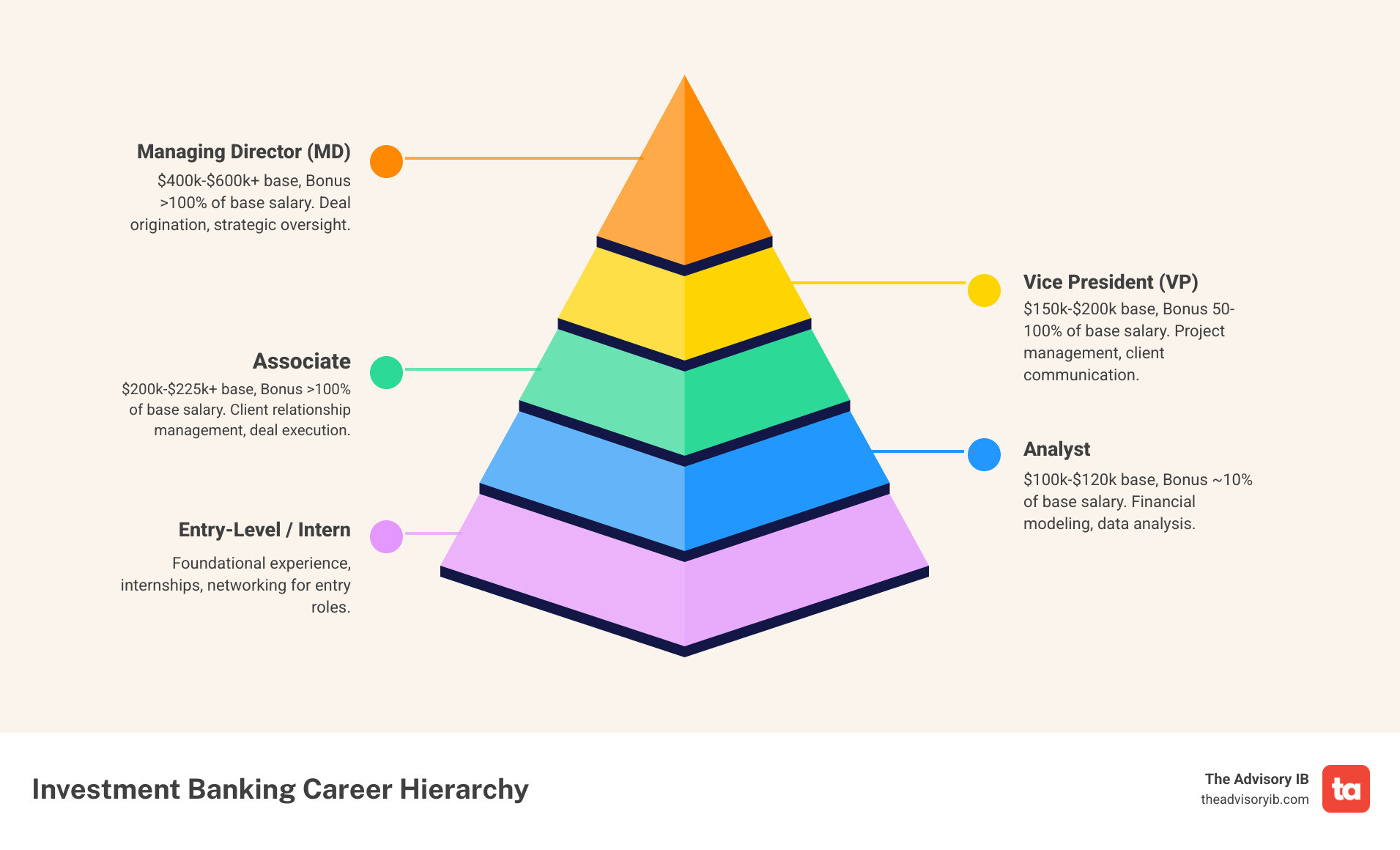
The Investment Banking Team Structure: Your Deal Team
The execution of a successful financial transaction relies on a well-structured and coordinated team. Within an investment bank, professionals operate in a clear hierarchy, ensuring that every aspect of a client’s deal, from initial analysis to final negotiation, is handled with the appropriate level of expertise and oversight. This structured management ensures clear communication, effective decision-making, and a seamless experience for our clients.
The Analyst: The Data Engine
Analysts are the foundation of the deal team, responsible for the heavy lifting of financial modeling, data analysis, and preparing the detailed presentations that inform strategic decisions. They spend countless hours in Excel creating valuation models and in PowerPoint crafting the materials—or “pitch books”—that clearly articulate the strategic rationale behind a transaction.
The Associate: The Project Manager
Associates act as the crucial bridge between the analytical team and senior bankers. They manage the day-to-day workflow of a deal, oversee the work of Analysts, and take ownership of the financial models. As they develop, they begin to interact more directly with clients, ensuring that the project is progressing smoothly and that all parties are aligned.
Vice President (VP) to Managing Director (MD): The Strategic Leadership
As an investment bank professional gains experience, their role shifts from technical execution to client relationship management, strategic guidance, and deal origination. This senior leadership is who clients interact with most directly to shape the strategy and outcome of their engagement.
- Vice President (VP): VPs are senior project managers who oversee the entire deal process. They manage client relationships, coordinate teams of Associates and Analysts, and are heavily involved in client communication and strategic positioning.
- Senior Vice President (SVP) / Director: These senior professionals focus heavily on developing new business and deepening client relationships. They act as key strategic advisors, leveraging their extensive market knowledge to identify opportunities for clients.
- Managing Director (MD): At the pinnacle of the team structure, MDs are responsible for the firm’s client relationships and strategic direction. Their role is almost entirely focused on building and maintaining partnerships with C-suite executives, understanding their long-term goals, and originating the deals that will help them succeed. They provide high-level strategic oversight, ensuring the right team and resources are deployed to achieve the client’s objectives.
Qualities of an Elite Investment Bank Professional
Engaging an investment bank is a significant decision, and the quality of the professionals you work with is paramount. A successful investment bank professional is defined by a unique combination of academic rigor, technical skill, and personal attributes that are essential for navigating high-stakes financial transactions. These are the qualities that ensure your interests are protected and your objectives are met.
Educational Foundation and Credentials
A strong educational foundation is a key indicator of the discipline and intellectual capacity required in this field. Most accomplished professionals hold degrees in finance, economics, business, or other highly analytical fields. Advanced credentials such as a Master of Business Administration (MBA) or a Chartered Financial Analyst (CFA) designation demonstrate a deeper commitment to and mastery of the financial industry, signaling a high level of expertise.
Key Skills and Attributes for Client Success
Beyond academic qualifications, an effective investment bank professional brings a specific blend of skills to every client engagement:
- Analytical Prowess & Quantitative Acumen: The ability to dissect complex financial data, build intricate models, and perform accurate valuations is the bedrock of sound financial advice.
- Communication Skills: Professionals must be able to present complex ideas clearly, negotiate effectively, and build strong relationships. Clear, concise, and persuasive communication is vital for aligning all parties and driving a deal forward.
- Attention to Detail: When significant capital is at stake, there is no room for error. Meticulous attention to detail ensures that every aspect of a transaction is executed flawlessly.
- Resilience & Strong Work Ethic: The financial markets are demanding and fast-paced. A professional’s ability to perform under pressure and manage a demanding workload is essential to keeping a transaction on track.
- Teamwork: Complex deals require seamless collaboration. The ability to work effectively with colleagues, clients, and legal and accounting advisors is crucial for a successful outcome.
- Commercial Awareness: A deep understanding of macroeconomic trends, financial markets, and industry-specific dynamics is what separates a good advisor from a great one. This awareness allows them to provide relevant, forward-looking strategic advice.
The US Investment Banking Landscape: A World of Opportunity
The United States stands as the global epicenter for investment banking activities, offering a vast and dynamic market for our clients. Our presence in major financial hubs like New York, Chicago, Houston, and San Francisco, among others, allows us to provide tailored advice with a deep understanding of both national trends and regional nuances.
A Market Primed for Growth and Transactions
The US market is characterized by high deal volume and large transaction sizes, providing immense opportunities for businesses looking to raise capital, expand, or execute a strategic merger or acquisition. This active environment means there is a constant flow of capital and a wide range of potential partners or targets. For our clients, this translates into a greater potential for finding the right deal structure and achieving an optimal outcome. The competitive nature of the market ensures that innovative strategies and expert guidance are paramount to success.
Primary Industries and Locations in the US
Our client locations highlight the diverse financial landscape of the US, with each hub offering specialized expertise:
- New York, NY: The undisputed financial capital, with deep expertise across all industries for M&A, capital markets, and sales & trading activities.
- Chicago, IL: A significant financial hub, particularly strong in derivatives, food & agriculture, and diversified industrial sectors.
- Houston, TX: A global center for energy investment banking, covering oil & gas, renewables, and related infrastructure.
- San Francisco, CA & San Jose, CA: Dominant in technology, venture capital, and life sciences, reflecting the innovation of Silicon Valley.
- Dallas, TX & Fort Worth, TX: Growing financial centers with strong activity in diversified industrials, consumer, and energy.
- Charlotte, NC: A major banking center, especially for commercial banking and middle-market investment banking.
- Boston, MA: Strong in biotech, healthcare, and asset management.
- Other Key Cities (Phoenix, Philadelphia, San Antonio, San Diego, Austin, Jacksonville, Columbus, Indianapolis, Seattle, Denver, Washington D.C., Nashville, Detroit, Portland, Memphis, Louisville): These cities offer diverse opportunities, often specializing in regional industries such as healthcare, technology, real estate, consumer goods, or government services, and are crucial for middle-market deals.
The dynamic interplay between these regional hubs and their specialized industries creates a vibrant and competitive environment for executing successful transactions across the United States.
The Broad Expertise of an Investment Bank Professional
One of the hallmarks of a top-tier investment bank professional is the incredible breadth of their business and financial acumen. The skills developed in this field are so valuable and transferable that these professionals are highly sought after for leadership roles across the entire business landscape. Our expertise in navigating the deal: why you need an M&A consulting service is built on this foundation of comprehensive strategic knowledge.
A Testament to Versatile Skill Sets
The fact that former investment bankers are often recruited for roles in private equity, hedge funds, venture capital, and corporate development is a testament to the quality of their training. Their skills in financial modeling, valuation, strategic thinking, and project management are directly applicable to identifying, executing, and managing successful investments and corporate strategies.
This versatility offers a significant advantage to our clients. When you partner with an experienced investment bank professional, you are not just hiring a deal-maker. You are gaining a strategic advisor with a holistic understanding of the business world, including:
- Investor Perspectives: Deep insight into what private equity, venture capital, and public market investors look for in a company.
- Corporate Strategy: An understanding of how large corporations evaluate M&A, divestitures, and strategic partnerships from the inside.
- Entrepreneurial Mindset: Many professionals have experience with the challenges of building and scaling a business, providing a practical, results-oriented approach.
This broad perspective ensures that the advice you receive is not just technically sound but also strategically aligned with your long-term business and financial goals. It is this depth of experience that transforms a transaction into a truly value-creating event.
Conclusion: Charting Your Course in Finance
Engaging an investment bank professional is a pivotal step in navigating the complexities of the financial world. It is a partnership that provides unparalleled access to financial mastery, strategic growth opportunities, and expert guidance. A skilled professional gives you a deep understanding of global capital markets, razor-sharp analytical and strategic thinking, and a powerful network to help you achieve your most ambitious goals.
Whether your goal is to execute a merger, raise capital for expansion, or plan a successful exit, the foundation laid with a trusted investment banking partner is robust. We, at The Advisory IB, understand the intricate world of finance and the strategic objectives that drive successful transactions. Our mission is to be trusted advisors, providing expertise in areas like cross-border mergers, IPO structuring, and bond refinancing. We believe in building long-term client relationships and fostering a dynamic workplace where top talent thrives.
If you are a business owner seeking expert guidance for your next strategic move, we invite you to connect with us. Find how our insights and experience can help you achieve your financial goals. Meet an Advisor today, or explore the industries that we serve.