
Why Affordable Housing Finance Matters Now More Than Ever
Investment bank affordable housing finance has emerged as a critical solution to one of North America’s most pressing challenges: the widening gap between housing demand and supply for low- and middle-income families. The numbers tell a stark story—Canada alone faces a $77 to $121 billion capital requirement for affordable housing over the next decade, a figure that dwarfs available government funding by billions each year. Meanwhile, in the United States, millions of families struggle to find quality housing they can actually afford, despite strong employment and economic growth.
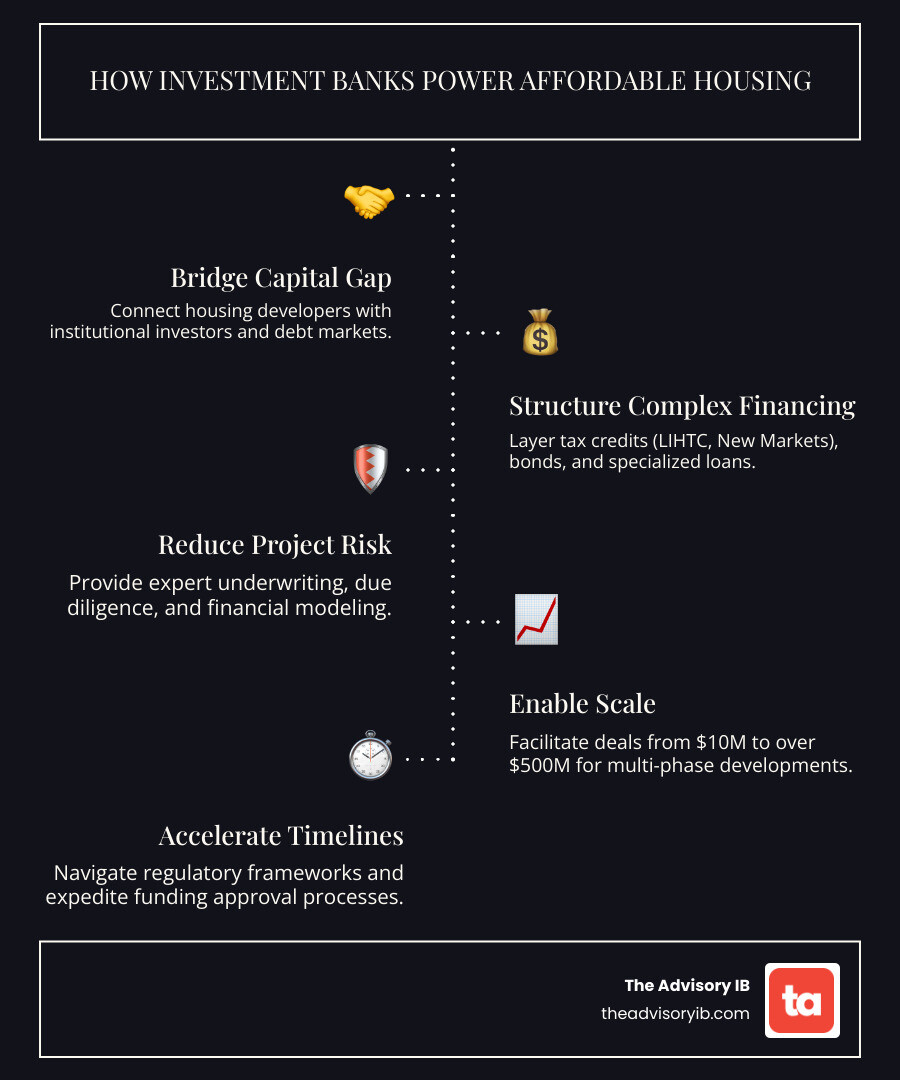
How Investment Banks Support Affordable Housing:
- Bridge the Capital Gap: Connect housing developers with institutional investors and debt markets
- Structure Complex Financing: Layer tax credits (LIHTC, New Markets), bonds, and specialized loans
- Reduce Project Risk: Provide expert underwriting, due diligence, and financial modeling
- Enable Scale: Facilitate deals from $10 million to over $500 million for multi-phase developments
- Accelerate Timelines: Steer regulatory frameworks and expedite funding approval processes
The core challenge is straightforward: most housing providers lack expertise in accessing capital markets, while most institutional investors lack familiarity with the unique economics of affordable housing projects. This creates a critical bottleneck. Investment banks step into this gap with specialized knowledge in both housing development and sophisticated finance, structuring deals that make sense for all parties—developers, investors, and most importantly, the communities that need these homes.
Real-world examples demonstrate this impact. In one case, an investment bank provided a $12.9 million loan for a 780-unit affordable development, enabling a non-profit to offer middle-income families a realistic path to homeownership. On a national scale, some large financial institutions have taken this model even further, creating and preserving over 140,000 affordable rental units through more than $25 billion in specialized financing. These aren’t abstract numbers—they represent families with stable housing, children attending consistent schools, and neighborhoods gaining economic vitality.
I’m Oliver Bogner, Managing Partner of The Advisory Investment Bank, and while our primary focus is helping essential service business owners achieve successful exits, the principles of investment bank affordable housing finance—structuring complex deals, bridging information gaps, and aligning incentives—mirror the advisory work we do daily for founders navigating M&A transactions. Both require translating technical financial structures into real-world outcomes that serve communities and stakeholders alike.
How an Investment Bank Makes Affordable Housing Possible
Investment banks play a multifaceted and indispensable role in the ecosystem of affordable housing. They act as sophisticated matchmakers, bringing together the significant capital held by institutional investors and the pressing need for funding from housing developers. This intermediary role is crucial for bridging the financial chasm that often separates ambitious housing projects from realization. Without them, many vital developments would simply never get off the ground.
At its heart, an investment bank’s function in this sector is to transform the complex and often fragmented world of affordable housing into an investable opportunity. Housing providers, whether non-profits or mission-driven developers, typically excel at building and managing properties that serve community needs. However, they often lack the specialized financial expertise to tap into large-scale debt markets or structure deals that attract private investment. On the flip side, institutional debt investors—like pension funds, insurance companies, or large banks—possess vast amounts of capital but may not have the in-house expertise or appetite for the unique risks and social return considerations of affordable housing.
This is where investment banks step in. They understand the nuances of both worlds. They work closely with housing providers to understand their project needs, financial projections, and social impact goals. Simultaneously, they engage with debt investors to structure financial products that meet their return expectations, risk tolerances, and often, their growing interest in environmental, social, and governance (ESG) investments. This dual understanding allows them to create bespoke financial solutions that benefit all parties involved.
Think of it as a finely tuned engine. Housing providers are the creators, building the physical structures. Debt investors are the fuel, providing the necessary capital. The investment bank is the sophisticated transmission system, ensuring that the fuel is delivered efficiently and effectively to power the creation of homes. Our role, as an Investment Bank, is to steer this intricate process, ensuring that the financial mechanisms are robust and transparent. This detailed Investment Banker Process is essential for bringing complex projects to fruition.
Furthermore, investment banks are instrumental in fostering public-private partnerships. Government funding, while vital, is often insufficient to meet the overwhelming demand for affordable housing. Investment banks help leverage limited public resources by attracting private capital, creating a synergistic approach where public and private entities collaborate to achieve common goals. This collaborative model is increasingly seen as the most viable path forward for tackling the affordable housing crisis in our communities, from New York to San Francisco, and across our other major cities like Chicago, Houston, and Phoenix.
The Core Strategy of an investment bank affordable housing team
An effective investment bank affordable housing team operates with a strategic blend of specialized expertise, rigorous underwriting, innovative financial structuring, and robust risk management. Our goal is to ensure that affordable housing projects are not only financially viable but also deliver lasting social impact.
Our expertise is multifaceted. We don’t just have financial analysts; our teams often include professionals with backgrounds in real estate development, urban planning, compliance, and even legal counsel. This allows us to approach projects holistically. For instance, our asset and fund management teams are structured to monitor portfolios throughout their entire lifecycle, from construction risk management to stabilized asset management, ensuring yield and asset quality protection. These teams comprise diverse professionals, including architects, engineers, compliance experts, CPAs, and attorneys, who bring a comprehensive understanding to every project.
When it comes to assessing risk and return in affordable housing projects, investment banks employ a rigorous process. We conduct extensive due diligence, analyzing everything from market demand and developer track record to regulatory compliance and the long-term sustainability of the property’s operations. This involves:
- Project Viability Assessment: Evaluating the fundamental soundness of the development, including construction costs, operating expenses, and projected rental income. This often includes stress-testing projections against various economic scenarios.
- Social Impact Metrics: Beyond financial returns, we assess the project’s ability to meet its social mission, such as the number of affordable units created, the income levels served, and the positive impact on the surrounding community.
- Developer Capacity: Scrutinizing the experience and financial health of the development team, ensuring they have the capability to execute the project successfully.
- Government Subsidies and Regulatory Environment: Understanding and navigating the complex web of federal, state, and local subsidies, tax credits, and zoning regulations that are often critical to affordable housing feasibility.
- Long-Term Stability: Focusing on the durability of the project, including its ability to generate sufficient cash flow to cover operating costs and debt service over decades, not just a few years.
This comprehensive approach allows us to identify potential challenges early and structure deals that mitigate risks for all stakeholders. Our objective is always to ensure the financial health and longevity of these crucial housing developments.
Open uping Capital with Specialized Financial Products
The financial products offered by investment banks are the lifeblood of affordable housing development. These aren’t your typical loans; they are often complex, layered instruments specifically designed to make projects that would otherwise be unprofitable, financially feasible. We specialize in using these tools to bring capital into communities across our service areas, from the busy streets of New York to the growing neighborhoods of Dallas.
Here are some of the key financial products and services we deploy:
- Low-Income Housing Tax Credit (LIHTC): The cornerstone of affordable housing finance in the United States, LIHTC is a federal tax credit program that incentivizes the development and rehabilitation of affordable rental housing. Investment banks act as syndicators, connecting developers (who receive the credits) with corporate investors (who buy the credits to reduce their tax liability). This equity investment significantly reduces the amount of debt a project needs, making it more affordable. For example, major banks often invest LIHTC equity as upper-tier investors through syndicators, demonstrating the critical role they play in this mechanism.
- New Markets Tax Credit (NMTC): While broader in scope, NMTC can be applied to affordable housing projects located in low-income communities. It provides investors with a tax credit against federal income taxes for making equity investments in Community Development Entities (CDEs), which then channel the investments into eligible projects.
- Historic Tax Credit (HTC): This federal program provides a tax credit for the rehabilitation of historic buildings. It’s often layered with LIHTC to finance the preservation and conversion of historic structures into affordable housing units, revitalizing neighborhoods while creating much-needed homes.
- Bond Financing: Investment banks underwrite and sell tax-exempt municipal bonds on behalf of state and local housing finance agencies. These bonds provide low-cost, long-term debt for affordable housing developments, attracting institutional investors looking for stable, tax-advantaged returns.
- Construction Loans: These are short-term loans provided to cover the costs of building a new affordable housing project or rehabilitating an existing one. Investment banks facilitate these loans, ensuring developers have the necessary capital during the construction phase.
- Acquisition Financing: This type of financing is used to acquire land or existing properties for future affordable housing development. It’s an essential first step in many projects, allowing developers to secure sites in competitive markets.
- Letters of Credit (LOCs): Investment banks provide LOCs to improve the creditworthiness of affordable housing bonds or other debt instruments. This can lower borrowing costs for developers, making projects more financially viable and attractive to investors.
- Asset Management: Beyond initial financing, investment banks offer comprehensive asset management services. This includes monitoring the development portfolio through various stages, managing underperforming properties, and ensuring compliance and financial health post-occupancy. This ensures yield protection and asset quality protection over the long term.
These financial products are often combined in complex capital stacks, requiring sophisticated financial engineering and expertise to optimize for both affordability and investor returns.
From Blueprint to Community: The Tangible Impact of Investment
The involvement of investment bank affordable housing finance transforms abstract financial concepts into concrete realities: homes for families, revitalized neighborhoods, and sustainable communities. The impact is profound, reaching far beyond balance sheets to touch lives directly.
The most direct impact is the sheer volume of affordable housing units created and preserved. Investment bank financing enables developers to build new structures or rehabilitate existing ones, bringing thousands of much-needed homes to market. This directly addresses the housing shortage faced by low- and middle-income households in cities like Chicago, Houston, and Philadelphia. For instance, some major financial institutions have been monumental forces in this area, creating and preserving over 140,000 affordable housing rental units and providing over $25.3 billion towards financing affordable housing. These aren’t just numbers; they represent stable homes for families, allowing children to thrive in consistent environments and parents to focus on their livelihoods without the constant stress of housing insecurity.
Furthermore, investment banks contribute significantly to the sustainability and financial self-sufficiency of housing providers. By structuring long-term, stable financing solutions, they free housing organizations from the cycle of short-term fundraising and enable them to focus on their core mission: providing quality housing and support services to residents. This financial stability allows providers to invest in property maintenance, resident programs, and future development, fostering a more resilient and impactful sector. When housing providers have access to reliable capital, they can plan for the future, expand their reach, and become more effective stewards of their communities. This long-term perspective is a key benefit of working with an investment bank, as highlighted in our discussion on What are the benefits of working with an investment bank?.
Case Study: Large-Scale Impact in Action
Major investment banks can drive significant change in the affordable housing sector. Through dedicated community development arms, these firms demonstrate a deep commitment to addressing the housing needs of low- and middle-income families across the United States.
The track record of such initiatives can be impressive, with some institutions helping to create and preserve over 140,000 affordable housing rental units, backed by more than $25.3 billion in financing. This scale of impact is a testament to a comprehensive approach, which includes leveraging various financial tools and offering custom solutions. For example, in a major city with a significant housing affordability challenge, one institution invested over $630 million in affordable housing and community services over a decade. This commitment helps to revitalize neighborhoods, ensuring that essential workers and families can afford to live in the communities they serve.
A successful strategy involves providing a full spectrum of financing options. This includes acquisition financing for land, construction loans to build new properties, and permanent financing for long-term stability. These institutions also actively engage with specialized tax credits like LIHTC, acting as upper-tier investors through syndicators. This robust financial toolkit allows them to support a diverse range of projects, from large-scale multifamily developments to smaller, community-focused initiatives. The focus often extends to workforce housing, recognizing the need to provide accessible homes for essential workers who often struggle to afford market-rate rents. This comprehensive and sustained involvement exemplifies the transformative power of investment bank affordable housing initiatives.
The Future of Housing Finance: Challenges and Opportunities
The landscape of affordable housing finance is constantly evolving, presenting both significant challenges and exciting opportunities for investment banks. As we look ahead, factors such as economic shifts, changing demographics, and a growing emphasis on sustainability will continue to shape our approach.
One of the primary challenges is the persistent and growing demand for affordable housing, which continues to outstrip available resources. Economic volatility, rising interest rates, and increasing construction costs further complicate the picture, making it harder to deliver projects within budget. Regulatory frameworks, while essential, can also be complex and vary significantly across jurisdictions, requiring deep expertise to steer.
However, these challenges also open doors to innovation. The increasing focus on ESG (Environmental, Social, and Governance) investing presents a massive opportunity. Institutional investors are not just looking for financial returns; they are actively seeking investments that generate positive social and environmental outcomes. Affordable housing, by its very nature, aligns perfectly with the “S” (social) aspect of ESG, and when combined with green building standards, it also addresses the “E” (environmental). Investment banks are uniquely positioned to structure these “impact investments,” connecting capital with projects that deliver both financial and social dividends.
Innovative financing mechanisms are also on the rise. We are seeing greater interest in blended finance models, where philanthropic capital or government grants are strategically used to de-risk projects, attracting larger pools of private investment. Technology, too, will play an increasingly vital role in streamlining processes, improving data analysis, and enhancing transparency in affordable housing finance. Our own experience at The Advisory, leveraging AI-driven platforms for M&A transactions, demonstrates the power of technology to deliver faster, stronger outcomes in complex financial dealings. The principles of efficient data analysis and strategic matchmaking are highly relevant to optimizing financing for affordable housing projects.
Regulatory frameworks continue to adapt, with ongoing discussions at federal, state, and local levels about new incentives and funding mechanisms to stimulate affordable housing development. Investment banks will be at the forefront, advising on these changes and helping clients adapt their strategies. The overall outlook for investment bank affordable housing finance is one of continued growth and innovation, driven by both societal need and investor demand for impact.
Assessing Risk and Return in a Changing Market
In the dynamic world of affordable housing, assessing risk and return is a nuanced process that goes beyond traditional financial metrics. While financial viability remains paramount, we also factor in the social return on investment (SROI) and the long-term community benefits. This dual bottom line approach is critical for sustainable development.
When evaluating affordable housing projects, our due diligence process is comprehensive, encompassing several key areas:
- Project Viability: We scrutinize the developer’s pro forma, construction budget, operating expenses, and projected cash flows. This includes a deep dive into the local housing market to understand demand, rental rates, and absorption trends in cities like Los Angeles, Houston, or Phoenix. We also assess the physical condition of the property (for rehabilitation projects) and the suitability of the location.
- Social Impact Metrics: Beyond the financials, we quantify the social good. This involves analyzing the number of affordable units, the income levels they serve, the availability of supportive services for residents, and the project’s contribution to neighborhood revitalization. These metrics are increasingly important for attracting impact investors and aligning with ESG mandates.
- Developer and Management Team Strength: The experience and track record of the development and property management teams are crucial. We assess their capacity to execute the project on time and within budget, as well as their ability to manage the property effectively post-completion, ensuring long-term stability and resident satisfaction.
- Regulatory and Policy Environment: We carefully analyze the relevant federal, state, and local regulations, including zoning laws, affordable housing mandates, and the availability of subsidies or tax credits. Understanding this complex landscape is essential for mitigating regulatory risks.
- Long-Term Stability: We focus on creating sustainable financial structures that ensure the project’s longevity. This includes evaluating the reliability of income streams, the adequacy of reserves, and the potential for future capital needs. Our goal is to create projects that remain affordable and well-maintained for decades.
As Oliver Bogner, I founded The Advisory with a vision to provide unparalleled strategic financial advisory services. This commitment to thorough due diligence and strategic insight is a principle we apply across all our financial engagements, including understanding complex markets like affordable housing.
The Evolving Role of an investment bank affordable housing finance
The role of investment bank affordable housing finance is continuously evolving, driven by technological advancements, changing market demands, and a heightened awareness of social responsibility. We anticipate a future where investment banks leverage cutting-edge tools to deliver even more efficient and impactful solutions.
Technology integration is at the forefront of this evolution. Advanced data analysis and predictive modeling are becoming indispensable for assessing market needs, identifying optimal development sites, and forecasting financial performance. Artificial intelligence, similar to the AI-driven platform we use at The Advisory for M&A, has the potential to revolutionize how affordable housing projects are underwritten, risk-assessed, and managed. This could lead to faster deal closures, more precise valuations, and ultimately, a more streamlined process for bringing affordable homes to market.
Furthermore, there is a growing emphasis on green building standards and sustainable development practices within affordable housing. Investment banks are increasingly structuring financing packages that incentivize energy efficiency, renewable energy integration, and environmentally friendly construction methods. This not only reduces operating costs for residents and developers but also aligns with broader climate goals and attracts environmentally conscious investors.
Community engagement is another area where the role of investment banks is evolving. Beyond just providing capital, we are increasingly involved in facilitating partnerships and ensuring that projects are truly responsive to the needs of the communities they serve. This might involve working with local non-profits, community development corporations, and resident groups to ensure that developments are integrated seamlessly into the existing social fabric.
The future of investment bank affordable housing finance lies in developing scalable solutions that can be replicated across diverse markets. By combining financial innovation with technological prowess and a deep commitment to social impact, we can open up greater capital flows and accelerate the creation and preservation of affordable homes in our cities like San Antonio, Denver, and Charlotte.
Frequently Asked Questions about Affordable Housing Finance
What is the primary role of an investment bank in affordable housing?
Investment banks act as crucial intermediaries, structuring complex financial deals to connect affordable housing developers with large-scale capital from institutional investors, bridging a funding gap that government programs alone cannot fill.
What are the main financial tools used to fund these projects?
The most common tools include issuing tax-exempt bonds, syndicating Low-Income Housing Tax Credits (LIHTC), and providing specialized debt products like construction loans and permanent financing, often layering multiple sources to ensure project viability.
How does this financing impact communities?
By enabling the creation and preservation of thousands of affordable housing units, this financing provides stable, quality homes for low- and middle-income families, which in turn fosters stronger, more economically diverse communities.
Conclusion: Building a Better Future, One Home at a Time
The journey from a blueprint to a thriving affordable housing community is complex, requiring vision, dedication, and sophisticated financial expertise. As we’ve explored, investment bank affordable housing finance is not just about transactions; it’s about changing communities and empowering individuals. Investment banks play an indispensable role in bridging the critical funding gap, connecting vital projects with the capital needed to make them a reality.
Through specialized financial products like LIHTC, strategic underwriting, and robust risk management, we facilitate the creation and preservation of thousands of affordable homes. This work contributes to the financial self-sufficiency of housing providers and generates tangible social impact, creating stable environments for low- and middle-income families across our nation. The success stories of large-scale financing initiatives underscore the power of this collaborative approach.
Looking ahead, the commitment to affordable housing will only grow, driven by societal need and the increasing demand for impact investing. Investment banks will continue to innovate, leveraging technology and fostering public-private partnerships to build a more equitable and sustainable housing future.
At The Advisory, we believe in the power of expert financial advisory to open up potential and drive meaningful outcomes. While our primary focus is on guiding essential service businesses through successful M&A, the principles of strategic structuring, rigorous analysis, and a commitment to client success are universal. We are proud to contribute to an economic ecosystem where financial expertise serves to build a better future, one home, and one business, at a time.
To learn how specialized financial advisory can open up potential in essential industries, we invite you to Explore how specialized financial advisory can unlock potential in essential industries.