
Why Understanding the Business Sale Timeline Matters
How long does it take to sell a business? Most transactions take between six and twelve months from preparation to closing. However, this timeline can vary based on factors like your business size, industry, preparation level, asking price, buyer financing, and market conditions. The median time on market is approximately 200 days (about 7 months), though essential services businesses with strong financials and recurring revenue often move faster when properly positioned.
Typical Business Sale Timeline:
- Preparation Phase: 1-2 months (financial documentation, valuation, CIM creation)
- Marketing Phase: 3-6 months (finding qualified buyers, initial meetings)
- Due Diligence: 1-3 months (financial review, operational assessment)
- Closing: 1-2 months (finalizing agreements, legal transfer)
If you’re a founder of an essential services business generating $2-100M in annual sales, understanding this timeline is critical to planning your exit strategy. The process isn’t like selling a house – it requires methodical preparation, strategic marketing, and patient execution. Rushing the process typically results in lower valuations or deal failure, while proper preparation and professional guidance can compress timelines without sacrificing value.
The average time to sell has increased over the past two decades, from about six months in the early 2000s to closer to ten months today. This shift reflects greater buyer sophistication, more extensive due diligence requirements, and increased information availability that can give buyers more options and research time.
I’m Oliver Bogner, a two-time Forbes 30 Under 30 honoree and Managing Partner at The Advisory Investment Bank, where I’ve guided hundreds of essential services business owners through successful exits. Having built and sold five companies myself before becoming an investment banker, I understand how long it takes to sell a business and the critical factors that accelerate or delay the process.
How Long Does It Take to Sell a Business?
The question of how long does it take to sell a business is one we hear frequently, and for good reason. It’s a significant life event, and knowing the timeframe helps you plan your future. While the intro touched on the average, let’s dive deeper. On average, it takes between six to eleven months to sell a business, with some estimates ranging from eight to ten months for small businesses. Data from BIZCOMPS, a database of business-for-sale transactions, indicates that for all transactions since 2000, the average time on the market was approximately 200 days, or about 7.3 months. However, the overall median days on market (MDOM) is around 200 days, meaning half sell faster and half sell slower.
This general rule of six to twelve months encompasses everything from the initial preparation to the final closing. It’s a complex journey, and understanding each step is key to navigating it successfully. For a detailed look into why these deals take time, we invite you to explore Why Great Deals Take Time: Understanding the Modern M&A Timeline.
Historical Trends in Sale Duration
The landscape of business sales has evolved significantly. Historically, in the early 2000s, the average time to sell a business was around six months. Today, that figure has increased to closer to ten months. This shift isn’t just a random fluctuation; it reflects fundamental changes in how businesses are bought and sold.
The internet, surprisingly, plays a dual role here. While it has democratized access to information and expanded the pool of potential buyers, it has also, paradoxically, made the market less efficient. Buyers now have access to vast amounts of information, leading to more extensive research and due diligence. This increased scrutiny, coupled with a broader range of options, can extend the time it takes for a buyer to make a decision and commit. The more prepared a seller is, however, the quicker the business will sell.
Impact of Business Size on the Clock
The size and complexity of your business directly influence its selling timeline. Generally, smaller businesses with straightforward operations tend to sell faster than larger, more complex enterprises. This is often because smaller businesses attract individual buyers who may have simpler financing structures and less extensive due diligence requirements.
For mid-market deals, which typically involve businesses with sales between $2 million and $100 million (our area of expertise), the timeline can be more extended. These transactions often attract private equity groups or strategic buyers, who conduct thorough financial and operational reviews. The larger the deal, the greater the risk, and thus the more time buyers will spend evaluating every aspect of the business. However, larger businesses can also be easier to sell than smaller ones due to higher demand from professional buyers.
Understanding these nuances is crucial, and engaging expert guidance can be invaluable. Learn more about how we help steer these complexities in Navigating the Deal: Why You Need an M&A Consulting Service.
The Four Critical Phases of the Selling Process
Selling a business isn’t a single event; it’s a carefully orchestrated process comprising several distinct phases. While the exact duration of each can vary, understanding these stages is fundamental to setting realistic expectations and staying proactive.
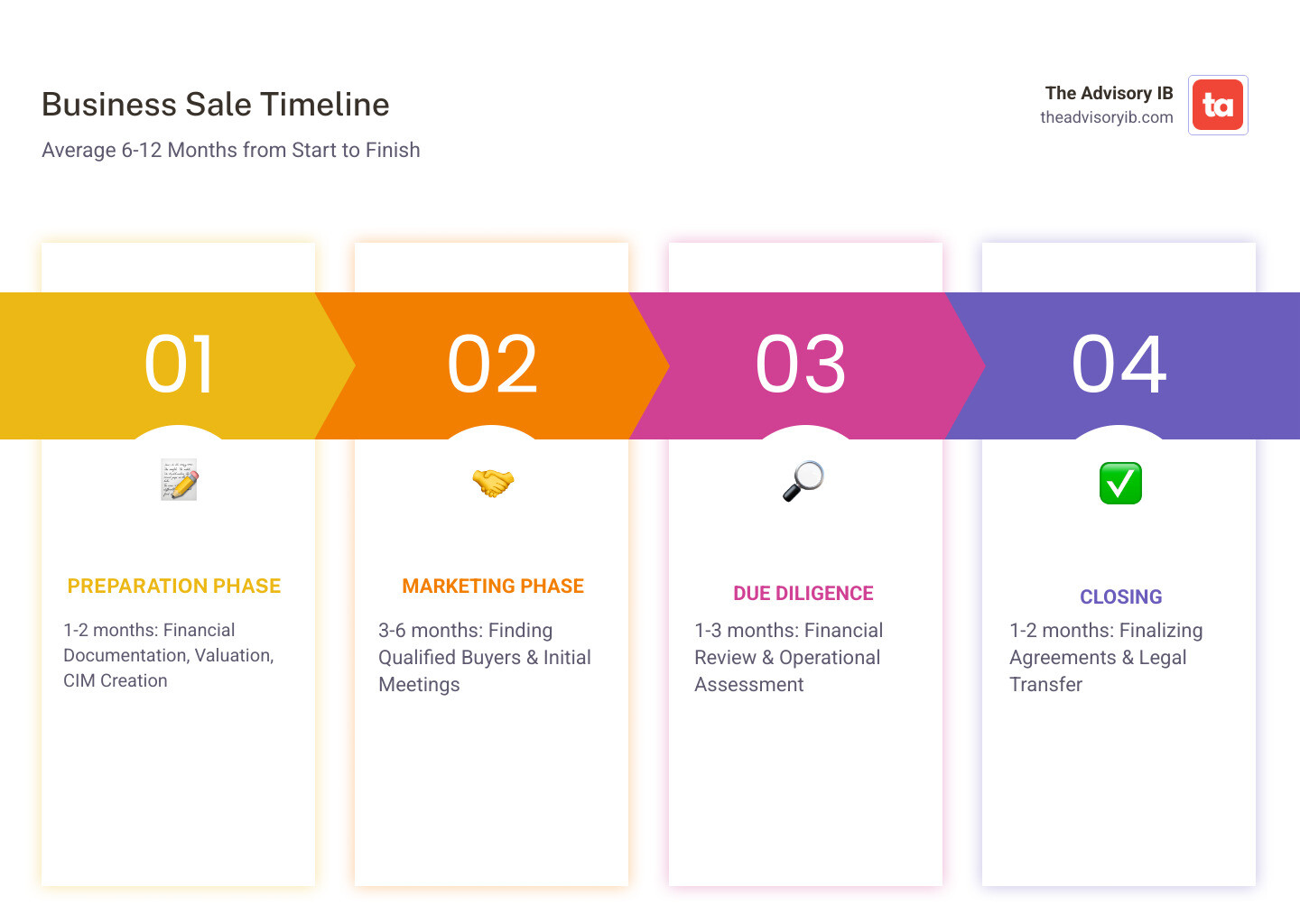
For a comprehensive overview of the entire process, we recommend reading How the M&A Process Actually Works in Plain English.
Phase 1: Preparation and Business Valuation
This initial phase is arguably the most crucial for setting the stage for an efficient sale. It typically takes anywhere from 3-5 weeks, though for complex businesses, it can extend to 1-2 months or even 2-6 months if documentation is not readily available.
During preparation, we focus on:
- Organizing Financial Records: This includes 3-5 years of clean, audited financial statements, current and projected cash flow documents, and tax returns. Clean books and organized documentation usually lead to shorter due diligence periods.
- Operational Documentation: Gathering details like leases, vendor agreements, customer contracts, employee lists, and standard operating procedures (SOPs). The most attractive businesses can operate independently of their founders, making detailed operations manuals essential.
- Business Valuation: Obtaining a professional valuation is critical. This involves assessing fair market value using methods like Seller’s Discretionary Earnings (SDE), EBITDA multiples, asset-based valuations, and comparable business sales. A realistic asking price, backed by solid valuation, prevents delays.
- Creating a Confidential Information Memorandum (CIM): This comprehensive document describes all facets of your business, serving as a critical selling tool for potential buyers.
Thorough preparation upfront can save months during the actual sale process. It demonstrates professionalism and reassures buyers, making your business more appealing. For a deeper dive into how we approach valuations, visit Business Valuation.
Phase 2: Marketing and Finding a Buyer
Once your business is prepared, the next step is to strategically market it to find the right buyer. This phase typically lasts anywhere from 3-5 weeks to several months, or even 3-6 months. Finding a qualified buyer can sometimes take from one month to over a year.
Our approach includes:
- Developing a Marketing Plan: Crafting a compelling narrative that highlights your business’s strengths and growth potential.
- Creating Blind Profiles and Teasers: These initial documents generate interest without revealing your identity, maintaining confidentiality.
- Buyer Research and Identification: Leveraging our network and advanced tools to identify strategic buyers and private equity groups that align with your business.
- Confidentiality Agreements (NDAs): Ensuring all interested prospects sign NDAs before receiving sensitive information.
- Screening Potential Buyers: Qualifying buyers for financial capability and strategic fit, ensuring we only engage with serious prospects.
- Management Meetings: Arranging meetings where you can discuss your business in more detail with serious buyers. These typically last a full day.
This phase is where the expertise of an investment banker truly shines, acting as a promoter, bouncer (screening buyers), and wingman (negotiating on your behalf). To understand the broader role of investment bankers in this process, read The Investment Banker Process
Variables That Impact how long it takes to sell a business
Many factors beyond our control can influence the duration of a business sale. These variables often dictate the pace and complexity of the transaction.
| Industry (SIC Code) | Average Days on Market (Approx. Months) |
|---|---|
| Communication (48) | 193 days (6.4 months) |
| Transportation (40-47) | 206 days (6.8 months) |
| Retail (52-59) | 211 days (7.0 months) |
| Services (70-89) | 214 days (7.1 months) |
| Insurance, Finance, Real Estate | 216 days (7.2 months) |
| Manufacturing (20-39) | 244 days (8.1 months) |
| Wholesale (50-51) | 243 days (8.1 months) |
| Electric, Gas, Sanitary Services | 247 days (8.2 months) |
| Construction (15-17) | 270 days (9.0 months) |
Source: BIZCOMPS data, averaged for transactions since 2000
The Role of Asking Price and Deal Structure
The asking price is one of the most significant factors influencing how long it takes to sell a business. Unrealistic pricing is a common reason businesses sit on the market for extended periods. Overpriced businesses often take longer to sell, attracting fewer qualified buyers. Proper valuation is critical for achieving a timely sale and maximizing returns.
Most smaller businesses are valued using the Seller’s Discretionary Earnings (SDE) method, while larger businesses often use EBITDA multiples. Understanding what your multiple will be is vital for setting expectations. Learn more about this in What Will My Multiple Be?.
Deal structure also plays a crucial role. Cash buyers can close quickly, while those requiring loans, especially Small Business Administration (SBA) loans, may need an additional 45-90 days for approval. Seller financing, where you carry a portion of the purchase price, can make your business more attractive to buyers and expedite the sale by alleviating financing gaps. However, deals with less than a 30% down payment, often involving bank financing, have historically lengthened closing times.
Balancing your financial needs with market realities is key to attracting serious buyers without leaving money on the table. For more on selling your business, explore Sell My Business.
How Industry Specifics Affect how long it takes to sell a business
Different industries have different selling timelines. Our focus at The Advisory IB is on essential services businesses, which often possess characteristics that can lead to faster sales. Businesses with recurring revenue models, for example, are attractive to buyers due to their predictable cash flow.
- Faster Sales: Industries like Communication (for example, certain service providers) tend to sell fastest, around 6.4 months. Service businesses with recurring customers often sell faster than specialized firms. Retail and service businesses also frequently sell more quickly than more complex sectors.
- Longer Sales: Manufacturing and Construction businesses typically take longer to sell, averaging over 8-9 months. This is often due to higher complexity, specialized assets, and more extensive due diligence requirements. Software and technology businesses can range from 6-18 months depending on retention, data room readiness, and diligence scope. Larger companies or those in highly specialized IT can face longer timelines due to more extensive due diligence.
Geographic location also matters. Businesses in metropolitan areas with larger pools of potential buyers often sell faster than those in rural locations. Areas experiencing economic growth tend to have more active business buyers.
How to Shorten the Timeline for Selling a Business
While many factors are at play, you’re not powerless in influencing how long it takes to sell a business. Proactive steps can significantly expedite the process and lead to a more favorable outcome.
Our AI-driven platform is a key differentiator in this regard. It helps deliver faster, stronger offers by efficiently connecting your essential services business with qualified private equity buyers. This technology streamlines the buyer identification and qualification process, compressing timelines that would traditionally take months.
Enhancing Business Appeal for Faster Offers
Making your business as attractive as possible is paramount. Buyers look for stability, growth potential, and operational efficiency. Here’s how you can improve your business’s appeal:
- Strong Management Teams: Businesses with capable management teams that can operate independently of the founder are highly desirable. This reduces key-person risk for the buyer.
- Operational Manuals and Documented Processes: Detailed SOPs and clear operational manuals demonstrate a well-run business and facilitate a smoother transition.
- Customer Diversity: A diversified customer base reduces reliance on a few key clients, making your business more stable and attractive.
- Consistent Profitability and Growth: Demonstrating 3+ years of strong financial performance makes your asking price more justifiable and attracts serious buyers.
- Clean Books and Records: Organized, accurate financial records are non-negotiable. They instill confidence in buyers and streamline the due diligence process.
- Physical Improvements: Investing in minor renovations, repairs, or technology upgrades with a good return on investment can help maximize the sale price and appeal.
Thorough preparation is the bedrock of a successful and timely sale. We dig deeper into this in Business Sale Preparation.
The Impact of Seller Responsiveness
Your responsiveness as a seller can dramatically impact the sale timeline. Delays in providing requested information or scheduling meetings can slow down momentum and even cause deals to fall apart.
- Prompt Information Provision: Be ready to provide financials, operational documents, and answers to buyer questions quickly. A virtual data room, pre-populated with all necessary documents, can be a game-changer.
- Timely Buyer Meetings: Be available for management meetings and follow-up discussions. Maintaining open communication channels with your advisors and potential buyers is crucial.
- Maintaining Momentum: The sales process thrives on momentum. Slow responses create skepticism and can lead to buyers losing interest or seeking other opportunities. Our role is to act as a buffer, managing information flow and creating a sense of urgency for buyers while ensuring you’re not overwhelmed.
Navigating Due Diligence and Closing Delays
Due diligence is a critical phase where buyers thoroughly investigate all aspects of your business. It typically takes 4-6 weeks, but can extend to 30-90 days, especially for complex businesses or if records are incomplete. For us, a key part of this is ensuring a Quality of Earnings (QoE) report is available, providing buyers with confidence in your financial health.
Common elements that can cause delays during due diligence and closing include:
- Quality of Earnings (QoE): A thorough QoE analysis can take time, but it provides a clear picture of your business’s true profitability, minimizing surprises later.
- SBA Loans: If a buyer relies on an SBA loan, the approval process alone can take 45-90 days, adding a significant chunk to the timeline.
- Lease Transfers and Landlord Issues: Obtaining landlord approval for a lease transfer can be a surprisingly lengthy process, sometimes taking weeks or months.
- Legal Complexities: Issues like intellectual property concerns, pending litigation, or complex regulatory compliance can extend the due diligence period as buyers seek legal assurances.
- Environmental Concerns: For certain industries, environmental assessments can add significant time and complexity.
We are adept at anticipating and mitigating these challenges, ensuring a smoother path to closing. For more on navigating the deal complexities, refer to Navigating the Deal: Why You Need an M&A Consulting Service.
Common Roadblocks in the Final Stages
Even after a Letter of Intent (LOI) is signed and due diligence is mostly complete, the closing phase, typically 2-4 weeks, can still encounter roadblocks.
- Financing Problems: Buyer financing falling through is a common deal-breaker, especially if the buyer was relying on external loans that didn’t materialize.
- Tax Planning: The tax implications of selling a business are complex. Sellers can typically choose between selling shares or assets, each with distinct tax implications. Early consultation with tax professionals is crucial to minimize liabilities and avoid last-minute issues. Proper valuation and allocation of the purchase price among different asset categories are essential for both buyer and seller.
- Inventory Audits: For businesses with significant inventory, detailed audits and reconciliation can cause delays, especially if discrepancies are found.
- Unnecessary Reviews: Sometimes, legal counsel unfamiliar with M&A processes can introduce unnecessary steps, like government agency reviews that may not actually be required, extending the timeline.
- Confidentiality Breaches: Maintaining discretion throughout the process is vital. Any breach can scare off buyers or damage the business’s reputation.
Our role is to manage these potential pitfalls, maintaining momentum and ensuring a clear path to the finish line.
Frequently Asked Questions about Business Sale Timelines
What is the average time to sell a small business?
Recent studies indicate that it now takes, on average, about eight to ten months to sell a small business. However, many traditional sales close in six to twelve months after listing, with a median of 200 days across common categories. The actual time can vary significantly based on factors like preparation, pricing, and the completeness of documentation. Businesses with clean books, strong profits, and growth potential typically sell faster.
How does buyer financing affect the closing speed?
Buyer financing options significantly impact closing speed. Cash buyers can close quickly, sometimes within weeks of due diligence completion. Buyers relying on external loans, particularly SBA loans, will add an additional 45-90 days to the timeline for financing approval. Pre-qualified buyers often move through the process more efficiently, as their financial capacity has already been vetted. Offering seller financing can also alleviate buyer risk and help close financing gaps, potentially accelerating the sale.
Why do larger businesses take longer to sell?
Larger businesses typically take longer to sell due to several factors:
- Complexity: They often have more complex operations, diverse revenue streams, multiple locations, or sophisticated legal structures, requiring deeper financial and operational reviews.
- Extensive Due Diligence: The financial stakes are higher, leading buyers (especially private equity groups and strategic buyers) to conduct more thorough and time-consuming due diligence. This includes detailed audits, legal reviews, and operational assessments.
- Smaller Buyer Pool: While there’s high demand from professional buyers, the pool of qualified buyers capable of acquiring very large businesses is inherently smaller.
- More Stakeholders: More individuals and entities (boards, legal teams, lenders) are typically involved in the decision-making and approval processes for larger transactions, adding layers of negotiation and review.
Conclusion
Understanding how long does it take to sell a business is the first step toward a successful exit. While the journey from preparation to closing typically spans six to twelve months, this timeline is not set in stone. Factors such as the size and industry of your business, your level of preparation, the asking price, buyer financing, and prevailing market conditions all play a crucial role.
At The Advisory IB, we understand that selling your essential services business is a monumental decision. Located in Beverly Hills, CA, we specialize in helping owners of businesses with $2-100M in sales achieve their exit goals. Our unique AI-driven platform is designed to streamline the sales process, delivering faster, stronger offers by efficiently connecting your business with the right private equity buyers. We operate on a 100% success-based model, aligning our success directly with yours.
We believe that with thorough preparation, a realistic approach to valuation, and expert guidance, you can steer the complexities of a business sale efficiently and achieve an optimal outcome. We are here to help you turn your hard work into a rewarding next chapter.