
Why Private Equity Investment Matters for Essential Service Businesses
Attract private equity investors successfully by demonstrating strong financial performance, scalable operations, and a capable management team that can drive growth without constant founder involvement. Private equity firms managing over $7 trillion in assets seek businesses with recurring revenue, defensible market positions, and clear paths to operational improvement—characteristics common in well-run essential service companies.
Key strategies to attract PE investment:
- Build predictable cash flows with GAAP-compliant financials and low capital expenditure requirements
- Demonstrate scalability through documented processes and growth potential beyond current markets
- Reduce owner dependency by developing a strong leadership team with proven track records
- Modernize operations using technology, automation, and real-time reporting systems
- Diversify your customer base to minimize concentration risk (no client over 10-15% of revenue)
- Prepare professional materials including pitch decks, data rooms, and detailed financial projections
- Establish competitive advantages that create barriers to entry and sustainable market position
The private equity landscape has shifted dramatically. While overall startup funding reached $314 billion in 2024, fundraising for traditional PE vehicles declined 24% year-over-year. This means investors are more selective than ever, conducting rigorous due diligence and prioritizing businesses that demonstrate operational readiness, digital infrastructure, and clear value creation opportunities. For essential service businesses—spanning HVAC, plumbing, electrical, landscaping, and related trades—this presents both challenge and opportunity, as PE firms increasingly recognize these sectors as recession-resistant with strong cash flow characteristics ideal for leveraged buyouts.
I’m Oliver Bogner, and after building and selling five companies with exits to Fortune 500s and private equity firms, I founded The Advisory Investment Bank to help essential service business owners steer PE transactions and maximize valuations. Throughout my career facilitating hundreds of millions in deals, I’ve learned exactly what it takes to attract private equity investors and structure competitive processes that defend founder interests.
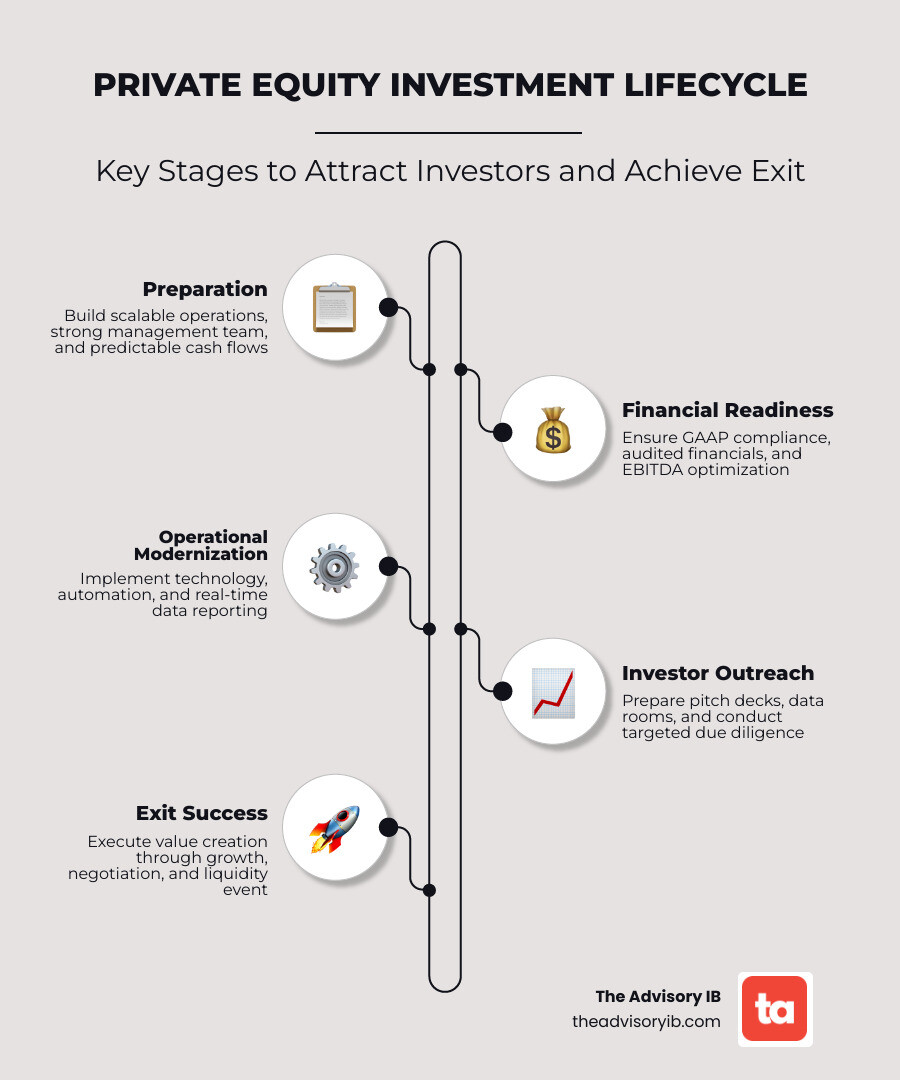
Core Characteristics to Attract Private Equity Investors
When we look at the $7 trillion managed by private equity firms today, we have to realize that this “smart money” isn’t looking for a hobby; they are looking for a machine. To attract private equity investors, your business needs to demonstrate that it can grow efficiently. PE firms prioritize companies with scalable growth potential—meaning you can increase your revenue significantly without a linear increase in costs.
Recurring revenue models are the “holy grail” for investors. Whether it’s through maintenance contracts in HVAC or subscription-based service agreements in plumbing, predictable income reduces risk. This predictability allows PE firms to use leverage (debt) safely, as they know the cash flow will be there to cover interest payments.
Furthermore, a sustainable competitive advantage is non-negotiable. This could be a dominant market position in a specific zip code or a proprietary way you route your technicians to ensure faster service than anyone else. Investors want to know why a competitor can’t simply pop up across the street and steal your lunch. Understanding Why Private Equity Loves Essential Service Businesses is the first step in positioning your firm as a “must-have” asset in a fragmented market.
Building a Management Team to Attract Private Equity Investors
One of the biggest mistakes we see is the “Founder Trap.” If you are the only person who knows how to bid a job or manage the top five customers, you don’t have a business—you have a high-paying job. PE firms invest in companies they can scale, not companies they have to run themselves.
To truly attract private equity investors, you need leadership depth. This means having a “Second-in-Command” (COO or GM) and a capable finance lead who can handle the rigors of institutional reporting. Succession planning is key; an investor needs to see that if the founder decides to go fishing for a month, the business won’t skip a beat.
Alignment is also critical. PE firms often want the management team to keep “skin in the game” through equity. Understanding What Rolling Equity Means for Sellers is vital here, as it aligns your financial interests with the new investors, proving you believe in the future growth of the company.
Financial Preparation and Reliable Cash Flows
If the numbers don’t check out, the deal won’t close. Period. Professional investors expect GAAP-compliant, audited financials. If your books are currently kept on a “cash basis” or managed in a way that mixes personal and business expenses, it’s time for a “financial house cleaning.”
PE firms prioritize EBITDA (Earnings Before Interest, Taxes, Depreciation, and Amortization) improvements. They also love businesses with low capital expenditures (CapEx). If you have to buy a $100,000 piece of equipment every time you want to make an extra $10,000 in profit, your “CapEx” is too high. Essential services are often favored because, once the trucks and tools are bought, the incremental cost of a new service call is relatively low.
Detailed revenue segmentation—breaking down your income by service line, customer type, and geography—provides the transparency investors crave. For a deeper dive into the technical side, check out our guide on Private Equity Accounting M&A.
Competitive Advantages and Market Positioning
What makes your business special? In a sea of service providers, having a defensible advantage is what creates “multiple expansion” (selling for a higher price). This might be a highly recognized local brand or a unique value proposition, like a “2-hour emergency response guarantee” that no one else can match.
Market fragmentation is actually your friend. If you are a leading player in a market with 500 small competitors, a PE firm sees you as a “Platform” company that can buy up those smaller “Add-ons.” When you ask yourself Who Will Buy My Business, PE firms are looking for the strongest foundations to build upon.
Modernizing Operations, Technology, and Pitch Materials
The days of managing a multi-million dollar business on a whiteboard are over. To attract private equity investors in the modern era, you must accept back-office modernization. This isn’t just about being “high-tech”; it’s about data integrity.
A unified Cloud ERP (Enterprise Resource Planning) system allows you to see your margins in real-time. It ensures that when an investor asks for your “customer acquisition cost” (CAC), you can give them a number backed by data, not a “gut feeling.” Furthermore, strengthening your cybersecurity posture is now a non-negotiable due diligence item. Investors want to ensure that a data breach won’t take down the company they just bought.
Leveraging AI to Attract Private Equity Investors
At The Advisory IB, we use AI to bridge the gap between “good” and “great” offers. For a business owner, AI-driven predictive analytics can help you forecast demand, allowing you to staff up before a heatwave or a freeze hits. This tech-enabled scaling proves to an investor that your business is ready for the future.
Digital readiness serves as a strategic signal. It tells the PE firm that you have already done the hard work of professionalizing the “boring” parts of the business—the back office—so they can focus on the “exciting” part: growth.
Creating Compelling Pitch Materials and Data Rooms
When you approach the market, your “first impression” is your pitch deck. It needs to tell a story of where you’ve been and, more importantly, where you’re going. Behind that deck sits the “Data Room”—a secure online repository of every contract, tax return, and employee agreement your business owns.
Being “due diligence ready” can be the difference between a deal that closes in 60 days and one that falls apart in 6 months. Preparation is everything when Selling to Private Equity.
| Feature | Pitch Deck | Data Room |
|---|---|---|
| Purpose | Marketing & Storytelling | Verification & Evidence |
| Audience | Potential Investors (Initial) | Serious Bidders (Due Diligence) |
| Content | Growth Strategy, Team, Vision | Audited Financials, Contracts, Legal |
| Tone | Ambitious & Persuasive | Factual & Comprehensive |
Diversifying Customer Base and Reducing Risk
Customer concentration is a deal-killer. If your largest customer represents 30% of your revenue, a PE firm sees a 30% risk that the business could collapse if that one person leaves. We recommend that no single client represents more than 10-15% of total revenue.
Reducing risk also involves cleaning up legal and compliance issues. Ensure your intellectual property (IP)—like your brand name and logos—is trademarked. Conduct internal regulatory audits to ensure you are compliant with local labor laws and licensing requirements.
Developing a Clear Growth Strategy and Exit Roadmap
A PE firm isn’t just buying your past; they are buying your future. You need a clear, achievable business plan that outlines “Value Creation.” This might include expanding into a neighboring city (geographic expansion) or adding a new service line, like electrical services to an existing HVAC business (cross-selling).
In Private Equity Goes Small to Grow Big, investors are looking for “white space”—untapped opportunities where their capital can accelerate your current success.
Defining Your Exit Strategy and Value Creation
Every PE investor has an “exit” in mind from the day they buy. Usually, they plan to hold the business for 3 to 7 years. During that time, they want to increase the EBITDA and then sell the company to an even larger PE firm or a strategic buyer (like a national corporation).
Understanding Who Do Private Equity Firms Sell To helps you understand what you need to build. If the ultimate goal is an IPO, your reporting needs to be world-class. If the goal is a sale to a strategic buyer, your brand reputation in the industry is paramount.
Platform vs. Add-on Positioning
Are you the “Platform” or the “Add-on”?
- Platform: A large, professionalized company with a strong management team that the PE firm will use to buy other companies.
- Add-on: A smaller company (often $2M – $10M in revenue) that is “tucked into” an existing platform to increase its size.
Knowing Add-on vs Platform What It Means for Selling Your Business changes how you pitch. Platforms command higher multiples because they include the “management engine” required to grow.
Common Mistakes and the Evolving PE Landscape
The PE landscape is more selective today. The “Crash Champions” case study is a perfect example of success: they expanded from 8 shops to over 200 in just three years by leveraging PE capital to consolidate a fragmented industry.
Common mistakes include:
- Mismatched figures: Having different numbers in your pitch deck than in your tax returns.
- Over-reliance on the founder: Not having a team that can run the business.
- Poor timing: Waiting until the business is declining to look for an investor.
Frequently Asked Questions about Private Equity Investment
What is the typical holding period for PE investors?
The average holding period for a private equity investment is between 3 and 7 years. During this time, the firm works to implement operational improvements, drive growth, and professionalize the business before seeking an exit to realize a return for their Limited Partners.
How do PE firms make money from their investments?
PE firms make money through three primary “levers”:
- Operational Improvements: Increasing revenue and cutting unnecessary costs to boost EBITDA.
- Deleveraging: Using the company’s cash flow to pay down the debt used to buy the business.
- Multiple Expansion: Buying a company at a lower multiple (e.g., 6x EBITDA) and selling it at a higher multiple (e.g., 10x EBITDA) because it is now larger and more professional.
For more secrets, see How Do Private Equity Firms Make Money.
What size companies do private equity firms target?
While some mega-funds target multi-billion dollar deals, many firms focus on the “middle market.” This typically includes companies with transaction values between $50 million and $1 billion. However, lower-middle-market firms often look for essential service businesses with $2 million to $100 million in sales. You can learn more about Who Buys My Business Private Equity to see where you fit.
Conclusion
Attracting the right partner is about more than just a paycheck; it’s about finding the strategic capital that will take your legacy to the next level. At The Advisory Investment Bank, we specialize in helping essential service business owners in the $2M to $100M revenue range steer this complex world.
Based in Beverly Hills, CA, and serving major hubs from New York to Dallas and Seattle to Nashville, we are a FINRA-licensed M&A firm that understands the “boots on the ground” reality of your business. Our USP is our AI-driven platform that connects you with the right PE buyers faster, delivering stronger offers through a 100% success-based model. We don’t get paid unless you win.
If you are ready to see what your business is truly worth in today’s private equity market, start your exit planning today and let us help you turn your hard work into a life-changing exit.