
Why Finding the Right Buyer Matters for Your Exit Success
Finding the right buyer isn’t just about getting the highest offer—it’s about aligning your exit goals with a buyer who shares your vision for the business’s future. The wrong buyer can lead to regret, failed deals, and missed opportunities to maximize value. Here’s what you need to know:
Key Steps to Finding the Right Buyer:
- Define Your Ideal Buyer Profile – Determine whether you prioritize maximum valuation, legacy preservation, or a balance of both
- Understand Buyer Types – Strategic buyers typically pay 25% more than financial buyers, but each serves different exit goals
- Engage an M&A Advisor – Sellers working with advisors are 29% more likely to close deals and receive higher sale prices
- Vet Financial Capability – Only 23% of inquiring buyers are truly qualified to complete a transaction
- Run a Competitive Process – Having 5-10 interested buyers maximizes exit potential and creates competitive tension
The statistics tell a sobering story: 75% of business owners regret selling their business, often because they sold to the wrong buyer or failed to prepare adequately. Meanwhile, only 20% of listed small businesses actually sell each year, and there are 40% fewer qualified buyers than most owners expect. The difference between a successful exit and a regrettable one often comes down to how strategically you identify and engage potential buyers.
Strategic buyers—typically competitors or companies in adjacent markets—seek synergies like expanded market share, cost savings, or access to new technologies. They often pay premium valuations but may absorb your brand entirely. Financial buyers, including private equity firms and family offices, focus on return on investment and typically preserve your business’s identity while bringing capital and operational expertise to accelerate growth.
As Oliver Bogner, a two-time Forbes 30 Under 30 honoree who has built and sold five companies with exits to Fortune 500s and private equity firms, I’ve experienced both sides of the M&A table and understand that finding the right buyer requires strategic positioning, competitive processes, and expert guidance. My experience founding The Advisory Investment Bank has shown me that the most successful exits happen when sellers approach buyer identification as a deliberate, methodical process rather than a reactive scramble.
Ready to explore your exit options? Learn more about who will buy your business or schedule a confidential consultation to discuss your specific situation.
Understanding the Landscape: Main Types of Business Buyers
When we sit down with business owners in cities like Houston, TX or Phoenix, AZ, the first question is almost always: “Who is actually going to buy this?” It’s a valid concern. The buyer pool isn’t a monolith; it’s a diverse ecosystem of entities with wildly different motivations. Understanding who will buy my business is the first step in tailoring your marketing narrative.
Generally, we categorize buyers into four main buckets:
- Strategic Buyers: These are usually your competitors or companies in a related vertical. They aren’t just looking at your cash flow; they are looking at how your business makes their business better.
- Financial Partners: This group includes private equity (PE) firms and family offices. They buy businesses based on their ability to generate a return on investment. In 2022 alone, private equity firms invested $712 billion in M&A deals.
- Management Buyouts (MBO): Sometimes the best buyer is sitting right across the hall. An MBO involves your existing leadership team taking the reins, often with the help of outside financing.
- Family Succession: While a beautiful sentiment, the data is tough: only 30% of family businesses make it to the second generation, and a tiny 3% survive to the fourth.
If you are wondering who’s going to buy my business, you must first look at your own goals. Are you cashing out completely, or do you want to stay on for a “second bite of the apple”?
Strategic vs. Financial: Finding the Right Buyer for Your Goals
The choice between a strategic and financial buyer is often a choice between a higher immediate price and the preservation of your company’s independent culture.
Strategic buyers are often willing to pay a premium—sometimes 25% more than financial buyers—because of “synergies.” If a competitor in Chicago, IL buys your plumbing business, they can eliminate duplicate back-office costs, combine routes, and instantly gain your customer list. However, this often means your brand might disappear into theirs.
On the other hand, private equity buyers often prefer to keep the existing brand and team in place. They view your company as a “platform” to build upon.
| Feature | Strategic Buyer | Financial Buyer (PE/Family Office) |
|---|---|---|
| Primary Goal | Operational Synergies | Return on Investment (ROI) |
| Valuation | Often higher (Premium for fit) | Market-based (Multiples of EBITDA) |
| Culture | Integration into parent company | Usually preserved |
| Owner’s Role | Short transition, then exit | Often asked to stay for 3-7 years |
| Legacy | Brand may be absorbed | Brand typically continues |
Aligning Your Exit Strategy with the Right Buyer
Before we go to market, we help our clients build an Ideal Buyer Profile (IBP). This isn’t just a wishlist; it’s a strategic document that answers the “money vs. legacy” question.
If you want to ensure your employees in San Antonio, TX are taken care of and the business name stays on the building for another thirty years, you might lean toward a family office or an internal management buyout. If you are ready to retire to the beach and want the absolute highest check possible, a strategic auction is likely your best bet.
Many owners are now selling to private equity because it offers a middle ground: a significant payout today (“taking chips off the table”) while retaining equity to benefit from the future growth the PE firm will fund.
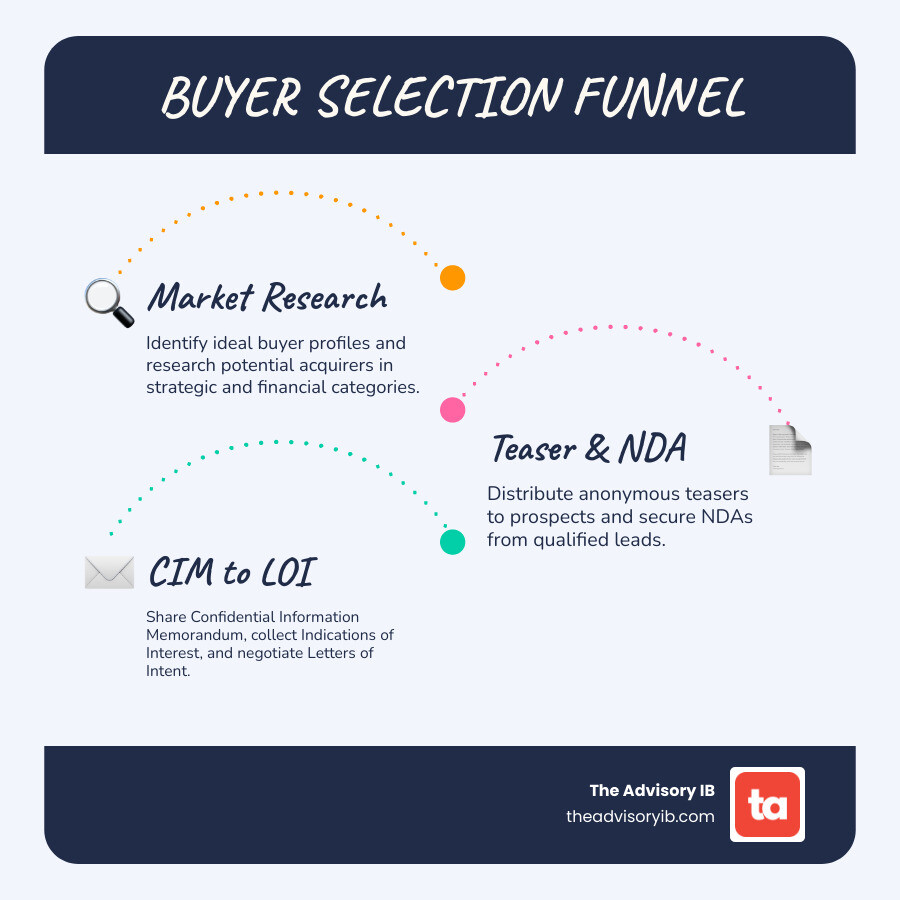
The Step-by-Step Process for Finding the Right Buyer
Finding the right buyer is a marathon, not a sprint. It requires a disciplined, sequential process to ensure confidentiality and maintain leverage.
- Market Research: We identify a broad list of potential “suspects” based on your IBP.
- The Teaser: We send out a one-page, anonymous document that describes the opportunity without naming your company.
- NDA Management: Interested parties must sign a Non-Disclosure Agreement before seeing any sensitive data.
- CIM Distribution: Once vetted, they receive the Confidential Information Memorandum (CIM)—the “story” of your business.
We handle the heavy lifting of finding buyers so you can keep running your company. If you lose focus on the business and your numbers dip during the sale process, buyers will use that as an excuse to lower their offer.
Vetting and Qualifying Potential Leads
One of the biggest mistakes we see is owners getting excited because “someone called and said they want to buy the business.” Here is the reality: Only 23% of buyers who inquire are truly qualified.
If you spend months talking to an unrepresented individual who doesn’t have the cash or a clear financing plan, you aren’t selling your business—you’re wasting your time. We tell our clients to run from unrepresented buyers because they often lack the sophistication to actually close a deal.
When vetting, we look for:
- Financial Capability: Do they have “dry powder” (cash) or a committed line of credit?
- Acquisitive History: Have they done this before? Experienced buyers are much easier to work with.
- Internal Resources: Do they have a team to handle the acquisition, or will they be overwhelmed?
- Cultural Fit: Will they treat your customers in Philadelphia, PA with the same care you do?
Navigating the Selection Funnel: From CIM to LOI
As we move potential buyers through the funnel, the documents become more serious.
- Indication of Interest (IOI): This is a non-binding “ballpark” offer. It tells us who is serious and what they think the business is worth.
- Letter of Intent (LOI): This is the real deal. It outlines the price, terms, and usually includes an exclusivity period (often 30 to 120 days).
During exclusivity, you are “off the market,” so we must be 100% sure the buyer is the right fit before signing an LOI. Confidentiality is paramount here; if your employees or competitors find out you’re selling too early, it can destabilize the whole operation.
Preparing Your Business to Attract Top-Tier Offers
You wouldn’t sell a house in San Diego, CA without cleaning the carpets and painting the walls. Selling a business is no different. Businesses that are well-prepared for sale achieve an average asking price 12% higher than those that are not.
Preparation involves:
- Financial Cleanup: Ensure your books are audit-ready. No more “personal expenses” running through the business.
- SOP Documentation: Can the business run without you? If you are the only one who knows how to fix a specific HVAC unit or manage a specific client in Dallas, TX, you aren’t selling a business—you’re selling a job. Buyers pay more for systems.
- Growth Narrative: Show them where the business could go.
Private equity firms especially love essential service businesses like HVAC, plumbing, and electrical because they offer recurring revenue and recession-proof stability. If you own an “unsexy” business that works every day, you are exactly what the market wants.
Auction vs. Limited Process
How do we actually engage these buyers? There are two main philosophies:
- The Broad Auction: We cast a wide net to hundreds of potential buyers. This creates maximum competitive tension and usually results in the highest price.
- The Limited Process: We target a hand-picked group of 10-20 highly qualified buyers. This is quieter, more confidential, and often preferred by owners of very specialized companies.
Whether you are positioned as an add-on or a platform, the goal is to have 5-10 interested parties at the table. When buyers know they have competition, they move faster and offer better terms.
Frequently Asked Questions about Finding a Buyer
Why is an M&A advisor essential for finding qualified buyers?
Could you sell your business yourself? Maybe. But the data shows that sellers who work with an M&A advisor are much more likely to receive a higher sale price. An advisor provides:
- Access to Networks: We have databases of thousands of PE firms and strategic buyers that you simply can’t find on Google.
- Negotiation Neutrality: We can be the “bad guy” in negotiations, preserving your relationship with the buyer (which is crucial if you are staying on after the sale).
- Higher Closing Rates: Professional advisory services increase the likelihood of closing a deal by 29%.
What are the most common mistakes when trying to find a buyer?
The biggest mistake is lack of preparation. Many owners wait until they are burnt out or have a health scare to sell. By then, the business might be declining, and you’ve lost your leverage.
Another major pitfall is information leakage. If your suppliers in Seattle, WA hear a rumor you’re selling, they might change your credit terms. If your top salesperson in Denver, CO hears it, they might jump ship. A professional process keeps the sale under wraps until the ink is dry.
How long does it typically take to find the right buyer?
From the moment we start research to the day you get your wire transfer, the average timeline is 6 to 12 months.
- Months 1-2: Preparation, valuation, and marketing materials.
- Months 3-4: Marketing and receiving IOIs/LOIs.
- Months 5-8: Due diligence (where the buyer “checks under the hood”).
- Months 9-12: Legal documentation and closing.
Maintaining momentum is key. Deals don’t get better with age; they get “deal fatigue.” Our job is to keep the “spinning plates” moving so the buyer stays engaged.
Conclusion
Finding the right buyer is the final, most important act of your entrepreneurial journey. It’s the difference between a legacy that thrives and a business that fades away.
At The Advisory Investment Bank, we specialize in this exact transition. As a FINRA-licensed M&A firm based in Beverly Hills, CA, we focus exclusively on essential services businesses with $2-100M in sales. Our USP is our AI-driven platform that identifies the perfect private equity or strategic buyer faster than traditional methods, delivering stronger offers through a 100% success-based model. We don’t get paid unless you win.
Whether you are in Washington, DC, Boston, MA, or right here in California, we are ready to help you steer the art of the sale.
Ready to see what your business is worth in today’s market? Start your exit planning today and let us find the buyer your legacy deserves.