
What Is a Business Exit Strategy? (And Why It Matters More Than You Think)
A business exit strategy is a plan that defines how a business owner will transfer or reduce their ownership in a company — whether by selling to a buyer, passing the business to family, or winding it down — while maximizing the value they walk away with.
Here is a quick overview of what you need to know:
| Key Question | Quick Answer |
|---|---|
| What is it? | A plan to transfer ownership and convert business value into personal financial outcomes |
| Who needs one? | Every business owner — not just those planning to sell soon |
| When to start? | 3-5 years before your intended exit |
| Most common options | Strategic sale, private equity, management buyout, family succession, ESOP, IPO, liquidation |
| Biggest mistake | Waiting too long to plan |
| What drives value? | Clean financials, owner independence, diversified customers, scalable systems |
Despite the stakes involved, research shows that 68% of business owners are unfamiliar with their exit options — and over 70% of businesses listed for sale never close a transaction. For founders who have spent years building something real, that is a sobering number.
The truth is, a business exit strategy is not just an endgame decision. It shapes how you build your business from day one — what systems you create, which customers you serve, how you structure your finances, and whether your company can stand on its own without you. The owners who plan early do not just exit better. They build better businesses along the way.
Whether you are actively exploring a sale or simply want to understand your options, this guide covers everything you need to know: the most common exit types, how valuation works, how to maximize what you walk away with, and how to avoid the mistakes that cost founders millions.
I am Oliver Bogner — Managing Partner of The Advisory Investment Bank, a two-time Forbes 30 Under 30 honoree, and a founder who has personally navigated a business exit strategy five times, with exits to Fortune 500s and private equity firms. My experience on both sides of the table is the foundation of everything in this guide.
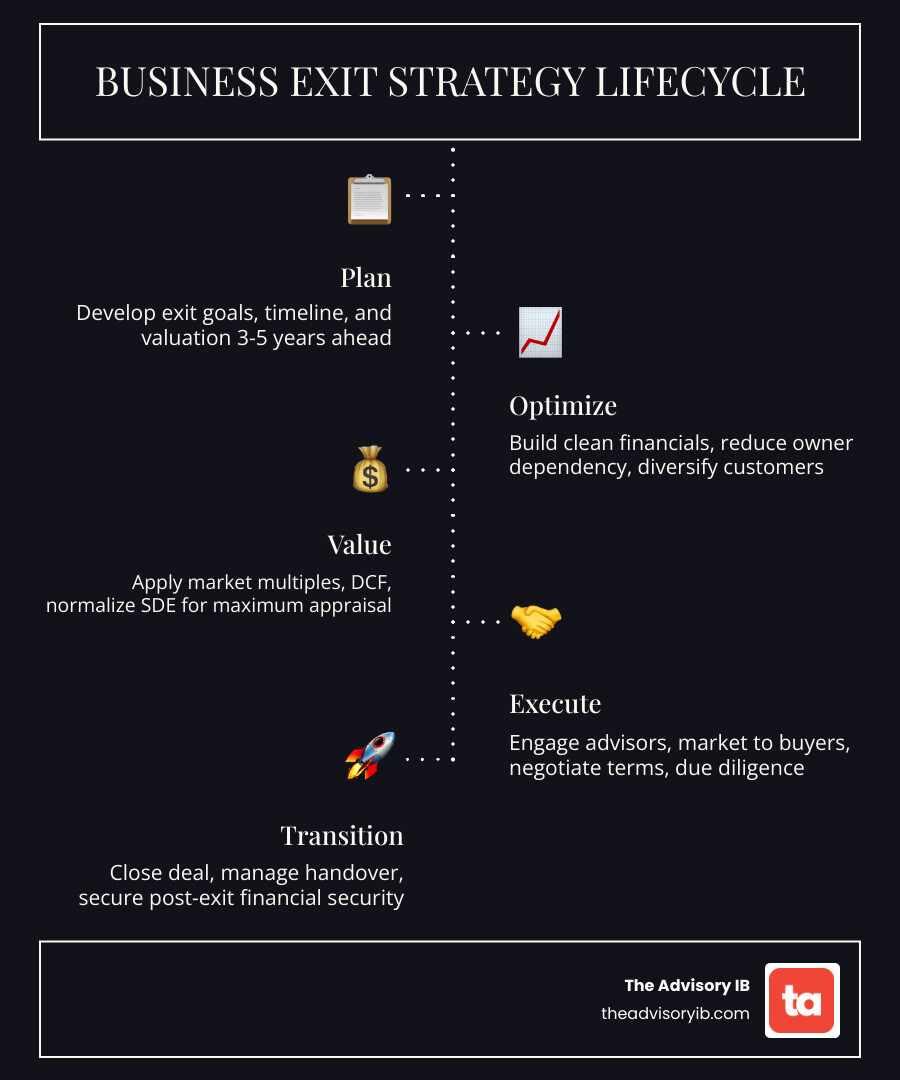
Why Every Owner Needs a Business Exit Strategy
Think of a business exit strategy as a “pre-nuptial agreement” with your company. You might be head-over-heels in love with your business today, but Why Every Founder Needs a Pre-Nup With Their Business is about acknowledging that one day, the relationship will end. Whether it’s due to retirement, a new venture, or an unexpected life event, you want to leave on your own terms.
Risk Mitigation and Financial Security
Without a plan, you are vulnerable. If a health crisis or market shift forces a sudden departure, you may be forced to sell at a “fire sale” price. A proactive strategy mitigates this risk by ensuring the business is always “sale-ready.” This provides a safety net for your family and ensures your life’s work doesn’t vanish overnight.
Capturing the “Boomer Wave”
We are currently entering one of the most significant periods of wealth transfer in history. As thousands of Baby Boomer business owners reach retirement age, the market will be flooded with companies for sale. The Boomer Exit Wave Is Real (And So Is the Opportunity), but it also means competition for high-quality buyers will be fierce. Having a sophisticated business exit strategy ensures your company stands out to private equity and strategic acquirers.
Goal Alignment and Market Timing
A well-crafted plan aligns your personal financial goals with market reality. It helps you identify the “top of the market” rather than guessing. By monitoring industry multiples and economic cycles, we can help you time your exit to achieve maximum liquidity.
Common Types of Business Exit Strategies
Choosing the right path depends on your goals: Do you want the highest possible check? Do you want to preserve your legacy? Or do you want your employees to take over the reins?
| Exit Option | Best For… | Primary Benefit |
|---|---|---|
| Strategic Acquisition | Maximizing Sale Price | Synergies drive higher multiples |
| Private Equity | Growth & Partial Liquidity | “Second bite of the apple” via recapitalization |
| Management Buyout | Continuity | Seamless transition to known leaders |
| Family Succession | Legacy | Keeping the business in the family |
| ESOP | Employee Culture | Significant tax benefits and employee loyalty |
| IPO | Massive Scale | Prestige and public capital (rare for most) |
| Liquidation | Winding Down | Quickest exit, but often lowest value |
Internal vs. External Business Exit Strategy Options
When evaluating your business exit strategy, we generally categorize options into internal and external transfers.
Internal Options focus on people who already know the business. This includes family members or your management team. While these options are great for legacy preservation, they often come with challenges. For instance, over 50% of owners want to pass their business to family, but only 30% successfully do so. If you choose this path, you must be careful: Don’t Leave Your Family a Mess: Your Business Succession Plan Starts Here.
External Options involve selling to a third party. This is where most owners find the highest valuations. Whether you are looking at Business Exit Planning in Boston, MA or Austin, TX, external buyers like strategic competitors or private equity firms have the capital to pay for the “future value” of your company.
One popular external middle ground is Recapitalization. This allows you to sell a majority stake to a financial buyer (like private equity), take some chips off the table, and stay on to grow the business for a second, even larger exit later.
The Role of Valuation in a Business Exit Strategy
You cannot plan an exit if you do not know what your business is worth. Valuation is not just about looking at last year’s tax returns; it’s a complex analysis of your company’s “transferable value.”
Key components of valuation include:
- SDE/EBITDA Normalization: We look for “add-backs”—one-time expenses or personal perks—to show the true earning power of the business.
- Market Multiples: What are similar companies in your industry selling for right now?
- Intangible Assets: Your brand, proprietary systems, and customer loyalty often drive the price higher than your physical assets ever could.
- Discounted Cash Flow: A look at what your future earnings are worth in today’s dollars.
Understanding these metrics is a core part of Exit Planning. For essential services businesses with $2-100M in sales, Business Exit Strategy often hinges on showing a buyer that the profit is sustainable and scalable.
How to Maximize Value Before Your Exit
If you want to Sell My Business for a premium, you cannot just be a “profitable” company; you must be an “investable” one. This requires shifting your focus from day-to-day operations to value-building.
1. Eliminate Owner Dependency
The biggest value killer is a business that cannot run without the owner. If you are the primary salesperson, the chief problem solver, and the only one with the “secret sauce,” a buyer will see you as a risk. To maximize value, you must document every process and empower a management team to lead.
2. Clean Up the Financials
Buyers hate surprises. You need at least three years of clean, GAAP-compliant financial statements. If your books are a mess, a buyer will either walk away or slash their offer to account for the risk.
3. Diversify Your Customer Base
If one customer accounts for more than 15-20% of your revenue, you have “customer concentration” risk. Broadening your client base makes your revenue stream much more attractive to private equity.
4. Build Scalable Systems
Whether you are Crafting Your Entrepreneurial Exit Plan in Jacksonville or Seattle, buyers look for systems that can handle 10x growth. This includes your CRM, your hiring process, and your technology stack.
For a deeper dive into these value drivers, check out The Definitive Guide to Selling Your Business.
Key Steps to Implementing a Successful Exit Plan
A successful business exit strategy is a marathon, not a sprint. It usually takes 6 to 12 months just to execute a transaction, but the preparation should start years earlier.
Step 1: Assemble Your “A-Team”
Don’t try to DIY your exit. You need a team of specialists, including an M&A attorney, a tax-focused CPA, and a specialized investment bank. We use AI-driven platforms to identify the best buyers and create a competitive bidding environment that drives up your price.
Step 2: Conduct Due Diligence Early
Don’t wait for a buyer to find the “skeletons in your closet.” Perform your own due diligence first. Fix legal issues, secure your intellectual property, and ensure all contracts have “successor clauses” so they remain valid after the sale. This is a critical part of The Official Guide to Navigating Your Business Exit.
Step 3: Identify and Vet Buyers
Not all money is good money. You want a buyer who fits your culture and can actually close the deal. Whether you are seeking Exit Strategy Excellence: Planning Your Business’s Next Chapter in Austin or looking for a national acquirer, vetting for financial capability and industry experience is vital.
Step 4: Negotiation and Closing
This is where the “deal fatigue” sets in. Negotiating terms—like earn-outs, holdbacks, and transition periods—requires a steady hand. Once the deal is signed, Post-Exit Planning begins, helping you manage your new wealth and figure out your “life after business.”
Frequently Asked Questions about Business Exits
When is the right time to start planning?
The best time was the day you started the business. The second best time is today. Ideally, you want a 3-5 year window to optimize your value. Many owners fall for the Myth of the Perfect Time to Sell, waiting for a “magic number” that may never come. Instead, plan for operational readiness so you can strike when market cycles are in your favor.
What are common mistakes to avoid?
The most frequent errors include:
- Overestimating Value: Getting emotionally attached to a number that the market won’t support.
- Poor Confidentiality: Letting employees or competitors know you are selling too early, which can cause panic.
- Lack of Records: Trying to sell a business with “shoebox” accounting.
- Ignoring the Emotional Side: Not being prepared for the loss of identity that comes after an exit.
Before you list, ask yourself: Should You Sell Your Business in the Next 12 Months?
How do taxes impact my exit?
Taxes can eat up 20% to 50% of your sale proceeds if you aren’t careful. The structure of the deal—whether it is an asset sale or a stock sale—has massive implications for your capital gains. Why Most Business Owners Will Miss the Greatest Wealth Transfer in US History is often because they didn’t have a tax-efficient business exit strategy in place.
Conclusion
Exiting your business is likely the most significant financial event of your life. You shouldn’t leave it to chance. At The Advisory IB, we specialize in helping owners of essential services businesses—from HVAC and plumbing to healthcare and B2B services—achieve the exits they deserve.
Based in Beverly Hills but serving clients in major hubs like New York, Chicago, Houston, and Phoenix, we use a proprietary, AI-driven M&A platform to connect businesses with $2-100M in sales to the most aggressive private equity buyers. Our 100% success-based model means we are fully aligned with your goals: we only win when you win.
Ready to see what your business is truly worth? Let’s build your Entrepreneur Exit Services plan together. Visit us at https://theadvisoryib.com/ to start your journey toward a clean, lucrative exit.