
Understanding the Business Exit Planning Strategy
A business exit planning strategy is a comprehensive roadmap that prepares your company, your finances, and your stakeholders for the eventual transfer of ownership—whether through a sale, succession, or other transition. Most business owners will exit their companies within the next decade, yet shockingly, 50% have no formal exit plan in place, and 92% haven’t put their plans in writing.
Quick Answer: The 5 Core Components of a Business Exit Planning Strategy
- Define Your Goals – Determine your financial needs, timeline, and post-exit lifestyle objectives
- Build Your Advisory Team – Assemble M&A advisors, tax professionals, legal counsel, and financial planners
- Maximize Business Value – Strengthen financials, diversify customers, and build management depth
- Choose Your Exit Path – Select between strategic sale, private equity buyout, family succession, or other options
- Execute with Precision – Maintain confidentiality, negotiate favorable terms, and communicate transparently with stakeholders
The statistics are sobering: 69% of business owners plan to exit within 10 years, yet 68% haven’t even discussed their plans with their spouse or family. Perhaps most concerning, 85% have no one ready to replace their skills or responsibilities. This gap between intention and preparation creates significant risk—not just to the business’s value, but to the owner’s financial security and legacy.
Exit planning isn’t just about the endgame. It’s a mindset shift that transforms how you run your business today. When you plan with the exit in mind, every decision—from hiring key managers to documenting processes to diversifying your customer base—becomes an investment in future value. Research shows that proper exit planning typically takes 3-5 years, and businesses that follow a structured approach consistently achieve higher valuations and smoother transitions.
The best time to start planning your exit was five years ago. The second-best time is today. Whether you’re considering a strategic acquisition, exploring private equity interest, or preparing to pass the business to family members, the principles remain the same: start early, assemble the right team, focus relentlessly on value creation, and execute with discipline.
I’m Oliver Bogner, Managing Partner of The Advisory Investment Bank, and I’ve personally navigated business exit planning strategy from both sides of the table—building and selling five companies before founding The Advisory to help essential service business owners achieve life-changing exits. My mission is to level the playing field between Wall Street buyers and Main Street sellers through expert guidance and competitive M&A processes.
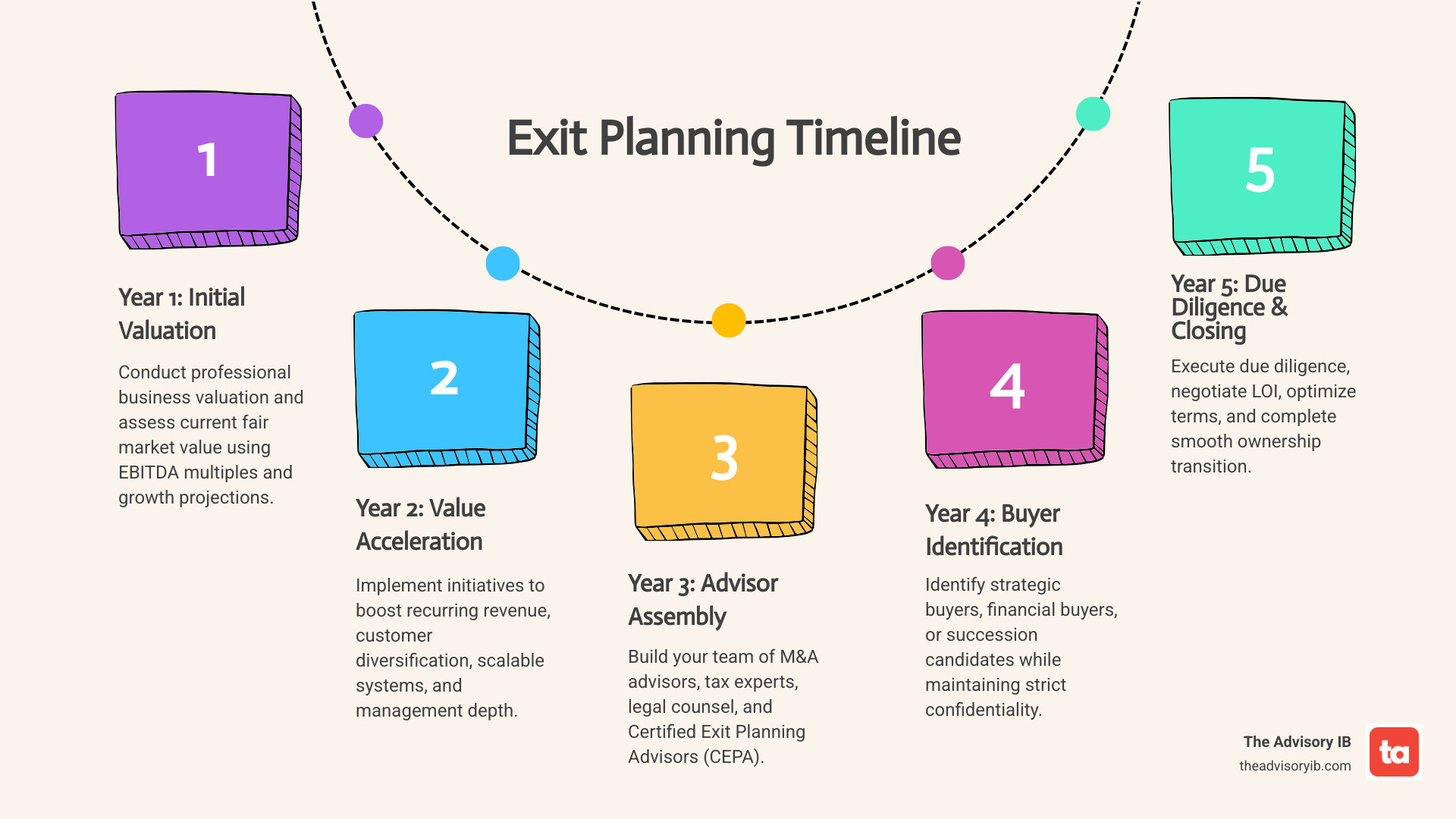
Why Every Owner Needs a Business Exit Planning Strategy
The reality of business ownership is that you will eventually leave your company. It is not a matter of if, but when. Without a business exit planning strategy, you leave your legacy and your net worth to chance. We are currently entering a period of massive transition; over $2 trillion in business assets are at stake as the majority of small business owners plan to exit over the next decade.
If you don’t have a written plan, you are part of the 92% of owners who are statistically likely to miss out on the full value of what they’ve built. This is particularly dangerous considering that Why Most Business Owners Will Miss the Greatest Wealth Transfer in US History highlights how a lack of preparation can lead to “deal fatigue” or leaving significant money on the table.
A proactive strategy allows for:
- Legacy Preservation: Ensuring the business continues to serve the community and its employees.
- Risk Mitigation: Protecting against the “5 Ds”—death, disability, divorce, distress, and disagreement.
- Stakeholder Alignment: Getting family members, partners, and key employees on the same page before the “For Sale” sign goes up.
The Role of Professional Advisors in Your Transition
You wouldn’t perform surgery on yourself, and you shouldn’t try to navigate a multi-million dollar exit alone. A successful Exit Planning process requires a multidisciplinary team. No single professional can handle the tax, legal, financial, and operational complexities involved.
Your “A-Team” should include:
- M&A Advisors/Investment Bankers: To run a competitive process and find the right buyers.
- Tax Professionals/CPAs: To ensure you keep as much of the sale price as possible after Uncle Sam takes his cut.
- Legal Counsel: To draft the airtight contracts that protect you post-sale.
- Financial Planners: To ensure the proceeds of the sale will actually fund your desired lifestyle.
- Certified Exit Planning Advisors (CEPA): Professionals specifically trained in the Value Acceleration Methodology™ to align your business, personal, and financial goals.
Common Types of Business Exit Strategies
Choosing the right path depends on your specific goals—do you want the highest possible price, or is it more important that your employees are taken care of?
| Strategy | Best For | Pros | Cons |
|---|---|---|---|
| Strategic Sale | Maximizing Price | Highest valuation due to synergies | High confidentiality risk; cultural shifts |
| Private Equity Buyout | Growth & Liquidity | Significant upfront cash; future “second bite” | Loss of full control; focus on aggressive growth |
| Management Buyout | Continuity | Seamless transition; known successor | Often requires seller financing; lower price |
| Family Succession | Legacy | Keeps the business in the family | Emotional complexity; tax hurdles |
Selecting the Right Business Exit Planning Strategy for Your Goals
There is no “one-size-fits-all” answer. When we work with owners in cities like Houston, Austin, or San Diego, we start by asking: “What does a ‘win’ look like for you?”
If you need maximum liquidity to fund a lavish retirement, a strategic sale to a larger company is often the best Business Exit Strategy. However, if you want to see your name stay on the building, family succession might be the goal. In those cases, remember: Don’t Leave Your Family a Mess: Your Business Succession Plan Starts Here. You must objectively evaluate if your family members have the skills to lead, or if you are simply passing them a burden they aren’t prepared for.
Internal vs. External Exit Options
Broadly, your options fall into two buckets: internal and external.
Internal Options:
- Management Buyouts (MBO): Selling to your current leadership team. This minimizes due diligence because they already know where the “bodies are buried.”
- Employee Stock Ownership Plans (ESOP): A tax-advantaged way to sell the business to your employees over time.
- Partner Buyouts: If you have co-owners, they may have the right of first refusal to buy your shares.
External Options:
- Third-Party Sales: This is where our Entrepreneur Exit Services shine, using AI to match your business with the perfect strategic or financial buyer.
- IPOs: While often called the “holy grail,” initial public offerings are incredibly expensive and rare for mid-market companies.
- Asset Sales: Selling the “stuff” (equipment, real estate, inventory) rather than the entity itself. This is common in liquidation scenarios if a buyer for the ongoing concern cannot be found.
How to Determine and Maximize Business Value
Before you can exit, you need to know what the “number” is. A formal business valuation is the first step. Most essential services businesses are valued based on a multiple of EBITDA (Earnings Before Interest, Taxes, Depreciation, and Amortization).
However, we don’t just look at the raw numbers. We perform EBITDA normalization. This means adding back one-time expenses (like that personal vehicle you run through the company) or adjusting for above-market rent. This ensures we show the buyer the “true” profitability of the business. Understanding Business Sale Preparation involves identifying these “add-backs” early so they don’t surprise you during due diligence.
Key Value Drivers for Essential Services
In HVAC, plumbing, and home services, certain factors act as “multipliers” for your value. If you are operating in Austin or Phoenix, buyers are looking for:
- Recurring Revenue: Maintenance agreements are gold. A buyer would much rather buy a company with 2,000 service contracts than one that relies entirely on emergency calls.
- Customer Diversification: If one customer represents more than 10% of your revenue, you have “concentration risk.”
- The Switzerland Structure: This is a concept from the Exit Planning Institute where your business is neutral and independent. It shouldn’t rely too heavily on one vendor, one customer, or—most importantly—one employee (including you!).
- Management Depth: Can the business run for a month if you go to Hawaii? If the answer is no, your business is a “job,” not an asset, and its value will suffer.
- Scalable Systems: Having documented SOPs (Standard Operating Procedures) makes your business “transferable.”
For a deeper dive into these metrics, see our guide on Exit Strategy Excellence: Planning Your Business’s Next Chapter in Austin.
Preparing Your Financials for Due Diligence
When you decide to Sell My Business, the buyer’s accountants will descend upon your books like hawks. Preparation is the best defense.
- Clean Books: Ensure personal and business expenses are strictly separated.
- Audited or Reviewed Statements: Having a third-party CPA review your books adds a layer of trust that can actually increase the final sale price.
- Working Capital Optimization: Clean up your accounts receivable. No buyer wants to pay for 90-day-old invoices that might never be collected.
Key Steps to Execute a Successful Transition
Once you have a business exit planning strategy and a clean set of books, it’s time to go to market. This process usually begins with a Letter of Intent (LOI). This is a non-binding document that outlines the price and terms. It’s the “engagement” before the “marriage.”
Mitigating Risks During the Exit Process
The period between signing an LOI and closing the deal is the most dangerous time for a business owner. This is where “deal killers” lurk.
- Confidentiality: If your employees or competitors find out you’re selling too early, it can cause panic. Use NDAs for every potential suitor.
- Stay Bonuses: To prevent key managers from leaving during the transition, consider “stay bonuses” that pay out only if they remain with the new owner for a certain period.
- Key Man Insurance: Protect the deal against the unexpected.
- The Myth of the Perfect Time: Don’t wait for the “peak” of the market. As we discuss in the Myth of the Perfect Time to Sell, the best time to sell is when the business is performing well and you are ready.
Communicating the Plan to Stakeholders
Transparency is a delicate balance. You don’t want to announce a sale before it’s certain, but you also don’t want your team to hear it through the grapevine.
- Employees: Focus on their future. Explain how the new owner will provide more opportunities for growth.
- Customers: Ensure them that the service quality they love won’t change.
- Family: This is often the hardest part. Ensure your Post-Exit Planning includes a clear vision for your life after the business so you don’t experience “seller’s remorse.”
Frequently Asked Questions about Business Exits
When should a business owner start planning their exit?
Ideally, 3 to 5 years before you want to leave. This gives you enough time to “clean the house,” improve your margins, and find a replacement for yourself. However, even if you want to sell in six months, starting a formal strategy today is better than winging it.
What are the most common exit planning mistakes?
- Unrealistic Valuation: Thinking your business is worth $10M because your neighbor’s sold for that, without looking at the actual multiples.
- Lack of Documentation: If your processes are all in your head, the business isn’t transferable.
- Poor Tax Structuring: Failing to consult a tax pro early can result in losing 40% or more of your proceeds to taxes.
- Over-reliance on the Owner: If you are the lead salesperson and the lead technician, the business has little value to a buyer.
How do I determine the value of my business for an exit?
While you can use online calculators, a professional appraisal is essential for a high-value exit. We look at industry benchmarks, current market conditions in cities like Dallas or Chicago, and normalized EBITDA. Proper Business Sale Preparation ensures we present your value in the best possible light.
Conclusion
Exiting your business is likely the most significant financial event of your life. You’ve spent years, perhaps decades, building your company. Don’t leave the final chapter to chance. A well-executed business exit planning strategy ensures that you receive the maximum value for your hard work while securing a lasting legacy for your employees and family.
At The Advisory IB, we specialize in helping owners of essential services businesses—from HVAC in Phoenix to plumbing in Philadelphia—navigate this complex journey. Our AI-driven platform is designed to deliver faster, stronger offers by connecting you with the right private equity partners and strategic buyers. Best of all, we operate on a 100% success-based model. We don’t get paid unless you get the result you deserve.
Start your business exit strategy today and let us help you turn your years of hard work into a rewarding future.