
Understanding the Role of a Business Broker
Hiring a business broker is one of the most important decisions you’ll make when selling your company — and getting it wrong can cost you years of time, significant money, and a deal that never closes.
Here’s a quick overview of how to hire a business broker the right way:
- Define your goals — Know your target sale price, timeline, and deal structure before approaching anyone.
- Verify industry specialization — Look for a broker with direct experience selling businesses in your sector.
- Check credentials — Look for designations like Certified Business Intermediary (CBI) and FINRA licensing for larger transactions.
- Review their track record — Ask for closing ratios and comparable sales, not just listings. The industry average closing rate is below 20%.
- Understand the fee structure — Know exactly what you owe, when you owe it, and whether fees are tied to a successful outcome.
- Scrutinize the listing agreement — Exclusive agreements can lock you in for 12 to 24 months, so read every term carefully.
- Assess buyer access — Ask how they find qualified buyers and how they screen out unserious prospects.
The stakes are high. Research consistently shows that less than 20% of businesses listed for sale ever actually close — yet brokered businesses that do sell tend to achieve 15% to 20% more than those sold without professional help. The difference between those outcomes often comes down to who you hire and how well they run the process.
For founders of profitable essential services businesses — HVAC companies, plumbing operations, landscaping firms, and similar trades — the challenge is even more specific. You’re not just selling a business. You’re navigating a competitive private equity landscape where buyers are sophisticated, valuations are complex, and the wrong advisor can leave serious money on the table.
I’m Oliver Bogner, Managing Partner of The Advisory Investment Bank and a licensed investment banker (FINRA Series 7, 63, 79) who has personally built and sold five companies before advising others on how to hire a business broker and execute successful exits. That dual perspective — as both a founder and a deal professional — shapes everything in this guide.
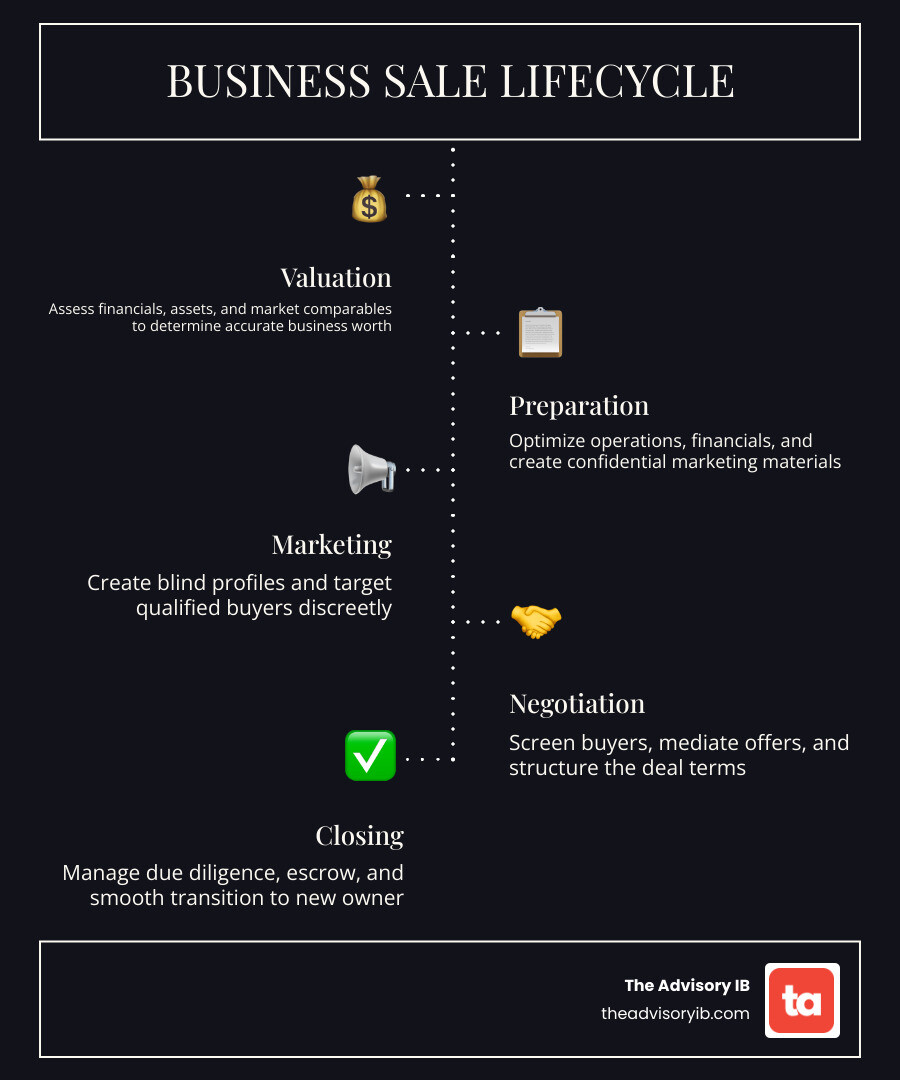
When you decide to hire a business broker, you are bringing on a professional intermediary to act as the bridge between your life’s work and a qualified buyer. Think of them as the “quarterback” of your Business Exit Strategy. Their primary role is to manage the transaction from end to end, allowing you to focus on what matters most: keeping your business profitable during the sale process.
The market for private businesses is incredibly complex. Unlike selling a home, where the price is public and the neighbors know it’s for sale, a business sale requires absolute discretion. A broker provides essential transaction management services, including the creation of marketing materials that highlight your company’s strengths without revealing its identity.
One of the most valuable tasks a broker performs is buyer screening. In the “wild west” of business sales, you will encounter many “tire kickers”—individuals who are curious about your numbers but lack the capital or experience to actually close. An effective broker filters these prospects, ensuring that only those with a signed Non-Disclosure Agreement (NDA) and proven financial capability get a look under the hood.
Furthermore, brokers handle the heavy lifting of Mergers & Acquisitions. This includes setting up secure data rooms for due diligence and maintaining strict confidentiality protocols. If your employees, customers, or competitors find out you are selling before a deal is signed, it can destabilize your operations and decrease your company’s value. A professional broker ensures that doesn’t happen.
Key Services When You Hire a Business Broker
The services provided by a broker go far beyond just “listing” a business. When you hire a business broker, you are paying for a comprehensive suite of professional services:
- Business Valuation: A broker uses financial modeling and market analysis to determine what your business is actually worth. While some brokers may provide an overly optimistic number just to get your listing, a high-quality advisor provides a realistic range based on recent comparable sales.
- Marketing Strategy: They develop a “CIM” (Confidential Information Memorandum) or a “blind profile” that markets the opportunity to their network and online platforms without naming your company.
- Negotiation Mediation: Emotions run high when selling a “business baby.” A broker acts as a buffer, handling the back-and-forth on price, earn-outs, and seller carry so that the relationship between you and the buyer remains professional.
- Due Diligence Management: This is where most deals die. Your broker helps with Business Sale Preparation, organizing your tax returns, equipment lists, and lease agreements so the buyer’s auditors can move quickly.
How to Evaluate and Hire a Business Broker
Choosing the right partner is the difference between a successful exit and a wasted year. Because the industry is largely unregulated, anyone can call themselves a “business broker.” This makes your evaluation process critical.
Start by looking for industry specialization. If you own an HVAC or plumbing business, a broker who typically sells coffee shops or dry cleaners may not understand your “adjacencies” or how to value your recurring maintenance contracts. You want someone who speaks the language of your specific trade.
We recommend looking at regional expertise as well. Whether you are seeking Business Broker Services in Jacksonville, FL, Business Broker Services in Boston, MA, or Business Broker Services in Charlotte, NC, a broker with local roots often has a deeper rolodex of local buyers and specialized attorneys.
When interviewing, ask for their closing ratios. As noted earlier, the industry average is abysmal—less than 20% of businesses on the market actually sell. If a broker has a 90% success rate, ask them to prove it. Also, be wary of the length of their exclusive listing agreements. Many traditional brokers will try to lock you into a 12 to 24-month contract. If they aren’t performing, you don’t want to be stuck in “broker jail” while your business value fluctuates.
Qualifications to Look For Before You Hire a Business Broker
Before you sign on the dotted line to Sell My Business, verify these key qualifications:
- Certified Business Intermediary (CBI): This designation from the International Business Brokers Association (IBBA) indicates the broker has met high standards of education and ethical practice.
- Financial Expertise: Do they understand EBITDA, SDE, and working capital pegs? If they can’t explain your financial statements better than you can, they won’t be able to defend your price to a sophisticated private equity buyer.
- Communication Style: You will be talking to this person daily for months. If they are unresponsive during the “honeymoon phase” of the interview, imagine how they will behave when a deal gets difficult during due diligence.
- Professional References: Ask to speak with three former clients who sold businesses in the last 18 months. Specifically, ask them if the broker was still active after the Letter of Intent (LOI) was signed.
The Process of Working with a Broker from Listing to Closing
The journey of selling your business is a marathon, not a sprint. It typically begins with an initial consultation where the broker reviews your goals and financials. From there, they create “blind profiles”—one-page summaries that describe your business (e.g., “$5M Revenue HVAC Company in Phoenix”) without giving away the name.
Once a potential buyer expresses interest, the broker vets them. This isn’t just about a signature; it’s about verifying they have the funds. If the buyer passes, they receive the full marketing package. If they like what they see, they submit an LOI.
After an offer is accepted, you enter the due diligence phase. Your broker will manage the “data room,” a secure online folder where all your business records are kept. They also coordinate with escrow agents and attorneys to ensure the paperwork is in order for the final “closing.”
A great broker doesn’t stop at the signature. They help with transition planning, ensuring that employee retention is addressed and that you have a clear path for handing over the keys.
| Feature | Broker-Led Sale | DIY Sale (Solo) |
|---|---|---|
| Average Sale Price | 15-20% Higher | Market Average or Lower |
| Confidentiality | High (Intermediary Layer) | Low (Owner is the face) |
| Buyer Reach | Global/Proprietary Networks | Limited to Personal Network |
| Success Rate | Higher with Specialists | Very Low for First-Timers |
| Time Commitment | Owner stays focused on Ops | Owner is distracted by “tire kickers” |
Frequently Asked Questions about Business Brokers
How do brokers maintain confidentiality during the sale?
Brokers use a multi-layered approach. First, they use “blind listings” that omit the business name and exact location. Second, no detailed information is released until a prospect signs a legally binding Non-Disclosure Agreement (NDA). Third, high-end firms use secure, encrypted data rooms to track exactly who has viewed which document. Finally, they often perform buyer qualification checks to ensure the person asking for info is a legitimate competitor or investor, not just a curious employee.
Do business brokers help with valuation accuracy?
Yes, but with a caveat. A professional broker uses market analysis and qualitative factors (like the strength of your management team or your “essential service” status) to build a financial model. However, be cautious of “valuation inflation”—where a broker gives you a high number just to win your business. A truly accurate valuation should be based on real-world data and what private equity is currently paying for similar firms in your industry.
When is the best time to engage a broker?
The best time is usually 12 to 24 months before you want to exit. This allows for proper succession planning and gives you time to “clean up the books.” If you wait until you are burnt out or facing a health crisis, you lose your negotiation leverage. Engaging a broker when your revenue is stable or growing—rather than during a plateau—will always yield a stronger offer.
Conclusion
When you are ready to hire a business broker, you aren’t just looking for a salesperson; you are looking for a strategic partner who understands the high stakes of your transition. At The Advisory IB, we do things differently. As a FINRA-licensed M&A firm based in Beverly Hills, we specialize in selling essential services businesses with $2M to $100M in sales.
Our AI-driven platform is designed to find the right private equity buyers faster, delivering stronger offers through a sophisticated, data-backed process. We believe in our results, which is why we operate on a 100% success-based model—we only win when you win.
Whether you are in New York, Chicago, Houston, Phoenix, or any of our other US locations, we are here to ensure your exit is as successful as the business you’ve built. When you are ready for a faster, smarter way to sell, Hire a Business Broker who leverages the future of M&A technology to protect your legacy.