
Why Building Transferable Value Determines Your Exit Success
Increase business value isn’t just about boosting revenue or cutting costs—it’s about creating a business that can thrive without you, command premium multiples, and attract serious buyers when you’re ready to exit. Most essential service business owners wait too long to think strategically about their exit, only to discover their company isn’t as attractive to private equity firms and strategic buyers as they assumed. In fact, only 20% to 30% of businesses that go to market actually sell, and 70% to 80% of owners who think they’re ready discover significant gaps that kill deals or crater valuations.
The key factors that increase business value before a sale:
- Reduce owner dependency through documented systems, processes, and a capable management team
- Diversify your customer base so no single client represents more than 10-15% of revenue
- Build recurring revenue streams that demonstrate predictable, sustainable cash flow
- Clean up your financials with consistent, buyer-ready statements and normalized EBITDA
- Strengthen competitive advantages through proprietary methods, IP, or scalable models
- Demonstrate operational independence with systems that run smoothly during your absence
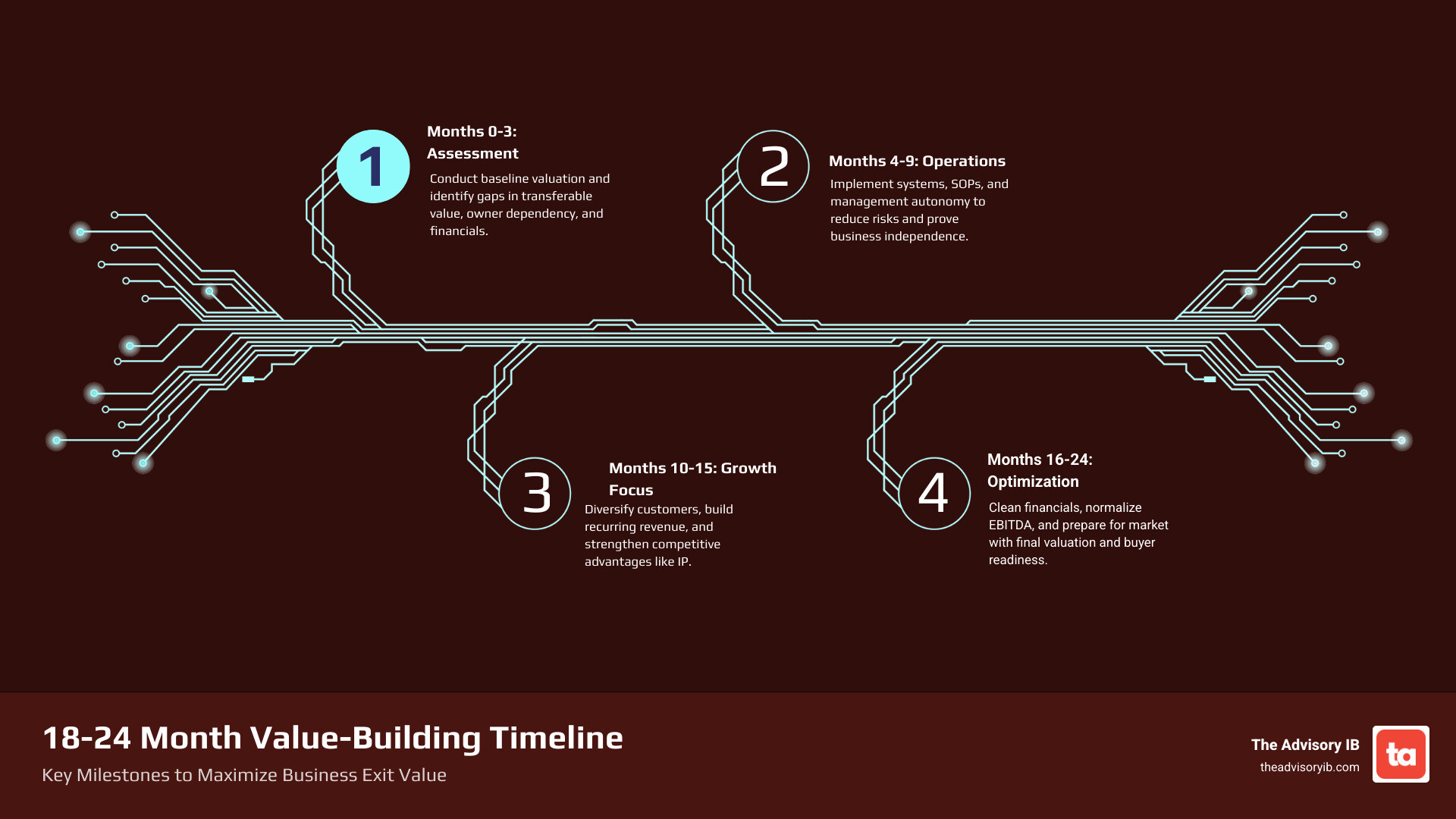
The timeline matters: most strategic value-building investments show initial results within 6-12 months, with full impact realized over 18-24 months. That means the best time to start building value is years before you plan to exit—not when you receive an unsolicited offer or suddenly decide it’s time to sell.
I’m Oliver Bogner, a two-time Forbes 30 Under 30 honoree and Managing Partner of The Advisory Investment Bank, where I’ve guided hundreds of essential service businesses through the process to increase business value and achieve premium exits. After building and selling five companies myself—with exits to Fortune 500s and private equity firms— I founded The Advisory to help Main Street founders navigate the power imbalance with Wall Street buyers.
Strategies to Increase Business Value Before a Sale
When we talk about how to increase business value, we have to look past the top-line revenue. A buyer isn’t just buying your past success; they are buying your future cash flow. This is where buyer psychology comes into play. Buyers are inherently risk-averse. Every “red flag”—whether it’s a messy balance sheet or a business that can’t run without the founder—is viewed as a risk that lowers the EBITDA multiple they are willing to pay.
To maximize your exit, you must focus on building “transferable value.” This is the worth of your business to a buyer in your absence. If the business relies on your personal relationships or your specific technical “magic” to function, it has very little transferable value. By focusing on Business Valuation early, you can identify which intangible assets—like your brand reputation, proprietary processes, and employee talent—need strengthening to justify a premium price.
Why Preparation is the Key to Increase Business Value
According to the Exit Planning Institute, only a small fraction of businesses that go to market actually close. The primary reason for this failure isn’t a lack of revenue; it’s a lack of Business Sale Preparation. Many owners treat selling a business like selling a car—they decide to do it on a Tuesday and expect a check by Friday.
In reality, market readiness requires a “polishing” phase. Statistics show that 70% to 80% of business owners who think they are ready to exit discover their business isn’t attractive to buyers. Strategic timing involves looking at your industry’s current multiples and ensuring your internal “house” is in order before the first non-disclosure agreement (NDA) is ever signed. If you wait until you are burnt out to start this process, you lose your leverage.
Reducing Owner Dependency to Increase Business Value
The “Mother of all Value Drivers” is a business that does not need its owner. If you want to increase business value, you need to pass the “Two-Week Vacation Test.” If you can leave your business for two weeks without checking your email, and the business actually grows or remains stable, you have a high-value asset.
To achieve this, we recommend:
- Developing Standard Operating Procedures (SOPs): Document every core process, from how a lead is handled to how an invoice is sent.
- Management Autonomy: Empower your team to make decisions. Buyers want to see a management team that stays after the sale.
- Systems and Processes: Invest in Exit Planning that focuses on automation. A business built on systems is scalable; a business built on a person is a job.
Critical Value Drivers for a Premium Exit
What makes one company sell for 4x EBITDA while another in the same industry sells for 8x? The answer lies in the value drivers. Buyers, especially private equity firms, look for “scalability”—the ability to grow the business without a linear increase in costs.
Diversifying Your Customer Base
Customer concentration is one of the biggest Red Flags That Scare Buyers. If any single customer accounts for more than 20-25% of your total revenue, your business will be valued at a significant discount. In fact, many sophisticated buyers prefer the “10% Rule”—where no single client represents more than 10% of sales.
Why? Because if that one client leaves the day after the sale, the buyer’s investment is underwater. To Grow Essential Service Business Value Beyond Revenue & Profit, you must aggressively diversify. A broad, loyal customer base suggests revenue stability and lower risk, which naturally leads to a higher valuation multiple.
Strengthening Your Competitive Position
To command a premium, you must show why you are better than the “guy down the street.” This is often referred to as your “moat.”
- Proprietary Technology or IP: Do you have a unique way of delivering service?
- Barriers to Entry: Is it hard for a new competitor to start up in your territory?
- Strategic Planning: Do you have a written growth plan that shows exactly how the buyer can double the business in three years?
When you Grow Your Business with an eye toward these differentiators, you move from being a “commodity” to a “strategic acquisition.” This is How Essential Service Businesses Maximize Valuation: they prove they own their market segment.
Financial and Operational Cleanup Strategies
Buyers trust numbers more than they trust promises. If your financials are a “black box,” buyers will either walk away or price in the uncertainty by offering a lower amount. Financial transparency is non-negotiable if you want to increase business value.
| Feature | Audited Financials | Reviewed Financials | Compiled Financials |
|---|---|---|---|
| Level of Assurance | Highest (independent verification) | Moderate (analytical procedures) | Low (no verification) |
| Buyer Perception | Gold Standard / High Trust | Generally acceptable for $5M-$10M | Often requires heavy due diligence |
| Cost | High | Moderate | Low |
| Recommended For | Sales over $10M | Sales $2M – $10M | Internal use only |
Implementing Robust Systems and Reporting
One of the best ways to Increase Valuation: Essential Service Business owners can pursue is upgrading to cloud-based accounting and ERP systems. Real-time metrics and KPI dashboards allow you to manage the business with “financial foresight” rather than looking in the rearview mirror.
You should also focus on “EBITDA Normalization.” This means adding back one-time expenses or personal perks (like that company-funded boat or family vacation) to show the buyer the true earning power of the business. Clean, buyer-ready financials are the foundation of every successful deal.
Optimizing Human Capital and Leadership
A business is only as good as the people who run it. “Next-level management” refers to hiring leaders who have experience running a company larger than yours currently is. This signals to a buyer that the infrastructure for growth is already in place.
Succession planning isn’t just about who takes over when you leave; it’s about performance accountability across the board. When employees are engaged and there is a clear organizational structure, the business becomes a “turnkey” investment for a private equity group.
Frequently Asked Questions about Business Value
How long does it take to see results from value-building strategies?
While you might see some quick wins in 3-6 months by cutting waste, a true Value Maximization strategy typically takes 18-24 months for full realization. This allows enough time to show a “trend line” of increased profitability and reduced risk in your financial statements.
What is the most common mistake that destroys business value?
The most common value-killer is Owner Dependency. If the phone only rings because people want to talk to you, you don’t have a business to sell; you have a reputation. Other major mistakes include ignoring customer concentration and having “messy” books where personal and business expenses are blurred.
When should a business owner get a formal valuation?
We recommend getting a baseline valuation at least two years before your intended exit. According to research from the Exit Planning Institute, around 60% of business owners have had their business formally valued within the last two years. This baseline tells you the “Value Gap”—the difference between what your business is worth today and what you need it to be worth to fund your next chapter.
Conclusion
At The Advisory IB, we understand that your business is likely your largest financial asset. You’ve spent years, perhaps decades, building it. Our mission is to ensure you aren’t part of the 70% that fails to sell. By using our AI-driven M&A platform, we help essential service businesses with $2M to $100M in sales find the right private equity partners faster and with more certain outcomes.
We operate on a 100% success-based model, meaning our interests are perfectly aligned with yours: we only win when you achieve a premium exit. Whether you are in Los Angeles, New York, Chicago, or any of our other major hubs, our team is ready to help you increase business value and navigate the complexities of a professional sale.
Ready to see what your business is truly worth? Contact an advisor to maximize your exit today and start your journey toward a premium valuation.