
Why Entrepreneur Exit Planning Is the Most Important Business Decision You’ll Never See Coming
Entrepreneur exit planning is the strategic process of preparing your business for eventual sale, succession, or transition—maximizing value, minimizing risk, and ensuring a smooth handover on your terms. Most business owners wait until a buyer appears or a crisis forces their hand, leaving millions on the table and their legacy vulnerable.
Key Components of Entrepreneur Exit Planning:
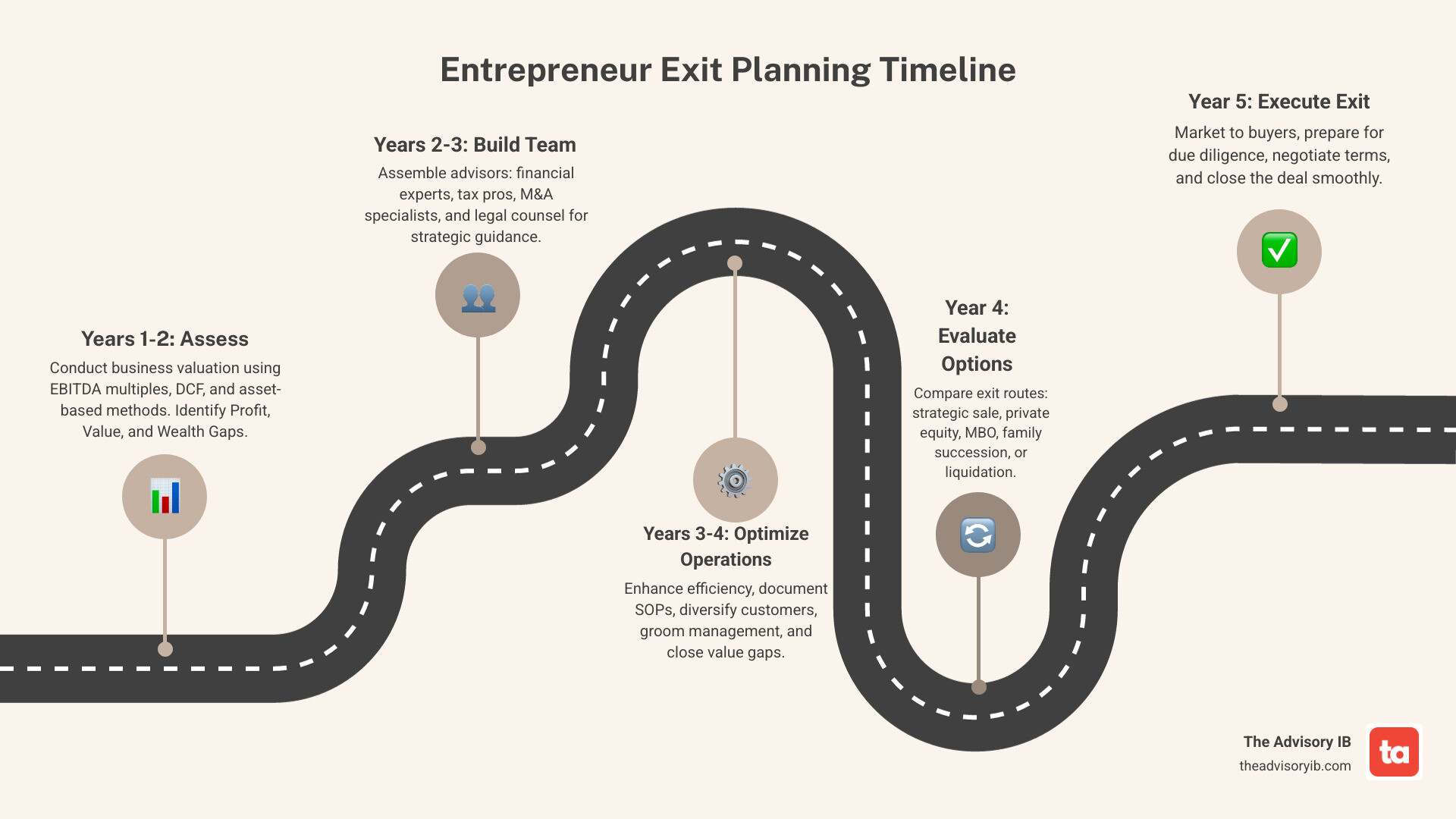
- Start early – Begin planning 3-5 years before your intended exit
- Know your numbers – Understand business value through EBITDA multiples, DCF, and asset-based valuation
- Close the gaps – Address your Profit Gap, Value Gap, and Wealth Gap
- Build your team – Assemble financial advisors, tax professionals, M&A specialists, and legal counsel
- Choose your path – Evaluate strategic acquisition, private equity, management buyout, family succession, or liquidation
- Prepare for scrutiny – Clean financials, documented SOPs, and operational independence
Here’s the reality: 68% of business owners are unfamiliar with their exit options, 78% don’t have an exit-focused advisory team, and 70% lack a contingency plan for forced transitions due to death, divorce, or disability. Meanwhile, 95% agree that having a transition strategy is critical to their personal and business future.
The disconnect is staggering—and expensive.
Exit planning isn’t about giving up on your business. It’s about building a more valuable, transferable asset that runs without you, attracts premium buyers, and funds the life you want after the deal closes. Every decision you make today—from hiring key managers to diversifying your customer base—either increases or decreases your eventual exit value.
I’m Oliver Bogner, Managing Partner at The Advisory Investment Bank, and I’ve built and sold five companies before founding The Advisory to help essential service business owners navigate entrepreneur exit planning with expert guidance and competitive deal processes. In this guide, I’ll walk you through the strategic framework that turns exit planning from a distant worry into a powerful growth tool you can use right now.
The Strategic Importance of Entrepreneur Exit Planning
Think of your business as a high-performance vehicle. You wouldn’t drive it at top speed without knowing how to use the brakes or where the nearest exit is. Yet, many founders operate their companies for decades without a clear “off-ramp.” We often tell our clients that entrepreneur exit planning is like a pre-nuptial agreement with your business: it defines the terms of the separation before emotions and high-stakes negotiations cloud your judgment.
A successful transition isn’t just a transaction; it’s the culmination of your life’s work. According to the 2022 State of Owner Readiness Report, while 95% of owners agree a transition strategy is important, a shocking 65% have no formal or written transition plans. This lack of preparation often leads to the “Value Gap”—the difference between what you think your business is worth and what a buyer is actually willing to pay.
To build a stable exit, we look at the “Three-Legged Stool” model:
- Business Planning: Maximizing the value and transferability of the company.
- Financial Planning: Ensuring the sale proceeds meet your personal wealth goals.
- Personal Planning: Preparing for your “Chapter 2” so you don’t suffer from “seller’s remorse.”
Without all three legs, the stool collapses. If you haven’t performed a business valuation, you’re essentially flying blind. You need to know your Profit Gap (how much more you could be making), your Value Gap (how much more the business could be worth), and your Wealth Gap (how much more you need to retire comfortably). This is where Business Sale Preparation becomes your most powerful growth engine.
Determining the True Value of Your Business
How do you know what your “baby” is worth? It’s not just a multiple of your feelings or the amount of “sweat equity” you’ve poured into it. Professional Exit Planning relies on standardized methodologies to determine a fair market price.
- EBITDA Multiples: This is the most common method for essential services. We look at your Earnings Before Interest, Taxes, Depreciation, and Amortization and apply a multiple based on your industry and growth rate. For a stable manufacturing firm, this might be 4-6x; for a high-growth SaaS platform, it could exceed 10-15x.
- Discounted Cash Flow (DCF): This method values the business based on its expected future cash flows, adjusted back to their value today. It’s great for companies with predictable, long-term growth.
- Asset-Based Valuation: Often used in liquidation scenarios, this totals the fair market value of all company assets (equipment, real estate, inventory).
However, the “secret sauce” that drives premium valuations often lies in intangible assets. A diversified customer base, a strong brand, and a management team that can function without the founder are all “value drivers” that can push your multiple higher. If the business is too dependent on you, its Business Exit Strategy value plummets.
Building Your Professional Advisory Team for Entrepreneur Exit Planning
You shouldn’t try to sell your business alone any more than you’d try to perform your own appendectomy. Research shows that 78% of business owners do not have an exit-focused team of advisors, which is a recipe for disaster.
A high-performing Business Owner Advisory team should include:
- M&A Specialists / Investment Bankers: To run a competitive process and find the right buyers.
- Certified Public Accountants (CPAs): To ensure your financial statements are pristine and to handle tax optimization.
- Financial Advisors: To help you manage the wealth you receive post-exit and close that “Wealth Gap.”
- Legal Counsel: To navigate complex contracts and protect your interests during due diligence.
- Estate Attorneys: To ensure your windfall is protected for your family and future generations.
As the Exit Planning Institute notes, this is an entire process that can take three to five years. Your team acts as your sherpas, guiding you through the climb and, more importantly, the descent.
Navigating Exit Routes and Market Trends
The “best” exit depends entirely on your goals. Do you want the highest possible price? Do you want to preserve your legacy? Or do you want to see your employees take over? Each path has its own pros and cons.
| Exit Option | Best For… | Pros | Cons |
|---|---|---|---|
| Strategic Acquisition | Maximizing Sale Price | Buyers pay a premium for synergies; fast liquidity. | Potential culture clash; founder usually exits quickly. |
| Private Equity | Growth & “Second Bite” | Professional expertise; founder can stay on with equity. | High pressure for returns; 3-7 year investment window. |
| Management Buyout | Legacy & Continuity | Smooth transition; buyers already know the business. | Financing can be difficult; lower valuation than a strategic sale. |
| Family Succession | Keeping it in the Family | Preserves family legacy and values. | Can be emotionally complex; successor readiness is often an issue. |
| IPO | Scaling & Prestige | High visibility; massive capital for growth. | Extremely expensive; Sarbanes-Oxley compliance is a nightmare. |
| Liquidation | Quick Exit / No Successor | Simple and fast way to settle debts. | Usually results in the lowest value; triggers higher tax liabilities. |
When you Sell My Business, you must choose the route that aligns with your “Life After Business” vision. For many in the essential services sector, a strategic sale or a private equity recapitalization offers the best balance of liquidity and legacy.
Succession Planning and Business Continuity
Succession planning is the “insurance policy” for your business’s future. It’s not just about picking a name; it’s about grooming leadership and ensuring knowledge transfer. We’ve seen too many founders treat their business like a personal kingdom, only to realize that without them, the kingdom has no king and no map.
Key steps for business continuity include:
- Identifying Successors Early: Whether it’s a family member or a key employee, they need years of training.
- Cultural Fit: As Mark Valentino from Citizens points out, a successor’s vision must align with the company’s mission to avoid internal friction.
- Documenting SOPs: If the “how-to” of your business only exists in your head, the business has zero transferability.
- Contingency Planning: 70% of owners lack a plan for a “forced” transition. You need a “business will” that dictates what happens in the event of death, divorce, or disability.
Modern Trends in the M&A Landscape
The world of business exits is changing rapidly. We are seeing a massive M&A dominance as IPOs hit decade-lows due to market volatility. For venture-backed companies, M&A has become the default exit, accounting for over 85% of exits in recent years.
In cities like Austin and Jacksonville, the influx of private equity capital is creating a “seller’s market” for well-run essential services businesses. You can see this trend highlighted in our local insights on Exit Strategy Excellence in Austin and Crafting Your Exit Plan in Jacksonville. Buyers today are extremely picky; they aren’t just looking for profit—they are looking for “de-risked” assets with predictable revenue.
Maximizing Attractiveness and Closing the Value Gap
If you want a premium offer, you have to think like a buyer. A buyer looks at your business and asks: “What could go wrong?” Your job in the years leading up to an exit is to eliminate those risks. This is the core of our Entrepreneur Exit Services.
To make your business “irresistible,” focus on these pillars:
- Operational Efficiency: Streamline your workflows and use technology to reduce costs.
- Management Depth: Can your business survive a month without you? If not, you don’t have a business; you have a job. Empower a second-tier management team.
- Recurring Revenue: Buyers love “sticky” revenue. Transitioning from one-off projects to service contracts or subscriptions significantly boosts your multiple.
- Customer Diversification: If one customer accounts for more than 15% of your revenue, you have a “concentration risk” that will scare off savvy investors.
- Financial Scrutiny: Prepare for “Quality of Earnings” (QofE) reports. Any inconsistency in your books will lead to a “haircut” on your valuation during due diligence.
Avoiding Common Mistakes in Entrepreneur Exit Planning
Even the smartest founders fall into traps. Here are the most common pitfalls we see at The Advisory:
- Emotional Overvaluation: Just because you spent 80 hours a week for 20 years building the company doesn’t mean a buyer will pay for your “sweat.” Valuation is based on future cash flow, not past effort.
- Neglecting Post-Exit Planning: Many founders fall into a depression after selling because they lost their identity. You need a plan for what you’ll do the Monday after the wire hits your account.
- Poor Documentation: If you can’t prove your numbers with clean, audited financials, the deal will die in due diligence.
- Tax Liabilities: Selling your assets in a single tax year can trigger massive capital gains. Early planning allows for entity conversions (like moving from a C-Corp to an S-Corp) that can save you millions.
- Going It Alone: Trying to run your business while simultaneously managing a sale process is a recipe for burnout and a lower sale price.
Frequently Asked Questions about Business Exits
When should entrepreneurs start planning their exit?
Ideally, 3 to 5 years before you want to leave. This gives you enough time to “clean the house,” improve your margins, and build a management team that makes the business transferable. However, as the saying goes, the best time to plant a tree was 20 years ago; the second best time is today. Even if you plan to work for another decade, exit planning informs better daily decisions.
How do you make a business more attractive to buyers?
Focus on “de-risking.” This means having clean, audited financials, a diversified customer base, documented Standard Operating Procedures (SOPs), and a management team that can operate the business without the founder’s daily involvement. Recurring revenue models are also highly prized by both strategic and private equity buyers.
What are the tax implications of a business sale?
They can be significant. Depending on your business structure and whether the deal is an asset sale or a stock sale, you could be looking at capital gains taxes ranging from 0% to 20% or higher. Strategic planning with a tax professional can help you utilize tools like buy-sell agreements or charitable trusts to minimize the bite the IRS takes out of your hard-earned legacy.
Conclusion
Entrepreneur exit planning isn’t just about the end—it’s about the beginning of your next great adventure. By treating your exit with the same strategic rigor you used to build the company, you ensure that your legacy is protected and your financial future is secure.
At The Advisory IB, we understand the unique challenges facing essential services business owners in the $2-100M range. Based in Beverly Hills, our FINRA-licensed M&A firm uses a proprietary AI-driven platform to deliver faster, stronger offers from top-tier private equity firms. We operate on a 100% success-based model, meaning we are as invested in your successful exit as you are.
Whether you are in Chicago, Houston, Phoenix, or any of our other US locations, our team is ready to help you navigate the complexities of your transition. Don’t leave your most important business decision to chance. Explore our Entrepreneur Exit Services today and let’s start building your off-ramp to success.