
Why Every Business Owner Needs a Clear Business Succession and Exit Strategy
A solid business succession and exit strategy is one of the most important plans you’ll ever make as a business owner — yet most owners put it off until it’s too late.
Here’s a quick overview of what this guide covers:
| Topic | What You’ll Learn |
|---|---|
| Succession vs. Exit Planning | The difference and why you need both |
| When to Start | Ideally 5-10 years before your transition |
| Types of Exit Strategies | Trade sales, ESOPs, MBOs, family succession, and more |
| Key Steps | Valuation, goal setting, successor identification, legal safeguards |
| Tax Implications | How different exits affect your tax bill |
| Legal Tools | Buy-sell agreements, shareholder agreements, insurance funding |
You’ve spent years — maybe decades — building a profitable business. But here’s the uncomfortable truth: only 30% of family businesses survive to the second generation, just 12% make it to the third, and fewer than one in four private company boards have a formal succession plan in place. Without a clear plan, the business you worked so hard to build can unravel fast.
The good news? A well-structured succession and exit plan doesn’t just protect your business — it preserves your legacy, secures your financial future, and gives you control over how and when you leave on your own terms.
I’m Oliver Bogner, Managing Partner of The Advisory Investment Bank, and having built and sold five companies — with exits to Fortune 500s, private equity firms, and strategic acquirers — I’ve lived the full arc of business succession and exit strategy from both sides of the table. In this guide, I’ll share what actually works, so you can avoid the costly mistakes most owners make when planning their exit.
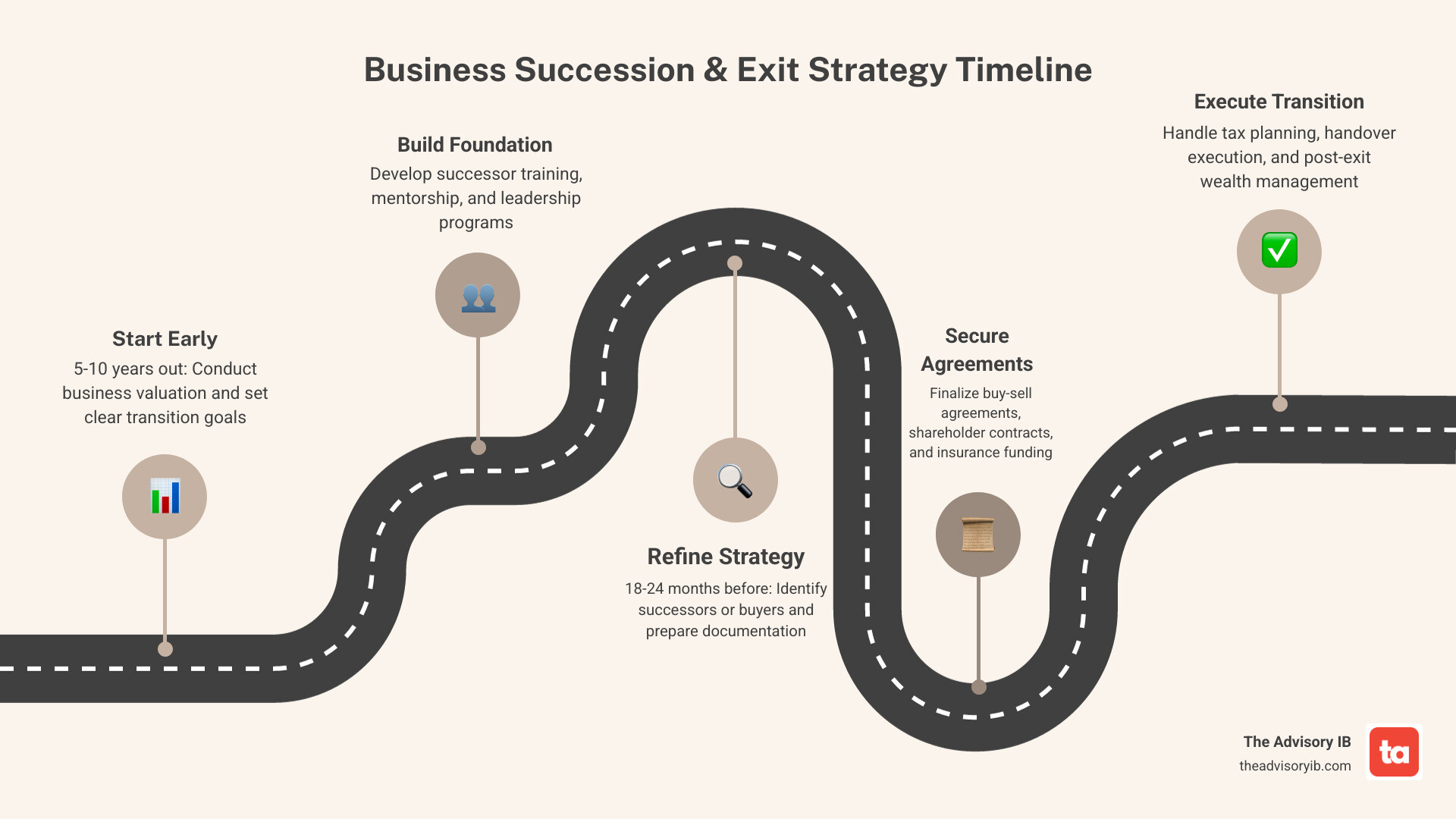
Defining Your Business Succession and Exit Strategy
When we talk about moving on from a company, we often hear the terms “succession planning” and “exit strategy” used interchangeably. However, they serve two distinct but complementary roles in your professional journey.
Succession planning is an internal process. It focuses on the “who” and the “how” of leadership continuity. It is about identifying and developing the next generation of leaders—whether they are family members or key employees—to ensure the business thrives after you step back. Think of it as passing the baton in a relay race; the goal is for the team to keep running at full speed without dropping the pace.
An exit strategy, on the other hand, is your personal roadmap for leaving the business while maximizing your Return on Investment (ROI). This is often an external-facing goal. It addresses how you will extract the value you’ve built, meet your tax obligations, and secure your financial future. Whether you are selling to a competitor, a private equity firm, or through a Business Exit Strategy, the focus is on the transaction and your life after the business.
| Feature | Succession Planning | Exit Strategy |
|---|---|---|
| Primary Focus | Internal leadership and operational continuity | External sale or transfer for maximum ROI |
| Primary Goal | Ensure the business survives and grows | Secure the owner’s financial future and legacy |
| Key Players | Internal successors, family, management team | Buyers, M&A advisors, tax specialists, lawyers |
| Outcome | New leadership takes the reins | Ownership is transferred; owner receives capital |
In our experience, you need both. A succession plan ensures you aren’t leaving behind a mess, while an exit strategy ensures you aren’t leaving money on the table.
Why Early Planning is Essential for Small and Family Businesses
If you own a family business, the stakes are incredibly high. The statistics are sobering: only about 30% of family-owned businesses survive into the second generation. That number drops to 12% for the third generation, and a mere 3% operate into the fourth.
Why is the failure rate so high? Often, it’s because the “plan” exists only in the founder’s head. When a life event happens—like a sudden illness, disability, or death—the business is thrown into chaos. Research shows that for four male business partners aged 35, the probability that at least one will die or become permanently disabled before age 65 is a staggering 77%. With six partners, that jumps to 89%.
Developing a business succession and exit strategy is essentially an insurance policy for your life’s work. Don’t Leave Your Family a Mess: Your Business Succession Plan Starts Here is a mantra we live by. Without a written plan, you risk family infighting, the loss of key clients, and a significant drop in business valuation.
Furthermore, we are currently witnessing a massive demographic shift. As millions of Baby Boomers reach retirement age, we are entering what many call the “Boomer Exit Wave.” This means more businesses will be on the market than ever before. If you don’t have a strategy, you may find yourself struggling to stand out in a crowded market. Understanding Why Most Business Owners Will Miss the Greatest Wealth Transfer in US History can help you realize that timing and preparation are your greatest allies.
5 Steps to Architecting a Successful Transition
Creating a transition plan isn’t something you do over a weekend. It’s a structured process that aligns your business’s health with your personal goals. Here is how we recommend you approach it:
- Assess the Current State: You can’t plan where you’re going if you don’t know where you are. This involves a deep dive into your financials, operations, and market position.
- Conduct a Business Valuation: Most owners have an “emotional valuation” of their business that is much higher than market reality. A professional appraisal helps you understand the true “EBITDA multiples” and asset values. This is a core part of Exit Planning.
- Define Your Goals: Do you want to retire completely? Do you want to stay on as a consultant? Do you need a specific dollar amount to fund your lifestyle? Be “SMART” (Specific, Measurable, Actionable, Realistic, Timely) about these objectives.
- Identify Potential Successors or Buyers: This could be a child, a key manager, or an external strategic buyer.
- Develop and Implement the Plan: This includes the legal, tax, and operational steps to hand over the keys.
The Boomer Exit Wave is Real and So is the Opportunity, but only for those who have a documented roadmap.
Selecting the Right Business Succession and Exit Strategy
Not every exit looks the same. Depending on your goals, you might choose one of these common routes:
- Trade Sale: Selling to another business (often a competitor or a company in a related industry). This often yields the highest valuation because the buyer sees “synergies”—ways they can save money or grow faster by owning your company.
- Sale to Private Equity: Ideal for high-growth businesses. PE firms often look for “essential services” businesses with stable cash flow.
- Management Buy-Out (MBO): Your existing management team buys the business. This is great for continuity and preserving culture.
- Employee Stock Ownership Plan (ESOP): A tax-advantaged way to transfer ownership to your employees over time.
- Family Succession: Passing the business to the next generation. This requires intense focus on family harmony and gift-tax planning.
Our Entrepreneur Exit Services are designed to help you weigh these options based on your specific financial and legacy goals.
Preparing the Next Generation for a Business Succession and Exit Strategy
If you are passing the business to a family member or an internal team, you can’t just hand them the keys on a Friday and expect them to lead on Monday. Leadership is developed, not born.
Successful preparation involves:
- Mentorship and Mentoring: Spending years—not months—transferring institutional knowledge.
- Stretch Assignments: Giving potential successors real decision-making power while you are still there to provide a safety net.
- Formal Education: Encouraging them to take industry-specific courses or leadership training.
- Governance Structures: Setting up a board of directors or an advisory council to provide objective oversight.
Post-Exit Planning is just as important for the business as it is for you. A successor who isn’t ready can quickly erode the value of the equity you might still hold.
Legal and Financial Safeguards for a Smooth Handover
A handshake deal is a recipe for disaster. To protect your interests and the business’s future, you need a robust legal and financial framework.
- Buy-Sell Agreements: These are “business wills.” They dictate what happens to a partner’s shares if they die, become disabled, or want to leave. They often include a pre-agreed valuation formula to prevent price disputes.
- Shareholder Agreements: These outline the rights and obligations of all owners, including “drag-along” and “tag-along” rights that become crucial during a sale.
- Insurance Funding: Many buy-sell agreements are funded by life or disability insurance. This ensures that if a partner passes away, the remaining partners have the cash to buy out the heirs, and the heirs get fair market value without having to run a business they don’t understand.
- Tax Planning: The difference between an asset sale and a share sale can mean millions of dollars in taxes. Strategies like “gift relief” for family transfers or utilizing capital gains exemptions are vital.
When you Sell My Business, these legal tools ensure that the transition is a “win” for everyone involved. Our Business Owner Services focus heavily on these protections.
Frequently Asked Questions about Succession and Exit Planning
When should I start planning my exit?
Ideally, you should begin developing your exit strategy at least 5 to 10 years before your intended transition date. This gives you enough time to maximize the value of the business, clean up your financials, and groom a successor. At the very latest, formal succession planning should begin 18 to 24 months before you want to step away. As we like to say, it’s never too early, but it can definitely be too late. For those in specific markets, check out Exit Strategy Excellence: Planning Your Business’s Next Chapter in Austin for localized insights.
What are the tax implications of selling my business?
Tax outcomes vary wildly based on the structure of the deal.
- Asset Sale: You sell the “stuff” (equipment, customer lists). This often results in higher taxes for the seller but is preferred by buyers.
- Share/Stock Sale: You sell the legal entity. This is often more tax-efficient for the seller and may qualify for specific capital gains exemptions.
- ESOPs: These offer significant tax advantages for both the company and the exiting owner. Consulting with a professional is non-negotiable here. Learn more about regional considerations in Beyond the Business: Crafting Your Entrepreneurial Exit Plan in Jacksonville.
How do I value my business for a transition?
Valuation is part science, part art. While you can look at “EBITDA multiples” (Earnings Before Interest, Taxes, Depreciation, and Amortization) common in your industry, other factors matter too. Buyers look for a professional management team, stable cash flows, and a diversified customer base. A professional appraisal will use the income approach, market approach, and cost approach to give you a realistic number.
Conclusion
Navigating a business succession and exit strategy is one of the most complex challenges a founder will ever face. It’s not just a financial transaction; it’s the culmination of your life’s work and the foundation of your family’s future.
At The Advisory Investment Bank, we specialize in helping owners of essential services businesses ($2-100M in sales) navigate this journey. Based in Beverly Hills and serving major hubs like New York, Chicago, Houston, and beyond, our AI-driven platform is designed to deliver faster, stronger offers from private equity and strategic buyers.
We operate on a 100% success-based model—which means we are as invested in your successful exit as you are. Don’t leave your legacy to chance. Secure your future with a professional business exit strategy and let us help you achieve the “win” you’ve earned.